
- Catalogs
- Alpha Moisture Systems Ltd
- Trace Moisture in Compressed Air Systems

- Company
- Products
- Catalogs
- News & Trends
- Exhibitions
Trace Moisture in Compressed Air Systems
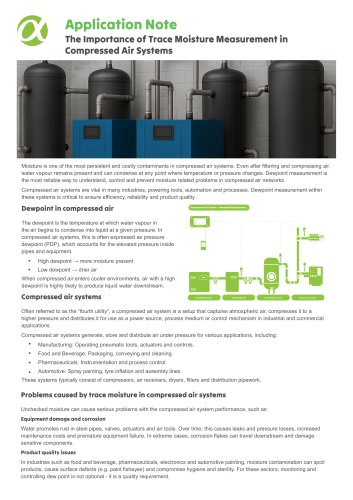
Trace Moisture in Compressed Air Systems
Compressed air systems are essential in various industries, functioning as a power source, process medium, or control mechanism. They are used in manufacturing, food and beverage, pharmaceuticals, and automotive sectors. Key components include compressors, air receivers, dryers, filters, and distribution pipework.
Moisture is a significant contaminant in compressed air systems, leading to equipment damage, corrosion, and product quality issues. Dewpoint measurement is crucial for controlling moisture levels, ensuring system efficiency, reliability, and product quality.
The dewpoint is the temperature at which water vapor condenses into liquid. In compressed air systems, it is expressed as pressure dewpoint (PDP). High dewpoint indicates more moisture, while low dewpoint indicates drier air. Monitoring dewpoint is essential to prevent moisture-related problems.
Moisture can cause equipment damage, corrosion, and product quality issues, especially in sensitive industries like food and beverage, pharmaceuticals, and automotive. Monitoring and controlling dewpoint is a quality requirement in these sectors.
Effective moisture measurement involves using dewpoint transmitters, online analysers, and portable meters. These tools help in continuous monitoring, audits, troubleshooting, and commissioning.
Different air dryers achieve specific dewpoint levels. Continuous monitoring ensures dryers meet performance requirements, optimizing energy efficiency and cost control.
For compliance and best practices, refer to ISO 8573-1 and ISO 7183 standards. Avoid exposing compressed air to freezing temperatures to prevent ice formation, which can disrupt operations.
Catalog excerpts
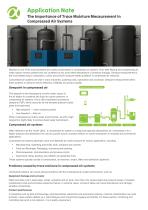
Application Note The Importance of Trace Moisture Measurement in Compressed Air Systems Moisture is one of the most persistent and costly contaminants in compressed air systems. Even after filtering and compressing air, water vapour remains present and can condense at any point where temperature or pressure changes. Dewpoint measurement is the most reliable way to understand, control and prevent moisture related problems in compressed air networks. Compressed air systems are vital in many industries, powering tools, automation and processes. Dewpoint measurement within these systems is critical to ensure efficiency, reliability and product quality. Dewpoint in compressed air The dewpoint is the temperature at which water vapour in the air begins to condense into liquid at a given pressure. In compressed air systems, this is often expressed as pressure dewpoint (PDP), which accounts for the elevated pressure inside pipes and equipment. High dewpoint → more moisture present Low dewpoint → drier air When compressed air enters cooler environments, air with a high dewpoint is highly likely to produce liquid water downstream. Compressed air systems Often referred to as the “fourth utility”, a compressed air system is a setup that captures atmospheric air, compresses it to a higher pressure and distributes it for use as a power source, process medium or control mechanism in industrial and commercial applications. Compressed air systems generate, store and distribute air under pressure for various applications, including: Manufacturing: Operating pneumatic tools, actuators and controls. Food and Beverage: Packaging, conveying and cleaning. Pharmaceuticals: Instrumentation and process control. Automotive: Spray painting, tyre inflation and assembly lines. These systems typically consist of compressors, air receivers, dryers, filters and distribution pipework. Problems caused by trace moisture in compressed air systems Unchecked moisture can cause serious problems with the compressed air system performance, such as: Equipment damage and corrosion Water promotes rust in steel pipes, valves, actuators and air tools. Over time, this causes leaks and pressure losses, increased maintenance costs and premature equipment failure. In extreme cases, corrosion flakes can travel downstream and damage sensitive components. Product quality issues In industries such as food and beverage, pharmaceuticals, electronics and automotive painting, moisture contamination can spoil products, cause surface defects (e.g. paint fisheyes) and compromise hygiene and sterility. For these sectors, monitoring and controlling dew point is not optional - it is a qua
Open the catalog to page 1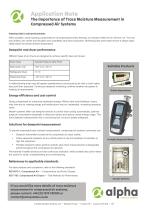
Application NoteThe Importance of Trace Moisture Measurement in Compressed Air Systems Freezing risks in cold environments When possible, avoid exposing compressed air to temperatures below freezing, as moisture within the air will form ice. This can lock airlines, jam valves and actuators and completely shut down production. Monitoring dew point helps ensure it always stays safely below the lowest ambient temperature. Dewpoint and dryer performance Different types of air dryers are designed to achieve specific dew point levels: Suitable Products A malfunctioning dryer may still appear operational...
Open the catalog to page 2All Alpha Moisture Systems Ltd catalogs and technical brochures
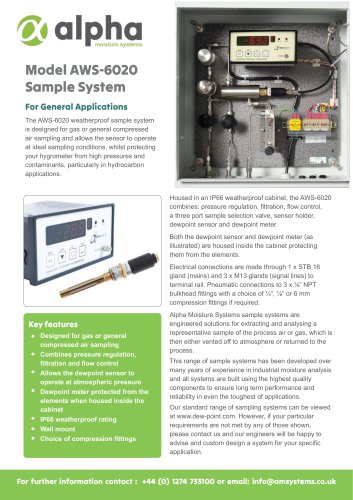 Model AWS-6020 Sample System
3 Pages
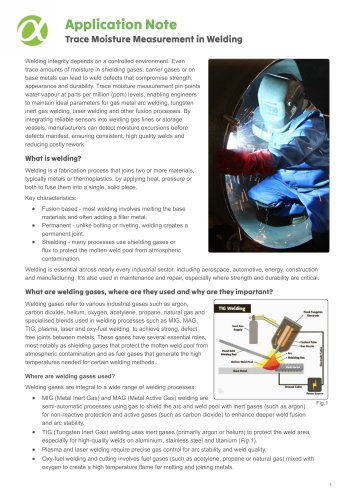 Trace Moisture In Welding
4 Pages
 Model 6020 User Manual
41 Pages
 SADPmini2 User Manual
57 Pages
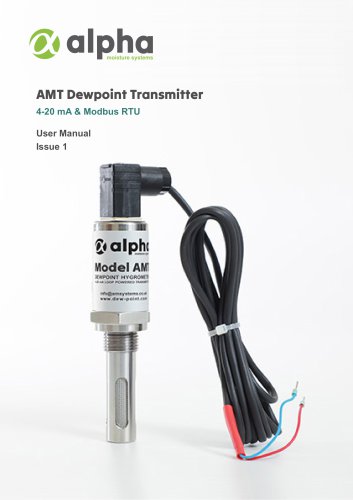
 AMT User Manual
14 Pages
 AMT-Ex User Manual
15 Pages
 PSS User Manual
17 Pages
 SADPmini2-Ex User Manual
86 Pages
 DS1200-Exd-AMT-Ex
3 Pages
 DS1500-Exd
2 Pages
 DS4000-Exd-AMT-Ex
3 Pages
 DSP-FCI Portable Hygrometer
3 Pages
 Model 6020 Exd
4 Pages
 Model 6020
3 Pages
 DS1500
3 Pages






- Digital indicator
- 4-20 mA indicator
- Automatic sampler
- Stainless steel sampler
- Gas sampler
- Humidity meter
- Sampler for the food industry
- Sampler for the pharmaceutical industry
- Humidity hygrometer
- 4-digit indicator
- Relative humidity hygrometer
- Digital hygrometer
- Portable sampler
- Compact sampler
- Alpha Moisture Systems dew-point transmitter
- Laboratory sampler
- Industrial hygrometer
- Dew-point humidity meter
- Analog dew-point transmitter
- Dew-point meter