
- Catalogs
- Alpha Moisture Systems Ltd
- Application Note - Trace Moisture Measurement in Air Separation Units

- Company
- Products
- Catalogs
- News & Trends
- Exhibitions
Application Note - Trace Moisture Measurement in Air Separation Units
Application Note - Trace Moisture Measurement in Air Separation Units
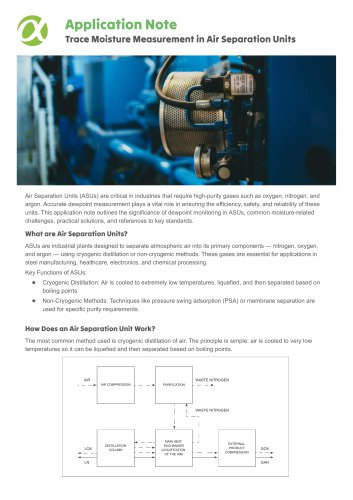
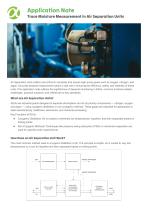
Air Separation Units are industrial plants that separate atmospheric air into nitrogen, oxygen, and argon using cryogenic distillation or non-cryogenic methods. These gases are crucial for industries like steel manufacturing, healthcare, electronics, and chemical processing.
Key Functions of ASUs
- Cryogenic Distillation: Air is cooled to extremely low temperatures, liquefied, and separated based on boiling points.
- Non-Cryogenic Methods: Techniques such as pressure swing adsorption (PSA) or membrane separation are used for specific purity requirements.
ASU Process Steps
- Compression: Atmospheric air is compressed to increase pressure, aiding in efficient cooling and separation.
- Purification: Compressed air is purified to remove impurities, ensuring high purity of separated gases.
- Cooling: Air is cooled to cryogenic temperatures, liquefying it for distillation.
- Separation: Liquefied air is separated into components based on boiling points in a distillation column.
- Collection and Delivery: Separated gases are stored and distributed according to purity requirements.
Moisture Challenges in ASUs
- Freezing Blockages: Water vapor can freeze, causing blockages.
- Corrosion: Moisture accelerates corrosion, reducing equipment lifespan.
- Product Purity: Excess moisture affects gas purity and downstream processes.
- Safety Risks: Ice formation can lead to pressure build-up and equipment failure.
Importance of Dewpoint Measurement
- Prevents ice formation by maintaining moisture levels below freezing thresholds.
- Ensures product quality by meeting purity specifications.
- Optimizes maintenance through early detection of moisture ingress.
- Ensures compliance with industry standards for gas purity and safety.
Solutions for Trace Moisture Measurement
- High-Precision Dewpoint Sensors: Install at critical points for real-time monitoring.
- Regular Calibration: Maintain sensor accuracy through scheduled maintenance.
- Alarm Systems: Alert operators when dewpoint thresholds are exceeded.
Reference Standards
- ISO 8573-1: Compressed air quality standards.
- ASTM D5464: Standard test method for moisture in gases.
- IEC 61207-1: Performance evaluation of analyzers for industrial process control.
Dewpoint measurement is crucial for the safe, efficient, and reliable operation of ASUs. Proactive moisture monitoring helps prevent downtime, maintain gas purity, and comply with industry standards. Investing in robust dewpoint monitoring solutions is recommended for facilities operating ASUs.
Catalog excerpts
Application Note Trace Moisture Measurement in Air Separation Units Air Separation Units (ASUs) are critical in industries that require high-purity gases such as oxygen, nitrogen, and argon. Accurate dewpoint measurement plays a vital role in ensuring the e ciency, safety, and reliability of these units. This application note outlines the signi cance of dewpoint monitoring in ASUs, common moisture-related challenges, practical solutions, and references to key standards. What are Air Separation Units? ASUs are industrial plants designed to separate atmospheric air into its primary components — nitrogen, oxygen, and argon — using cryogenic distillation or non-cryogenic methods. These gases are essential for applications in steel manufacturing, healthcare, electronics, and chemical processing. Key Functions of ASUs: Cryogenic Distillation: Air is cooled to extremely low temperatures, lique ed, and then separated based on boiling points. Non-Cryogenic Methods: Techniques like pressure swing adsorption (PSA) or membrane separation are used for speci c purity requirements. How Does an Air Separation Unit Work? The most common method used is cryogenic distillation of air. The principle is simple: air is cooled to very low temperatures so it can be lique ed and then separated based on boiling points. WASTE NITROGEN WASTE NITROGEN DISTILLATION COLUMN MAIN HEAT EXCHANGER (LIQUIFICATION OF THE AIR) EXTERNAL PRODUCT COMPRESSION
Open the catalog to page 1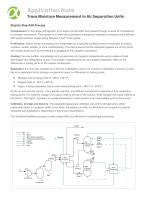
Application NoteTrace Moisture Measurement in Air Separation UnitsStep by Step ASU Process Compression: In this stage, atmospheric air is drawn into the ASU and passed through a series of compressors to increase its pressure. The purpose is to make the subsequent cooling and separation processes more efficient, with typical pressure ranges going between 5 and 10 bar gauge. Purification: Before further processing, the compressed air is typically purified to remove impurities (including moisture, carbon dioxide, or trace contaminants). This step ensures that the separated gasses are of high purity...
Open the catalog to page 2
Application NoteTrace Moisture Measurement in Air Separation Units Moisture Problems in Air Separation Units Moisture is a critical contaminant in ASUs. Even trace amounts can cause significant operational issues: • Freezing Blockages: Water vapour can freeze at cryogenic temperatures, leading to blockages in heat exchangers and distillation columns. • Corrosion: Moisture accelerates corrosion of internal components, reducing equipment lifespan. • Product Purity: Excess moisture compromises the purity of separated gases, affecting downstream processes and product quality. • Safety Risks: Ice...
Open the catalog to page 3All Alpha Moisture Systems Ltd catalogs and technical brochures
 Model AWS-6020 Sample System
3 Pages
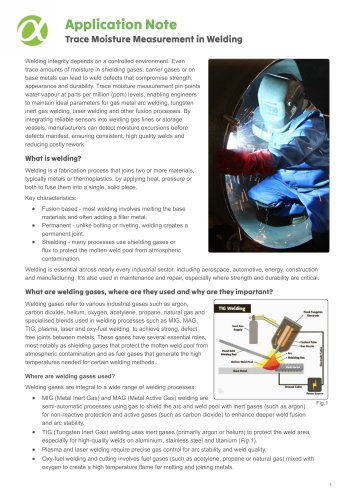 Trace Moisture In Welding
4 Pages
 Model 6020 User Manual
41 Pages
 SADPmini2 User Manual
57 Pages
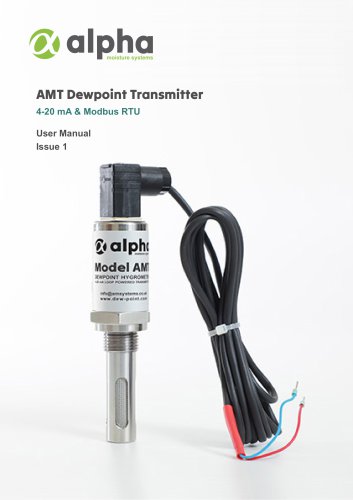
 AMT User Manual
14 Pages
 AMT-Ex User Manual
15 Pages
 PSS User Manual
17 Pages
 SADPmini2-Ex User Manual
86 Pages
 DS1200-Exd-AMT-Ex
3 Pages
 DS1500-Exd
2 Pages
 DS4000-Exd-AMT-Ex
3 Pages
 DSP-FCI Portable Hygrometer
3 Pages
 Model 6020 Exd
4 Pages
 Model 6020
3 Pages
 DS1500
3 Pages




- Digital indicator
- 4-20 mA indicator
- Automatic sampler
- Stainless steel sampler
- Gas sampler
- Humidity meter
- Sampler for the food industry
- Sampler for the pharmaceutical industry
- Humidity hygrometer
- 4-digit indicator
- Relative humidity hygrometer
- Digital hygrometer
- Portable sampler
- Compact sampler
- Alpha Moisture Systems dew-point transmitter
- Laboratory sampler
- Industrial hygrometer
- Dew-point humidity meter
- Analog dew-point transmitter
- Dew-point meter