
- Catalogs
- Alpha Moisture Systems Ltd
- Application Note - Trace Moisture in Breathing Gases

- Company
- Products
- Catalogs
- News & Trends
- Exhibitions
Application Note - Trace Moisture in Breathing Gases
Application Note - Trace Moisture in Breathing Gases
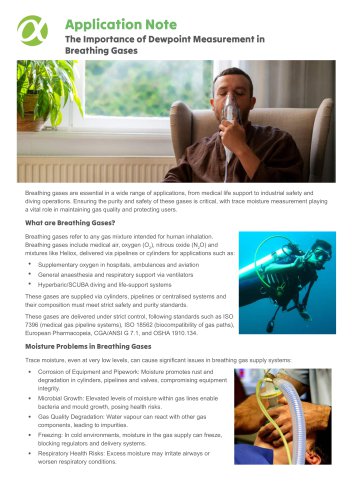
Breathing gases are crucial in various applications, including medical life support, industrial safety, and diving operations. Ensuring their purity and safety is essential, with trace moisture measurement playing a vital role in maintaining gas quality and protecting users.
Breathing gases are gas mixtures intended for human inhalation, such as medical air, oxygen, nitrous oxide, and mixtures like Heliox. They are used in hospitals, ambulances, aviation, general anesthesia, respiratory support, and diving systems. These gases must meet strict safety and purity standards, following guidelines like ISO 7396, ISO 18562, European Pharmacopeia, CGA/ANSI G 7.1, and OSHA 1910.134.
Trace moisture can cause significant issues, including equipment corrosion, microbial growth, gas quality degradation, freezing, and respiratory health risks.
Dewpoint measurement is critical to ensure dryness and prevent issues. Solutions include:
- Online Dewpoint Sensors: Continuous measurement with transmitters in pipelines, often with real-time alarms. Typical range: -40 °C to -70 °C dewpoint.
- Portable Dewpoint Meters: Used for spot checks and verifying pipeline dryness, featuring fast response, battery power, and data logging.
The 2002 European Pharmacopoeia recommends a maximum moisture concentration of 67 ppm by volume (-46 °C dewpoint). The UK HTM02 advises continuous monitoring. Key standards include:
- EU Pharmacopeia: Medical oxygen ≤ 67 ppm H2O (≈ -46 °C dewpoint).
- ISO 7396-1/BS EN 7396-1: Governs pipelines for compressed medical gases.
- UK HTM02: Continuous monitoring, max 67 ppm/-46 °C dewpoint.
- OSHA & CGA G-7.1: Grade D breathing air max dewpoint -50 °F (-45 °C).
- NFPA 99: Health care facilities.
Accurate trace moisture measurement is crucial for breathing gas safety and quality. Implementing reliable solutions and adhering to international standards prevent equipment damage, mitigate health risks, and ensure compliance, ensuring safe and consistent gas delivery systems.
Catalog excerpts

Application NoteThe Importance of Dewpoint Measurement in Breathing Gases Breathing gases are essential in a wide range of applications, from medical life support to industrial safety and diving operations. Ensuring the purity and safety of these gases is critical, with trace moisture measurement playing a vital role in maintaining gas quality and protecting users. Breathing gases refer to any gas mixture intended for human inhalation. Breathing gases include medical air, oxygen (O2), nitrous oxide (N2O) and mixtures like Heliox, delivered via pipelines or cylinders for applications such as: • Supplementary oxygen in hospitals, ambulances and aviation • General anaesthesia and respiratory support via ventilators • Hyperbaric/SCUBA diving and life-support systems These gases are supplied via cylinders, pipelines or centralised systems and their composition must meet strict safety and purity standards. These gases are delivered under strict control, following standards such as ISO 7396 (medical gas pipeline systems), ISO 18562 (biocompatibility of gas paths), European Pharmacopeia, CGA/ANSI G 7.1, and OSHA 1910.134. Trace moisture, even at very low levels, can cause significant issues in breathing gas supply systems: • Corrosion of Equipment and Pipework: Moisture promotes rust and degradation in cylinders, pipelines and valves, compromising equipment integrity. • Microbial Growth: Elevated levels of moisture within gas lines enable bacteria and mould growth, posing health risks. • Gas Quality Degradation: Water vapour can react with other gas components, leading to impurities. • Freezing: In cold environments, moisture in the gas supply can freeze, blocking regulators and delivery systems. • Respiratory Health Risks: Excess moisture may irritate airways or worsen respiratory conditions.
Open the catalog to page 1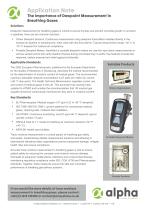
Application Note The Importance of Dewpoint Measurement in Breathing Gases Solutions Dewpoint measurement for breathing gases is critical to ensure dryness and prevent microbial growth or corrosion in pipelines. Here are two common solutions: Online Dewpoint Sensors: Continuous measurement using dewpoint transmitters installed directly in the medical air pipeline or sampling line, often used with real time alarms. Typical measurement range: -40 °C to -70 °C dewpoint for medical air compliance. Portable Dewpoint Meters: Handheld or portable dewpoint meters are used for spot check measurements...
Open the catalog to page 2All Alpha Moisture Systems Ltd catalogs and technical brochures
 Model AWS-6020 Sample System
3 Pages
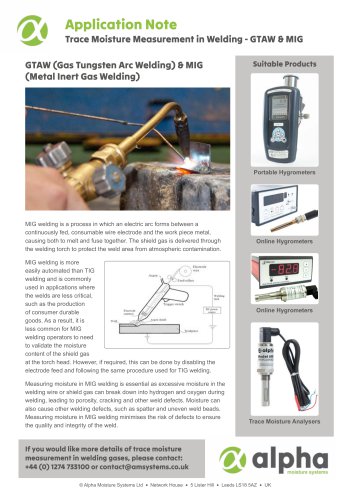
 Trace Moisture In Welding
4 Pages
 Model 6020 User Manual
41 Pages
 SADPmini2 User Manual
57 Pages
 AMT User Manual
14 Pages
 AMT-Ex User Manual
15 Pages
 PSS User Manual
17 Pages
 SADPmini2-Ex User Manual
86 Pages
 DS1200-Exd-AMT-Ex
3 Pages
 DS1500-Exd
2 Pages
 DS4000-Exd-AMT-Ex
3 Pages
 DSP-FCI Portable Hygrometer
3 Pages
 Model 6020 Exd
4 Pages
 Model 6020
3 Pages
 DS1500
3 Pages



- Digital indicator
- 4-20 mA indicator
- Automatic sampler
- Stainless steel sampler
- Gas sampler
- Humidity meter
- Sampler for the food industry
- Sampler for the pharmaceutical industry
- Humidity hygrometer
- 4-digit indicator
- Relative humidity hygrometer
- Digital hygrometer
- Portable sampler
- Compact sampler
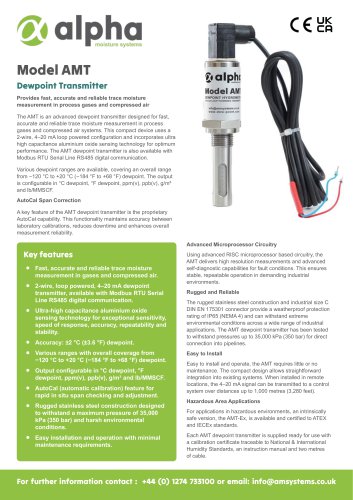
- Alpha Moisture Systems dew-point transmitter
- Laboratory sampler
- Industrial hygrometer
- Dew-point humidity meter
- Analog dew-point transmitter
- Dew-point meter