
- Catalogs
- ALLWEILER GmbH
- CONTINUOUS PUMP MONITORING


CONTINUOUS PUMP MONITORING

CONTINUOUS PUMP MONITORING
The document discusses the importance of high-performance ALLHEAT pumps from Allweiler in the context of Industry 4.0 and IoT, focusing on their role in moving heat transfer oils in production processes. Key priorities include safety, system availability, and cost-effectiveness.
High Pump Requirements
Heat-transfer pumps must operate safely and reliably under high loads and temperatures. Leakage, especially of hot oil, is a critical concern. Engineers must balance seal design to prevent overloading while minimizing leakage. Synthetic oils can reduce decomposition but have their own drawbacks.
Continuous Pump Monitoring
The IN-1000 condition monitoring platform is used to monitor mechanical seals, bearing temperatures, and pump vibrations. It provides real-time alerts and status updates, allowing operators to plan maintenance and avoid unexpected production interruptions. The system is robust, suitable for harsh environments, and can be integrated with control rooms or mobile devices.
Benefits and Savings
IN-1000 reduces the need for preventive maintenance by accurately detecting wear, leading to significant cost savings. It can be retrofitted to existing pumps, offering long-term savings by extending pump service life and reducing maintenance costs by up to 50%.
Customer Feedback
Customers, including Alpenhain, have reported positive experiences with the IN-1000 system, noting its effectiveness in optimizing pump performance and reducing alignment issues. The system's modular design allows for tailored monitoring solutions, and its data logging capabilities support further optimization efforts.
Conclusion
The IN-1000 system provides a reliable and cost-effective solution for continuous pump monitoring, enhancing safety and efficiency in heat-transfer systems. Its ability to integrate with existing infrastructure and provide remote access makes it a valuable tool for modern industrial operations.
Catalog excerpts
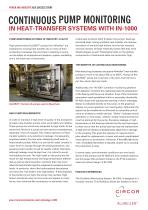
POWER AND INDUSTRY 2016 SUCCESS STORY CONTINUOUS PUMP MONITORING IN HEAT-TRANSFER SYSTEMS WITH IN-1000 PUMP-MONITORING IN TIMES OF INDUSTRY 4.0 & IOT High-performance ALLHEAT® pumps from Allweiler® are essential for moving heat transfer oils in many of their production processes. Top priorities in selecting a pump are the safety of employees and systems, system availability, and a low total cost of ownership. carbonized products. Both threaten the pumps' bearings and shaft seals. Using synthetic heat-transfer oils reduces formation of low and high boilers, but the low viscosity and low lubricity of these materials means that they have disadvantages as well. Tribological loads on the gliding components of mechanical seals are particularly high. THE BENEFITS OF CONTINUOUS MONITORING Manufacturing processes use special Allweiler® heat-transfer pumps to move oil at about 250 up to 400°C. Pumps of the ALLHEAT® series are in service in the main train 24 hours per day, seven days per week. ALLHEAT® thermal oil pumps used at Alpenhain HIGH PUMP REQUIREMENTS In order to maintain a high level of quality in the production process, heat-transfer pumps must work safely and reliably. These pumps are commonly subjected to high loads. At the same time, failure of a pump can have serious consequences, especially if hot oil escapes. This makes operators of heattransfer systems very sensitive to leakage. Consequently, engineers walk a fine line when designing shaft seals in heat-transfer pumps. While it is normal for water (mostly in vapor form) to escape through the sealing clearance, any escaping heat transfer oil will be readily visible. Therefore, although leakage must be kept low, it is critical to avoid overloading the seal. The high loads on the pump are the result of high temperatures and large temperature differentials as well as decomposition reactions that may occur when the heat transfer liquid is subjected to excessive thermal loads. In particular, chain-like hydrocarbons decompose over time into "low boilers" and "high boilers". If the proportion of low boilers is too high, the pump may cavitate. High boilers accelerate wear on the pump and appear in many forms, from bitumen-like consistency to extremely hard Additionally, the "IN-1000" condition monitoring platform from Allweiler® monitors the mechanical seal, the temperature of the bearing and the pump vibration. If any of the monitored parameters reach predefined initial or secondary thresholds, IN-1000 reacts with appropriate warning or alarm messages. Status is indicated directly at the pump on the graphical display, so pump operators can react quickly. Optionally the signal can be transferred via Ethernet to a possible control room or wireless to mobile devices. "Green" indicates normal operation; in most cases, “yellow” simply means that service must be planned for the pump. Excessive leakage or high temperature at the bearing indicate that the seal has begun to wear out or that the pump bearing requires replacement. A high level of vibration indicates faulty alignment or damage to the coupling. This gives the operator an opportunity to plan ahead for replacement or repair and avoid unanticipated interruptions to production. However, if the traffic light turns "red", immediate intervention is required, maybe up to causing the production to stop. In some cases, environmental conditions are very harsh. Some of the pumps (and IN-1000) are even located outdoors, but this poses little problem thanks to the IP 54 protection class and robust design of IN-1000. POSITIVE EXPERIENCES The Condition-Monitoring-System, IN-1000, is designed in a modular manner. This flexibility allows the System t
Open the catalog to page 1
POWER AND INDUSTRY 2016 SUCCESS STORY the module combination to a best fit for the monitored process. The system is using a Master-Satellite-Combination to be able to serve the needs from a simple condition monitoring task to complex monitoring of an multi pump system with product family. The desired capability to have remote access via network is reflected in the IN-1000 Master module already. Right now the Master Module is equipped with an integrated Web-Server. This connection allows remote access to the Master Module via a Web-Brower or a customized interface from an existing process monitoring...
Open the catalog to page 2All ALLWEILER GmbH catalogs and technical brochures
 IN-1000 CONDITION MONITORING
5 Pages
 PRODUCT CATALOG
35 Pages