1. Catalogs
  2. Allen-Bradley
  3. Safety Switches
video corpo
cad

Safety Switches

Safety Switches
1 / 160 PagesView full catalog

Safety Switches

Product catalog summary
Overview: The document provides a comprehensive guide on safety switches, focusing on selection criteria, types, and applications. It includes detailed sections on various interlock switches such as tongue, guard locking, non-contact, and hinge switches, as well as trapped key and limit switches. The document also covers accessories and product selection tips.
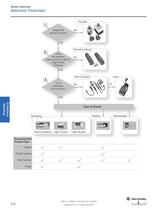
Selection Criteria: The selection flowchart helps determine the appropriate type of safety switch based on the environment and machine characteristics, such as washdown environments and high inertia machines. It emphasizes the importance of selecting switches with suitable ingress protection ratings for specific applications.
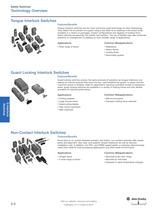
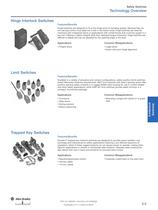
Technology Overview: The document outlines the features and benefits of different interlock switch technologies. Tongue interlock switches are noted for their cost-effectiveness and flexibility, while guard locking switches provide controlled access to hazardous areas. Non-contact switches offer tamper-resistance and are ideal for harsh environments. Hinge switches are suitable for misaligned doors, and limit switches meet Machinery Directive requirements.
Product Versatility: Many safety switches offer rotational flexibility, allowing them to be mounted in various positions to suit different applications. This adaptability is highlighted for models like Elf, Cadet3, and Trojan.
Accessories: A variety of actuators are available to accommodate different applications, including standard, flexible, and specialty types. The document explains the use of flexible actuators for doors that may not align perfectly with the switch.
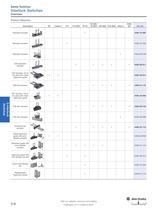
Product Selection: The document provides a detailed product selection guide, listing various models and their compatible actuators. It includes specific catalog numbers for easy reference.
Conclusion: The document serves as a detailed resource for selecting and implementing safety switches in various industrial applications, emphasizing the importance of choosing the right type and configuration to ensure safety and compliance.
Specifications and Features: The Elf and Cadet 3 are tongue-operated safety interlock switches designed for small, lightweight guards. They are compact, with the Elf being the smallest available, and are suitable for sliding, hinged, or lift-off guards. Both switches offer multiple actuator entry points and are sealed to IP67 for environmental protection.
Safety Ratings and Standards: Both switches comply with safety standards such as EN954-1, ISO13849-1, IEC/EN60204-1, and others. They are classified as Cat. 1 devices per EN954-1 and are suitable for Cat. 3 or 4 systems. Certifications include CE Marking, cULus, TÜV, and CCC.
Connection Systems: The document details various connector types, including 4-Pin, 5-Pin, 6-Pin Micro (M12), and 12-Pin M23, with their respective ratings and applicable standards. Connectors facilitate easy installation and replacement, reducing downtime.
Operating Characteristics: Both switches have a maximum actuation speed of 160 mm/s and a maximum actuation frequency of 2 cycles/s. The operating life is specified at 1 million operations at a 100 mA load.
Environmental and Physical Characteristics: The switches operate within a temperature range of -20 to +80°C and are made from UL-approved glass-filled PBT with stainless steel actuators. The Elf switch weighs 60g, while the Cadet 3 weighs 80g.
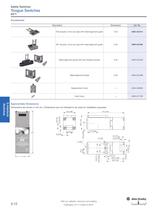
Accessories and Additional Information: Various actuators and alignment guides are available, including flat, 90°, and metal alignment guides with semi-flexible actuators. Typical wiring diagrams and product selection guides are provided for different configurations and connection systems.
Overview of Safety Switches and Guard Locking Switches: The document provides detailed specifications for various safety switches, including tongue switches and guard locking switches. Key features include mechanical locks, high locking force, and heavy-duty die-cast alloy housing suitable for harsh environments. The switches comply with multiple safety standards such as EN954-1, ISO13849-1, and IEC/EN60204-1.
Types of Guard Locking Switches: Power to Lock and Power to Release methodologies are discussed, highlighting their advantages and disadvantages in terms of safety and access control.
Methodologies for Risk Reduction: Time-based, Stop Motion, and Safe Speed Conditions are outlined as methods to manage access timing and ensure safety.
Typical Sequence of Actions: A sequence of actions for entering and exiting hazardous areas is described, emphasizing controlled stops and safety confirmations.
Manual Override Options: Rear Escape and Flexible Release options are provided for emergency situations.
Application Example: A scenario involving a 440G-MT safety switch is described, outlining steps for safe maintenance and emergency stop procedures.
Technical Specifications: The 440G-MT solenoid switch is highlighted for its positive mode, tongue-operated guard locking interlock capabilities, with specifications on safety ratings, contact configurations, and environmental ratings.
Safety Relays: The document details single-function, specialty, and modular safety relays, including their configurations, reset types, and power supply requirements.
Connection Systems: Details on cordsets and patchcords with various pin configurations for connecting safety devices are provided.
Guard Locking Switches: The Atlas 5 is highlighted for its robust design and high locking force, suitable for harsh environments.
Accessories: Various actuators and covers for TLS series switches are listed, along with warnings regarding emergency override keys.
Wiring Diagrams: Typical wiring configurations for different switch models are provided, detailing contact actions and power connections.
Conclusion: The document serves as a comprehensive guide for selecting and implementing safety relays and switches in industrial applications, emphasizing compatibility, safety standards, and operational efficiency.
Specifications: The document lists multiple types of actuators, including standard, fully flex, and GD2 models, with detailed dimensions and part numbers. It also covers beacons, bulbs, and conduit accessories, providing part numbers and descriptions for each item.
Procedures and Recommendations: The document advises on the compatibility of switches and actuators, recommending specific models for different applications. It highlights the importance of using the correct actuator with the corresponding switch to ensure safety and functionality.
Standards and Certifications: The SensaGuard product line is highlighted for its compliance with safety standards such as IEC 60947-5-3, IEC 61508, and EN 954. It is rated Cat 4/SIL 3, ensuring high safety performance.
Key Features: The SensaGuard switches offer features like large sensing distances, tolerance to misalignment, and integrated latch versions with adjustable magnetic latch force. They are designed for easy mounting and are suitable for harsh environments.
Accessories: The document lists various accessories, including replacement covers, emergency override keys, and flexible release cables, with specific part numbers for each.
Safety and Environmental Ratings: The switches have an IP69K environmental rating, ensuring protection against dust and high-pressure water. They are designed to operate in temperatures ranging from -10°C to +55°C.
Conclusion: The document serves as a comprehensive guide for selecting and using guard locking switches and accessories in industrial safety systems, emphasizing compliance with safety standards and providing detailed product information.
Specifications: The SensaGuard™ switches are designed for high-risk applications, incorporating magnetically coded sensing elements. They comply with various safety standards such as EN954-1, ISO13849-1, and IEC/EN60204-1. The switches are available in different models (MC1 and MC2) with varying operating distances and misalignment tolerances.
Features: Key features include non-contact actuation, high tolerance to misalignment, and compatibility with specified controllers. The switches are designed for use in systems requiring high safety integrity, with dual-channel interlocks suitable for Cat. 3 or 4 systems.
Wiring and Installation: The document includes typical wiring diagrams for different configurations, such as single sensor setups and systems with multiple sensors and light curtains. It emphasizes the importance of maintaining minimum spacing to prevent false triggering.
Performance and Diagnostics: The switches offer reliable performance with a high frequency of operating cycles and are equipped with diagnostic indicators for troubleshooting. The document outlines the response time and conditions for the switches, ensuring proper functionality and safety.
Environmental and Physical Characteristics: The switches are rated for IP67 and IP69K enclosure types, suitable for harsh environments. They operate within a temperature range of -10 to +55°C and are constructed from durable materials like molded ABS and Ultrador.
Product Selection and Logic Interfaces: The document provides a selection guide for different switch models and recommended logic interfaces, detailing their safety outputs, auxiliary outputs, and reset types.
Specifications: The document outlines the specifications for different models of safety switches, including the MSR310P and MSR320P modules. These modules feature PNP solid-state outputs and are designed for use with 24V DC power. The Ferrogard switches are noted for their non-contact actuation, high tolerance to misalignment, and high switching current capabilities.
Connection Systems: The document describes connection systems using 4-pin and 8-pin Micro (M12) connectors, with options for cordsets and patchcords of varying lengths. It also details the use of distribution boxes, shorting plugs, and T-ports for system integration.
Safety Switches: The Ferrogard range includes models FRS1, FRS2, FRS20, and FRS21, each with specific safety and auxiliary output configurations. These switches are designed to open safety contacts when a guard door is opened, ensuring machine safety. They are housed in IP67-rated enclosures, making them suitable for wet environments.
Operating Characteristics: The document provides operating distances for make and break actions, as well as environmental ratings such as operating temperature and humidity. It also includes details on shock and vibration resistance.
Product Selection: A selection guide is provided for choosing the appropriate Ferrogard model based on safety contact switching capability, connection type, and housing material. The document also lists recommended logic interfaces for integrating these switches into safety systems.
Additional Information: References are made to other sections of the catalog for further details on safety relays, safety I/O, and safety PLC connectivity, as well as application and wiring diagrams.
Specifications: The Ferrogard safety switches are designed for non-contact actuation with high tolerance to misalignment and high switching current capabilities. They are rated IP67 (NEMA 6P) for environmental protection and are available in both plastic and stainless steel housings. The document specifies operating distances, environmental ratings, and physical characteristics for each model.
Safety Ratings and Standards: The switches comply with various international safety standards such as EN954-1, ISO13849-1, and IEC/EN60204-1. They are classified as Cat. 1 devices suitable for Cat. 3 or 4 systems and are CE marked for applicable directives.
Functional Safety Data: The document provides functional safety data including B10d, PFHD, and MTTFd values, indicating the reliability and expected operational lifespan of the switches. The switches are suitable for performance levels PLe or PLd and can be used in SIL2 or SIL3 systems depending on application characteristics.
Product Selection and Connectivity: Detailed product selection tables list various models with their respective safety and auxiliary contact configurations, housing materials, and connection types. The document also includes recommended logic interfaces and connection systems for integrating the switches into safety systems.
Wiring and Installation: Typical wiring diagrams are provided for different switch models, along with notes on external fuse requirements for safety contacts. Approximate dimensions are given in millimeters and inches for installation purposes.
Accessories: The document lists available accessories such as replacement actuators and connection cords, with part numbers for easy reference.
Specifications: The document outlines the specifications for dual channel limit switches suitable for performance levels Ple or Pld according to ISO 13849-1:2006 and SIL2 or SIL3 systems according to IEC 62061. The switches are CE marked and certified by cULus and TÜV. They feature safety contacts with configurations of 1 N.C. snap acting, 2 N.C., 3 N.C., or 4 N.C. slow acting, and auxiliary contacts of 1 N.O. or 2 N.O. The thermal current is rated at 10 A, with a rated insulation voltage of 600V AC. The switches operate with a minimum switching current of 25 mA at 5V DC.
Operating Characteristics: The maximum actuation speed is 250 mm/s, with a minimum of 100 mm/min. The switches can handle up to 6000 operations per hour and have a mechanical life of 10 million operations. They are designed to operate in temperatures ranging from -25°C to 80°C and have an IP66 enclosure rating.
Physical Characteristics: The housing is made of die-cast alloy, and the actuator is composed of various polymers and metals. The switches can be mounted in any position using 2 x M5 fasteners. They are designed to withstand vibrations and shocks as per IEC standards.
Applications and Features: These 30 mm metal-body safety limit switches conform to EN 50041 standards and are available in snap acting or slow break/make configurations. They feature a rotating head adjustable in 90° increments for ease of mounting. Suitable for guard door applications, moving machine beds, crane arms, lifts, and elevators, the switches ensure safety by requiring the guard or moving object to remain engaged with the plunger or lever.
Product Selection: The document provides a detailed product selection guide, including various configurations of safety and auxiliary contacts, typical force/torque to operate, and contact opening characteristics. It also includes recommended standard cordsets and connector pinouts for different models.
Environmental and Safety Ratings: The switches are designed for harsh industrial environments with NEMA 4, 6P, 12, 13, and IP65/67 sealing. They comply with multiple safety standards, including EN 954-1, ISO 13849-1, and IEC/EN 60947-5-1, ensuring reliability and long life in safety applications.
See more

Catalog excerpts

Safety Switches-2

03-SafetySw_1_Tongue:03-SafetySw1 Tng.qxd 5/6/2010 10:52 AM Page 3-2 Safety Switches Selection Flowchart Pro Prosafe General Sequential Access Control? Yes No Guard Locking 1- Does the machine have a long run down? (high inertia machine) Yes No 2-Opto-electronics Non-Contact Is it a washdown environment? Limit Or Yes No 3-Interlock Switches Type of Guard Swinging Sliding Operator Interface Hard Guarding Light Guard Removable Light Guard d Recommended Product Type Tongue Guard Locking Logic Non-Contact Hinge Power Visit our website: www.ab.com/catalog 3-2 R Publication S117-CA001A-EN-P

 Open the catalog to page 2
Safety Switches-3

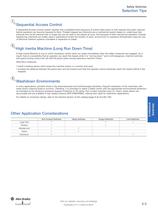
03-SafetySw_1_Tongue:03-SafetySw1 Tng.qxd 5/6/2010 10:52 AM Page 3-3 Safety Switches Selection Tips A Sequential Access Control system requires that a predetermined sequence of events takes place or that hazards have been reduced before operators can become exposed to them. Prosafe trapped key interlocks are a mechanical system based on coded keys that achieves this via the premise that no single key can be used in two places at once. And because of their mechanical operation, Prosafe trapped key interlocks are widely used in applications where the location of plant, environment or explosive...

 Open the catalog to page 3
Safety Switches-4

03-SafetySw_1_Tongue:03-SafetySw1 Tng.qxd 5/6/2010 10:52 AM Page 3-4 Safety Switches Technology Overview Tongue Interlock Switches Features/Benefits General Tongue interlock switches are the most commonly used technology for door interlocking. They detect the movement of a guard using a key fitted to an opening in the switch body. Available in a variety of packages, contact configurations and degrees of holding force, these switches are generally the lowest-cost solution. The use of flexible keys also enhances tolerance to misalignment to address an even broader range of applications. Applications...

 Open the catalog to page 4
Safety Switches-5

03-SafetySw_1_Tongue:03-SafetySw1 Tng.qxd 5/6/2010 10:52 AM Page 3-5 Safety Switches Technology Overview Hinge Interlock Switches Applications Common Misapplications Large doors Doors with poor hinge alignment Limit Switches Features/Benefits Available in a variety of actuators and contact configurations, safety position (limit) switches satisfy Machinery Directive requirements. 802T limit switches with direct opening action offer positive opening safety contacts in a rugged NEMA-style housing for use in control reliable and other safety applications, while 440P IEC limit switches provide safety...

 Open the catalog to page 5
Safety Switches-6

03-SafetySw_1_Tongue:03-SafetySw1 Tng.qxd 5/6/2010 10:52 AM Page 3-6 Safety Switches Interlock Switches Overview Versatility General Many safety switches allow the head of the switch to rotate, offering different options on how the switch can be operated and mounted on the guard. This offers flexibility to best fit typical applications. Elf, Cadet3, MT-GD2, 440G-MT The head can be rotated 4 times at 90º allowing the key to fit the switch in 8 different positions. 1- Trojan T15, Trojan 5, Trojan 6 (Not GD2 Models) The head rotates 180º allowing the key to fit the switch in 4 different positions:...

 Open the catalog to page 6
Safety Switches-7

03-SafetySw_1_Tongue:03-SafetySw1 Tng.qxd 5/6/2010 10:53 AM Page 3-7 Safety Switches Interlock Switches Overview Accessories for Tongue and Guard Locking Switches The correct actuator for your application General A large variety of tongue actuators are available: Standard: 90º, Flat, Standard Flexible: Semi and Fully Specialty: Extended Flat and GD2 models GD2 actuators are dedicated actuators for GD2 models and are not suitable for use with standard models. Power Logic Operator Interface Extended flat type actuator is used mostly when the actuator is mounted on a chain and inserted in the switch....

 Open the catalog to page 7
Safety Switches-8

Safety Switches Interlock Switches Product Selection Visit our website: www.ab.com/catalog 1 3-8 Publication si 1 7-OAOO-I A-FN-P Guarclima/ter

 Open the catalog to page 8
Safety Switches-9

Safety Switches Interlock Switches Safety Switches and Connectors Many interlock switches are offered with connectors allowing easy installation and replacement on-site, reducing downtime. Standard cordsets and connectors can be used to connect these products directly to: • Terminal Blocks • Safety Distribution Boxes • ArmorBlock™ Guard I/O (IP 67 Safety I/O Blocks on DeviceNet™ Safety) Type of Connector by Product Family Connection to ArmorBlock Guard I/O Other Connectors Type of Connector by Product Family (continued) Connection to ArmorBlock Guard I/O Other Connectors Note: All connectors...

 Open the catalog to page 9
Safety Switches-10

03-SafetySw_1_Tongue:03-SafetySw1 Tng.qxd 5/6/2010 10:53 AM Page 3-10 Safety Switches Tongue Switches Elf™ Specifications Safety Ratings EN954-1, ISO13849-1, IEC/EN60204-1, NFPA79, EN1088, ISO14119, IEC/ EN60947-5-1, ANSI B11.19, AS4024.1 Safety Classification Cat. 1 Device per EN954-1 Dual channel interlocks suitable for Cat. 3 or 4 systems Certifications General Standards CE Marked for all applicable directives, cULus, TÜV, and CCC Outputs Safety Contacts Direct Opening Action 2 N.C. Auxiliary Contacts 1 N.O. None Thermal CurrentIlth 1- 1 N.C. 5 A (10 A if A600) Rated Insulation Voltage 2-Opto-electronics...

 Open the catalog to page 10
Safety Switches-11

03-SafetySw_1_Tongue:03-SafetySw1 Tng.qxd 5/6/2010 10:53 AM Page 3-11 Safety Switches Tongue Switches Elf™ Product Selection M16 Conduit Connector§ 440K-E33036 440K-E33029 440K-E33074 440K-E33040 440K-E33030 440K-E33025 ⎯ GD2 Metal alignment guide w/semi-flex actuator BBM 440K-E33034 440K-E33031 440K-E33075 ⎯ ⎯ 440K-E2NNFPS — 440K-E33014 440K-E33053 440K-E33076 Flat 440K-E33080 440K-E33037 440K-E33077 1- 1 N.O. 1/2 inch NPT Adaptor Action 90° — — 440K-E33041 440K-E33045 440K-E33024 ⎯ GD2 Metal alignment guide w/semi-flex actuator ⎯ 440K-E33046 440K-E33078 440K-E2NNAPS — 2 N.C. 440K-E33047 ⎯ 440K-E33079...

 Open the catalog to page 11
Safety Switches-12

03-SafetySw_1_Tongue:03-SafetySw1 Tng.qxd 5/6/2010 10:53 AM Page 3-12 Safety Switches Tongue Switches Elf™ Accessories Description 3-52 440K-A21014 90° actuator, not to be used with metal alignment guide 3-52 440K-A21006 Metal alignment guide with semi-flexible actuator 3-52 440K-A21030 Metal Alignment Guide 3-52 440K-A21069 Replacement Cover — 440A-A33085 Dust Cover — 440K-A17182 1- Cat. No. Flat actuator, not to be used with metal alignment guide General Dimensions 2-Opto-electronics Dimensions are shown in mm (in.). Dimensions are not intended to be used for installation purposes. 75 (2.95)...

 Open the catalog to page 12

Archived catalogs

*Prices are pre-tax. They exclude delivery charges and customs duties and do not include additional charges for installation or activation options. Prices are indicative only and may vary by country, with changes to the cost of raw materials and exchange rates.