

Sanicro® 825 Bar Datasheet
Sanicro® 825 Bar Datasheet
Catalog excerpts
Sanicro® 825 is a nickel alloy with high iron content and a copper addition, suitable for applications in special corrosive environments. — Very high resistance to general corrosion, pitting, and crevice corrosion — Excellent resistance to corrosion in environments containing hydrogen sulfide — Very high resistance to stress corrosion cracking, SCC, in chloride-bearing environments — High mechanical strength — Excellent toughness during continuous operation, at both room and elevated temperatures — Good hot-working properties — Excellent cold forming ability — Very good machinability — Good weldability — Physical properties that offer design advantages — Can safely be used in applications both at cryogenic and at elevated temperatures Product standards - ASTM B425 Approvals - Approved by the American Society of Mechanical Engineers (ASME) for use in accordance with ASME Boiler and Pressure Vessel Code, Section I, Section III Div. 1 class 1 and 3, Section VIII div.1 and div. 2 class 1 and 2. Datasheet last updated 5/9/2025 6:37:56 AM (supersedes all previous editions)
Open the catalog to page 1
Chemical composition (nominal) Chemical composition (nominal) % Sanicro® 825 belongs to the group corrosion-resistant alloys, CRA. The grade provides a cost-effective offering -achieved by lowering expensive alloy content, compared to superalloys, such as Alloy 625, and Alloy 718. Sanicro® 825 is a very versatile alloy with resistance to corrosion in acids and alkalis under both oxidizing and reducing conditions. Due to the high nickel content, the alloy has superior immunity to stress corrosion cracking. The corrosion resistance in various media like phosphoric, nitric, sulfuric, and organic...
Open the catalog to page 2
General corrosion Sanicro® 825 possesses excellent resistance to most types of corrosion. The material is far superior to molybdenum alloyed stainless steels such as ASTM 316L, particularly when exposed to non-oxidizing media such as sulfuric acid or phosphoric acid. The corrosion resistance in nitric acid is better than ASTM 316L. The corrosion resistance in sodium hydroxide is better than that for ASTM 904L. Intergranular corrosion Even in the heaviest sizes, Sanicro® 825 can be welded without the risk of carbide precipitation causing intergranular corrosion. This is due, in part, to the low...
Open the catalog to page 3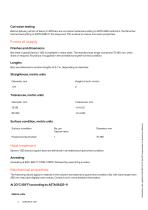
Before delivery, all lots of Sanicro® 825 bars are corrosion tested according to ASTM G28 method A, the Streicher test and according to ASTM A262 C, the Huey test. This is done to ensure corrosion properties. Bar steel in grade Sanicro® 825 is available in many sizes. The standard size range comprises 75-180 mm, other sizes on request. Round bar is supplied in the annealed and peel-turned condition. Bars are delivered in random lengths of 3-7 m, depending on diameter. Diameter, mm Height of arch, mm/m Surface condition Ra, |im Diameter, mm Typical value Sanicro® 825 stock program bars are delivered...
Open the catalog to page 4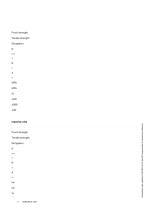
Proof strength Tensile strength Elongation R p0.2 a) Proof strength Tensile strength Elongation R p0.2 a) Datasheet last updated 5/9/2025 6:37:56 AM (supersedes all previous editions)
Open the catalog to page 5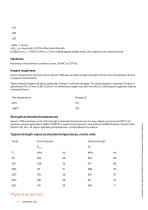
a) Rp02 corresponds to 0.2% offset yield strength b) Based on L0 = 5.65/S, where L0 is the original gauge length and S0 the original cross-sectional area. Hardness in the delivery condition is max. 35 HRC or 327 HB. Due to its austenitic microstructure, Sanicro® 825 has excellent impact strength both at room temperature and at cryogenic temperature. Typical impact toughness values tested by Charpy-V notched samples. The values apply for standard Charpy-V specimens (10 x 10 mm, 0.39 x 0.39 in.) For dimensions larger than 260 mm (10.2 in.) the impact toughness may be somewhat lower. Test temperature...
Open the catalog to page 6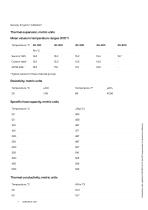
Thermal expansion, metric unitsMean values in temperature ranges (X10-6)30-400 15.4 *Typical values for these material groups. Temperature, °C |jQm Temperature, °F |jQin. Specific heat capacity, metric units Temperature, °C Datasheet last updated 5/9/2025 6:37:56 AM (supersedes all previous editions)
Open the catalog to page 7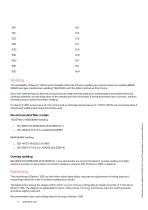
Welding The weldability of Sanicro® 825 is good. Suitable methods of fusion welding are manual metal-arc welding (MMA/ SMAW) and gas-shielded arc welding (TIG/GTAW), with the latter method as first choice. Since the material has low thermal conductivity and high thermal expansion welding plans should therefore be carefully selected, so that distortions of the welded joint are minimized. If residual stresses are a concern, solution annealing can be performed a er welding. For Sanicro® 825, a heat-input of <1.0 kJ/mm and an interpass temperature of < 100°C (210°F) are recommended. A string bead...
Open the catalog to page 8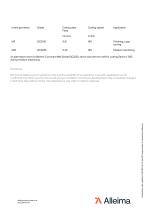
Insert geometry Cutting data Feed Cutting speed Finishing, copy turning Medium machining An alternative insert is Alleima® Coromant MM Grade GC2220, which can perform well for cutting Sanicro® 825 during medium machining. alleima.com/contact-us ALLEIMA.COM Datasheet last updated 5/9/2025 6:37:56 AM (supersedes all previous editions) Recommendations are for guidance only, and the suitability of a material for a specific application can be confirmed only when we know the actual service conditions. Continuous development may necessitate changes in technical data without notice. This datasheet is only...
Open the catalog to page 9All Alleima catalogs and technical brochures
Archived catalogs
 Sandvik diecutting products
8 Pages
 rock drill steel
12 Pages
 special strip steel
18 Pages
 Welding products
27 Pages
 Solid and hollow bar
25 Pages
 Sandvik 3R12
6 Pages
 Sandvik billets and blooms
10 Pages