

rock drill steel

rock drill steel
Sandvik is a prominent manufacturer of rock drill steel, known for its high-quality materials and production processes that ensure durability and performance. The company maintains a fully integrated production system, from steel melting to the finished product, ensuring complete quality control.
The production process involves selecting high-quality raw materials and executing controlled processes, including melting in an electric arc furnace, continuous casting, and precise rolling and cooling, to achieve desired mechanical properties.
Sandvik complies with ISO 9001 standards and other international quality certifications, and emphasizes environmental responsibility with ISO 14001 approval.
- Sanbar 20: High-strength chromium-molybdenum steel for integral drill steels, offering high fatigue strength and wear resistance.
- Sanbar 61: High-strength silicon steel for tapered rods, known for toughness and impact resistance.
- Sanbar 64: High nickel alloy steel for extension and shank rods, with excellent fatigue strength.
- Sanbar 23: High chromium-molybdenum alloy steel for extension and shank rods, offering high fatigue strength.
Sandvik drill steels are available in various grades and forms, including hollow, hot-rolled, round, or hexagon bars, designed to meet specific mechanical properties and dimensional tolerances.
Sandvik provides guidelines for forging, heat treatment, and machining to ensure optimal performance, including specific temperature ranges for annealing, normalizing, and hardening.
Sandvik offers technical support and advice, emphasizing collaboration to meet specific needs and improve production efficiency.
Sandvik's rock drill steels are engineered for high performance and longevity, supported by robust manufacturing processes and comprehensive quality assurance, with a commitment to innovation and customer satisfaction.
The document details hardening and tempering processes to achieve desired hardness levels, such as tempering at 150–250°C (300-480°F) for 0.5 hours to achieve 55–60 HRC. Induction heating and quenching are also discussed with specific temperature ranges and durations.
Maintaining high hardness in the transition zone during brazing is crucial to prevent interaction with geometrical notches, which could compromise material integrity.
Recommended for improving fatigue strength by introducing compressive stresses, increasing hardness, and smoothing surface defects.
Emphasizes protecting materials from corrosion, especially in underground applications, to prevent accelerated fatigue and premature breakages.
Detailed tables list standard sizes, tolerances, and weights for Sanbar 20, Sanbar 61, Sanbar 64, and Sanbar 23 in both imperial and metric units, including parameters like nominal hole diameter, eccentricity, and maximum length.
Sanbar materials can be machined in the hot rolled condition. Forging involves induction heating to specified temperatures, focusing on minimizing grain growth and decarburization to maintain fatigue strength.
Detailed procedures for annealing, gas carburizing, direct quenching, and tempering are provided, specifying temperature ranges and conditions for optimal surface and core hardness.
Recommended for enhancing surface hardness, with specific temperature and quenching guidelines. The process may not require tempering depending on the application.
For materials like Sanbar 64 and Sanbar 23, rapid heating and controlled atmosphere during carburizing are essential to ensure maximum service life and resistance to corrosive environments.
Catalog excerpts
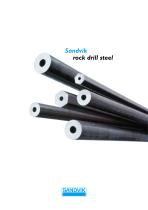
rock drill steel
Open the catalog to page 1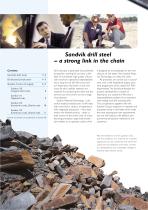
Sandvik drill steel – a strong link in the chain Contents: Sandvik drill steel Dedicated production Grades, Forms of supply Sanbar 20 Integral drill rods Sanbar 61 Tapered rods Sanbar 64 Extension rods, Shank rods Sanbar 23 Extension rods, Shank rods Sandvik and Sanbar are trademarks of Sandvik AB Drill rods take a great deal of punishment during their working life and only a drill steel of consistently high quality will provide maximum operational dependability and a long service life. We know from our experience that there is only one route for this: carefully selected raw materials for producing...
Open the catalog to page 2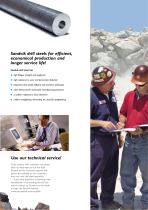
Sandvik drill steels for efficient, economical production and longer service life! Sandvik drill steel has G high fatigue strength and toughness G high resistance to wear and permanent distortion G properties that enable efficient and economic production G close tolerances for automated manufacturing processes G a uniform response to heat treatment G uniform straightness, eliminating the need for straightening Use our technical service! Close contact with customers has always been an important part of the total Sandvik service. Technical support and advice are available to our customers from...
Open the catalog to page 3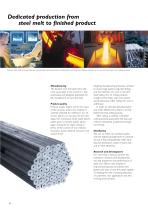
Dedicated production from steel melt to finished product Pictures from left: Scanning electron microscope, continuous bloom caster, billet mill, long-hole drilling, insertion of a core, rock drill steel mill, cooling process. Manufacturing The Sandvik rock drill steel mill is the most up-to-date in the world. It is fully automated and designed specifically for the manufacture of rock drill steel. Product quality Product quality begins at the very star t of the process, where raw material is carefully selected for melting in our 75 tonnes electric arc furnace. At the next stage, the continuous,...
Open the catalog to page 4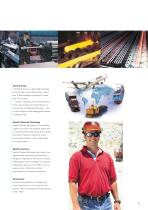
Sandvik Group The Sandvik Group is a global high technology enterprise with around 300 subsidiary companies, 37,000 employees and activities in more than 130 countries. Sandvik's operations are concentrated on its three core businesses of Tooling, Mining and Construction, and Materials Technology – areas in which the group holds leading global positions in selected niches. Sandvik Materials Technology Sandvik Materials Technology is a world-leading supplier of products with extensive added value in advanced stainless steels, special alloys, metallic and ceramic resistance materials as well as...
Open the catalog to page 5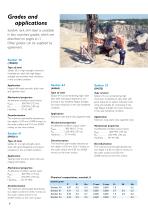
Grades and applications Sandvik rock drill steel is available in four standard grades, which are described on pages 6-11. Other grades can be supplied by agreement. Sanbar 20 (19HS20) Type of steel Sanbar 20 is a high strength chromiummolybdenum steel with high fatigue strength and excellent wear resistance in the as-rolled condition. Application Integral drill steels primarily (pilot rods and tapered rods). Mechanical properties As-delivered condition, typical values R p0.2 . . . . . . . . . 850 MPa (123 ksi) R m . . . . . . . . . . 1300 MPa (189 ksi) Hardness . . . . 37–43 HRC Decarburisation...
Open the catalog to page 6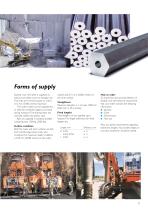
Forms of supply Sandvik rock drill steel is supplied as hollow, hot-rolled, round or hexagon bar. The ends are trimmed square to within 0.15 mm (0.006 inches) maximum. The outer surface can be supplied dry, or oiled for protection against corrosion during transport.The flushing holes are normally sealed with plastic caps. Bars are supplied in standard bundles containing max 1500 kg (3300 lbs). Surface condition Both the outer and inner surfaces are free from harmful slag marks, cracks and scratches.The maximum depth of defects is 0.20 mm (0.008 inches) on the outer surface and 0.15 mm (0.006...
Open the catalog to page 7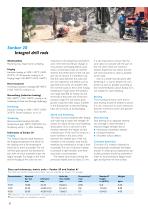
Sanbar 20 Integral drill rods Machinability Machining may require prior annealing. Forging Induction heating to 1000–1100°C (1830– 2010°F), 10–20 seconds, cooling in air. Forging range:1100–850°C (2010–1560°F). Heat treatment Annealing (induction heating) 850–900°C (1560–1650°F), cooling in air. Normalising (induction heating) 950–1050°C (1740–1920°F), cooling in air. Hardening of shank end (through hardening). Hardening Induction heating to 1000–1100°C (1830– 2010°F). Forced cooling in air or oil. Tempering Recommended hardness 50 HRC, temperature appr. 500°C (930°F)/0.5 hrs. Tempering within...
Open the catalog to page 8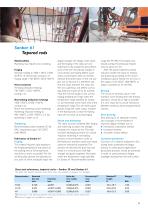
Sanbar 61 Tapered rods Machinability Machining may require prior annealing. Forging Induction heating to 1000–1100°C (1830– 2010°F), 10–20 seconds, cooling in air. Forging range: 1100–850°C (2010–560°F). Heat treatment Annealing (Induction heating). 730–780°C (1350–1440°F), cooling in air. Normalising (induction heating) 1000–1050°C, (1830–1920°F), cooling in air. Shank end hardening (case hardening) Hardening: Induction heating to 900–1000°C, (1650–1830°F ), 2–5 sec. quenching in water or oil. Tempering Recommended surface hardness 55–60 HRC, temperature appr. 150–250°C (300–480°F). Fabrication...
Open the catalog to page 9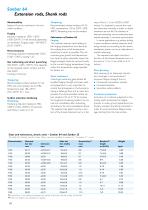
Sanbar 64 Extension rods, Shank rods Machinability Sanbar 64 can be machined in the hot rolled condition. Forging Induction heating to 1000–1100°C (1830–2010°F), 10–60 seconds, depending on dimension. Forging range: 1100–850°C (2010–1560°F). Heat treatment Annealing (induction heating) 680–720°C (1260–1330°F), cooling in air. Gas carburising and direct quenching 920–930°C (1690–1705°F).Time depends on the required carbon content and the case depth. Cooling in forced air. Tempering Recommended surface hardness 57–62 HRC and core hardness 36–44 HRC temperature appr. 180–230°C (355–450°F) for 1...
Open the catalog to page 10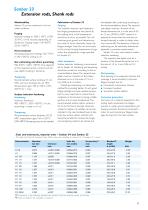
Sanbar 23 Extension rods, Shank rods Machinability Sanbar 23 can be machined in the hot rolled condition. Forging Induction heating to 1000–1100°C (1830– 2010°F), 10–60 seconds, depending on dimension. Forging range: 1100–850°C (2010–1560°F). Heat treatment Annealing (induction heating). 720–770°C (1330–1420°F), cooling in air. Gas carburising and direct quenching 920–930°C (1690–1705°F).Time depends on the required carbon content and the case depth. Cooling in forced air. Tempering Recommended surface hardness 57–62 HRC and core hardness 36–44 HRC. Temperature appr. 180 to 230°C (355– 450°F)...
Open the catalog to page 11All Alleima catalogs and technical brochures
 Sanicro® 825 Bar Datasheet
9 Pages
Archived catalogs
 Sandvik diecutting products
8 Pages
 special strip steel
18 Pages
 Welding products
27 Pages
 Solid and hollow bar
25 Pages
 Sandvik 3R12
6 Pages
 Sandvik billets and blooms
10 Pages