

- Products
- Catalogs
- News & Trends
- Exhibitions
Industrial hose & fittings

Industrial hose & fittings
- High Temperature Air Ducting: Made from black EPDM/PP, recyclable, halogen/phthalate-free, reinforced with steel helix wire. Suitable for hot air, gas, and fumes extraction with a temperature range of -40°C to +120°C (-40°F to +248°F).
- Polyurethane Air Ducting: Available in gauges of 0.4 mm, 0.8 mm, 1.2 mm, and 1.7 mm. Constructed from transparent polyurethane, resistant to abrasion and ozone, reinforced with copper-plated steel helix wire. Suitable for air, gas, fumes extraction, and abrasive material suction with a temperature range of -40°C to +85°C (-40°F to +185°F).
- Oxygen, Acetylene, and LPG Hoses: Made from synthetic elastomer, reinforced with high tensile textile cords, and covered with abrasion and ozone-resistant materials. Designed for specific gases with a safety factor of 3:1 and a temperature range of -10°C to +60°C (+14°F to +140°F).
- Welding Hoses: Comply with EN ISO 3821 and AS 1335 standards, suitable for oxygen, acetylene, and LPG welding. Safety factors and temperature ranges vary by application.
- Polyurethane and PVC Hoses: Designed for pneumatic tools and general industrial applications. Reinforced with high tensile textile cords, resistant to oil mist, abrasion, and ozone. Temperature ranges from -20°C to +60°C (-4°F to +140°F) for polyurethane and -5°C to +60°C (+23°F to +140°F) for PVC.
- Tables provide detailed dimensions, pressure ratings, and weight specifications for each type of hose, indicating suitability for various industrial applications.
- Ensure compatibility of hose materials with intended applications, especially concerning temperature and pressure requirements.
- Regularly inspect hoses for wear and tear to maintain safety and efficiency.
- Pressure: Most hoses are rated for 20 bar (300 psi), with some high-pressure models rated up to 80 bar (1200 psi).
- Temperature Range: Standard hoses operate between -10 °C to +60 °C, while high-temperature hoses can withstand up to +150 °C with peaks of 232 °C.
- Materials: Hoses are constructed with black synthetic elastomer, SBR/NBR, or EPDM, with reinforcements of high tensile textile cords or steel wire braids.
- 185AA/185AH: Standard duty hoses with abrasion and ozone-resistant covers.
- 186AA: Heavy duty hose with similar construction to standard models but designed for more demanding applications.
- 132AE: High-pressure, high-temperature hose with steel braided reinforcement for mining and quarry applications.
- 902AE/902LE: Hot air blower hoses with heat-resistant EPDM construction, suitable for food and material transport.
- 254AL: Soft wall hose for furnace cooling, made with black SBR, reinforced with high tensile textile cords, and covered with resin-coated dust-free fiberglass. It is designed to withstand heat, molten metal splashes, and open flames. Temperature range: -30°C to +80°C, with cover resistant up to 540°C.
- 203AL: Hard wall hose for furnace cooling, similar to 254AL but includes embedded steel helix wire for reinforcement.
- 957LL: Non-conductive cable cooling hose for electric furnaces, made with white EPDM, offering a higher temperature range of -40°C to +120°C.
- 375AA: Hot water car heater hose, made with black EPDM, suitable for automotive heating systems. Temperature range: -35°C to +100°C.
- 352AA: Radiator hose exceeding DIN 73411 and SAE 20R1 D-2 standards, with a temperature range of -40°C to +120°C.
- 395BT: Hot water wash down hose for the food and dairy industry, made with grey non-toxic PVC, designed for 50 bar at 70°C continuous use.
- 350LL and 350LE: Steam and hot water hoses for general industrial applications, with a safety factor of 10:1 for steam and 4:1 for water. Temperature range: -40°C to +165°C.
- 340AA and 340AH: Steam hoses with steel braided reinforcement, suitable for saturated and superheated steam, with a temperature range of -40°C to +220°C, intermittent to 232°C.
- Ensure hoses are identified as steam hoses with appropriate branding for working pressure and temperature.
- Do not exceed the specified working pressure and temperature.
- Avoid leaving hoses under pressure when not in use and prevent excessive bending near couplings.
- Use recommended steam hose couplings to ensure safety.
- Regular inspections should be conducted to check for cover blisters, lumps, and kinked areas that could damage the hose.
- Drain the hose after each use to prevent tube damage and "popcorning."
- Ensure clamp bolts are tight and that clamp halves are not touching; if they are, use smaller clamps.
- Avoid storing hoses over hooks and prevent them from drying out on metal racks or steel piping.
- For sub-zero applications, use chlorobutyl hoses.
- Steam containing dissolved air, oxygen, or carbon dioxide can be corrosive, attacking metals and oxidizing rubbers.
- Boiler water treatment is essential to remove hardness, oxygen, and carbon dioxide, ensuring steam is slightly alkaline.
- Steam hoses have a finite lifespan and can deteriorate due to changes in steam conditions.
- Understanding the impact of steam conditions on hose life is crucial.
- A chart provides the relationship between gauge pressure and temperature for saturated steam, highlighting the need for application-specific hoses.
- Various hoses are specified for different liquid food applications, including general-purpose, heavy-duty, and crush-resistant options.
- Specifications include FDA compliance, construction materials, temperature ranges, and pressure ratings.
- Hoses are designed for specific uses such as liquid food delivery, suction and delivery, and alcoholic beverages handling.
- Chapters cover different types of fittings, including hygienic-food, symmetric Guillemin, Storz, Tankwagen, and Cam & Groove.
- Fat Food S&D Hose: Designed for liquid and fat food-alcoholic beverages suction and delivery, with a maximum alcohol content of 75%. It can be sterilized with steam at 130°C for 30 minutes or with a 5% soda solution. The hose features a white NBR tube, high tensile textile cords with embedded steel helix wire reinforcement, and a white NBR/PVC cover.
- Bulk Food Delivery Hoses: These hoses are FDA approved and designed for the delivery of bulk food materials such as grain, flour, and plastic pellets. They feature a white NR tube, high tensile textile cords, and an abrasion-resistant cover.
- Bulk Material Delivery and S&D Hoses: These hoses are designed for heavy-duty applications such as dry cement, grain, and animal feed transfer. They feature a black conductive NR tube, high tensile textile cords, and a black conductive SBR/NR cover. The hoses are available in various pressure ratings and dimensions.
- PVC and Polyurethane Lined Hoses: Used for suction and low-pressure delivery of materials like gravel, cement, and iron ore. They are constructed with abrasion-resistant materials and are designed for gravity feed applications.
- Sandblast Hoses: These hoses are designed for abrasive material blasting and feature a black conductive NR tube, high tensile textile cords, and a pin-pricked cover for abrasion and ozone resistance. They are available in standard and premium quality options.
- Plaster Conveyance Hoses: Designed for pneumatic conveyance of pre-mixed synthetic plaster, these hoses feature a transparent polyurethane construction with rigid PVC reinforcement. They are suitable for use from silo to plaster pumping machines.
- 757AA: Designed for plaster and sand/cement mix pumping, with a safety factor of 3:1 and operational temperatures between -30°C and +80°C. It features a black conductive NR tube and a black conductive SBR/NR cover.
- 758AA & 758AE: Suitable for plaster pumping, with a safety factor of 2.5:1 for sizes <= 38 mm and 2:1 for 51 mm. Both have similar temperature ranges and construction materials, with 758AE having a blue SBR/EPDM cover.
- 754AA: Used for pneumatic concrete vibrators, featuring a black SBR tube and cover, with a safety factor of 4:1.
- 737AA: For concrete pumping at 40 bar, with a safety factor of 2.5:1, featuring a black conductive NR tube and SBR/NR cover.
- 740AA & 741AA: High-pressure concrete pumping hoses with steel reinforcement, designed for heavy-duty applications, with safety factors of 2:1 and 2.5:1 respectively.
- 984AH: Suitable for compressed air, water, fuel, and oil delivery, with a safety factor of 3:1 and temperature range of -10°C to +60°C.
- 974AH & 975AH: Non-conductive hoses for similar applications, with a safety factor of 4:1 and temperature range of -25°C to +80°C.
- 954AH: Similar to 975AH but with a safety factor of 3:1 and a broader temperature range.
- 503AA: Exceeds EN 12115 standards, used for acid and chemical suction and delivery, with a safety factor of 3:1.
- 505OG: Suitable for 90% of existing chemicals, featuring a transparent XLPE tube and green EPDM cover.
- 509AA: UHMWPE tube suitable for 98% of chemicals, with a safety factor of 4:1.
- Safety factors range from 2:1 to 4:1 depending on the hose type and application.
- Temperature ranges generally span from -30°C to +80°C, with some variations.
- Reinforcement typically involves high tensile textile cords, with steel reinforcement for high-pressure applications.
- Materials: Hoses are constructed with materials such as Black SBR, NBR, CR, and PVC, offering resistance to abrasion, ozone, hydrocarbons, and fire.
- Reinforcement: High tensile textile cords with embedded steel or nylon helix wire are used for reinforcement, providing strength and flexibility.
- Temperature Range: The hoses operate effectively within a temperature range of -54°C to +180°C (-65°F to +356°F), depending on the specific application.
- Pressure Ratings: Hoses are rated for pressures ranging from 10 bar (150 psi) to 25 bar (375 psi), with safety factors typically between 3:1 and 4:1.
- Oilfield Services: Hoses designed for vacuum tank service in crude oil mud handling.
- Fuel and Oil Delivery: Hoses suitable for tank trucks and general industrial applications, including biofuel and ethanol delivery.
- Hydraulic Systems: Hoses for hydraulic oil suction and return lines, requiring flexibility and high-temperature resistance.
- Aircraft Ground Fuelling: Hoses designed for aircraft fuelling and defuelling, meeting specific standards like EN 1361.
- Durability: Hoses are designed for long service life in heavy-duty applications, with features like abrasion and ozone resistance.
- Flexibility: Some hoses offer extra flexibility for applications requiring tight bend radii.
- Safety: Safety factors ensure reliability under specified pressure conditions.
- Soft Wall Hoses: Designed for fuel, oil, liquid mud, and potable water transfer. Available in pressure ratings of 10 bar (150 psi) and 20 bar (300 psi) with end load resistances ranging from 8,000 kg to 10,000 kg. Constructed with black conductive NBR tubes and high tensile textile cords.
- Hard Wall Hoses: Suitable for similar applications as soft wall hoses but include embedded steel helix wire for added strength. Used for fuel, oil, liquid mud, and potable water transfer.
- Bulk Material Hoses: Used for transferring bulk materials like barite and dry cement. Available in both soft and hard wall configurations with pressure ratings of 10 bar (150 psi) and 20 bar (300 psi).
- Drilling Waste Hoses: Hard wall hoses designed for high end load resistance (26,000 kg) and used for transferring drill cuttings and abrasive materials.
- Tubes: Made from black conductive NBR or NR, resistant to abrasion, ozone, hydrocarbons, and fire.
- Reinforcement: High tensile textile cords, with some hoses featuring embedded steel helix wire for additional support.
- Cover: Made from black conductive CR or SBR/NR, providing resistance to abrasion, ozone, and hydrocarbons.
- All hoses have a safety factor of 4:1, ensuring durability and reliability under specified conditions.
- Temperature range for most hoses is -30 °C to +80 °C (-22 °F to +176 °F).
- Special designs are available for reeling applications and weak link couplings.
- Pressure ratings ranging from 5 bar (75 psi) to 100 bar (1500 psi).
- Temperature ranges from -40°C to +90°C (-40°F to +200°F).
- Materials used include SBR/NBR, CR, and PVC, with reinforcements like high tensile steel cords and textile braids.
- Compressed air and water delivery in mining operations.
- Mine dewatering and stone dust delivery.
- Handling of abrasive slurries and explosive materials.
- Cable protection and mineral sampling in underground mines.
- Male BSPT and NPT: These are hose shanks designed for clamps, available in sizes ranging from 1/2 inch to 8 inches, made of plated steel.
- Hose Mender: Used for repairing hoses, available in sizes from 1/4 inch to 8 inches, also made of plated steel.
- Heavy Duty with Pre-Crimped Ferrule: Available for both BSPT and NPT threads, designed for heavy-duty applications with hose OD specifications provided.
- EN 14 420-5 / DIN 2817: Specifications for male and female BSP fittings, available in stainless steel and brass, with full hexagon or grooved hexagon designs.
- Aviation Refueling Service: Approved fittings for aviation use, including male BSPP and safety clamps.
- Quick Coupling: Made of nylon or malleable iron, designed for quick connections in sandblasting applications.
- Nozzle Holders: Available in BSP and coarse thread types, made of aluminum or nylon.
- Mortar Adapters and Couplers: Made of malleable iron, designed for hose shank connections.
- Concrete Couplings: Various styles including Victaulic, shouldered, and Schwing, made of hardened steel for durability.
- Dimensions are subject to change without notice.
- Consult the AG Hydraulic Catalogue for specific ferrule recommendations.
- Safety clamps and ferrules are essential for secure assembly.
Concrete couplings are available with pre-crimped ferrules and hardened inserts. They come in various thread types including BSPT, BSPP, and NPT, and are made from hardened steel. The hose IDs range from 2 to 3 inches (51 to 76 mm).
Flange Fittings
Swivel and fixed flanges are available with serrated hose shanks. These are made from plated steel or stainless steel (S/S 316) and are compatible with PN 10/16 and ASA 150 standards. Hose IDs range from 1 1/4 to 8 inches (32 to 203 mm).
Muff Couplings
Muff couplings for 706AA and 707AA hoses feature fixed flanges and are made from aluminum. They accommodate hose IDs from 2 to 12 inches (51 to 300 mm) with maximum hose ODs specified.
Clamps & Ferrules
Various clamps are available, including ear pinch clamps (1-ear and 2-ears), miniclamps, worm gear clamps, rubber-lined clips, and PW-clamps. Materials include plated steel (W1) and stainless steel (S/S 304 and S/S 316). Sizes vary to accommodate different hose ODs.
Double Bolt Clamps
These clamps come with two saddles and are made from malleable iron. They are designed for hose ODs ranging from 17 to 114.3 mm and comply with DIN 20039 A standards.
- Clamps & Ferrules: Safety clamps conforming to EN 14 420-3 / DIN 2817 standards are available in aluminum and stainless steel. Dimensions vary based on hose ID and OD.
- Crimping Rings: Made from aluminum, these rings are designed for specific hose IDs and ODs, with additional options for mortar applications.
- Smooth and Serrated Ferrules: Available in stainless steel, aluminum, and plated steel, these ferrules are suitable for composite and industrial hoses.
- Combination Nipples: These fittings are available with BSPP and NPT threads, made from aluminum, stainless steel, bronze, and plated steel.
- Flanges: Fixed and swivel flanges are available in plated steel and stainless steel, suitable for various hose IDs and flange types (PN 10/16 and ASA 150).
- Ensure compatibility of clamps and ferrules with hose dimensions to maintain safety and performance.
- Consult the AG Hydraulic Catalogue for ferrules with DN less than 76 mm.
- For smooth ferrules in plated steel, refer to the chapter on "Composite Hose Fittings."
- Item codes and part numbers are provided for easy reference and ordering.
- Material specifications are crucial for selecting the appropriate fitting for specific applications.
This document provides guidelines for the selection, storage, use, and maintenance of industrial hoses and fittings. It includes specifications, procedures, norms, and recommendations to ensure optimal performance and longevity of hoses.
1. Choice Criteria
To select a suitable hose, consider the following:
- Pressure and Suction: Determine maximum working pressure or suction values to avoid premature hose failure due to pressure variations.
- Compatibility: Assess the nature, concentration, temperature, and state of substances conveyed.
- Environment: Consider ambient conditions like temperature, humidity, and exposure to elements like UV rays and chemicals.
- Mechanical Stress: Establish minimum bend radius and assess stress from traction, torsion, and vibration.
- Cover Abrasion: Use additional protection if the hose is prone to damage from external factors.
- Working Position: Specify if the hose is on the ground, suspended, or immersed.
- Couplings: Ensure compatibility between hose and couplings, considering type, dimension, and application.
- Technical Standards: Adhere to relevant national and international standards.
- Marking: Hoses should be marked with necessary information for proper use.
2. Storage Recommendations
Proper storage is crucial to prevent deterioration:
- Storage Life: Rotate stock to minimize storage time; check hoses before use if stored long-term.
- Temperature and Humidity: Store between 10-25°C, avoiding extremes and maintaining humidity below 65%.
- Light: Store in dark places to avoid exposure to sunlight or strong artificial light.
- Oxygen and Ozone: Protect from air and ozone-producing materials.
- Contact with Other Materials: Avoid contact with solvents, oils, and certain metals.
- Heat Sources: Maintain distance from heat sources or use thermal shields.
- Electric or Magnetic Fields: Eliminate variations to prevent heating of metal couplings.
- Storage Conditions: Store hoses relaxed, avoiding tension or compression.
- Rodents and Insects: Protect from pests.
- Exit from Storage: Inspect hoses for integrity before use.
- Return to Storage: Clean hoses thoroughly before storing again.
3. Norms and Method of Use
Ensure proper installation and use:
- Preassembly Checks: Verify hose specifications and inspect for damage.
- Handling: Move hoses carefully to avoid damage.
- Pressure and Seal Test: Test for leaks after installation.
- Temperature: Use within specified temperature limits.
- Conveyed Products: Use hoses only for intended substances.
- Environment: Use in suitable environmental conditions.
- Bending Radius: Avoid installation below minimum bending radius.
- Torsion and Traction: Avoid excessive torsion and traction.
- Vibration: Ensure hoses can withstand vibrations.
- Kinking: Avoid kinking to prevent damage.
- Couplings: Ensure compatibility and avoid sharp edges.
- Electrical Properties: Understand the electrical resistance of hoses.
- Installation Between Points: Support hoses to allow normal movement.
- Mobile Pieces: Ensure hose length accommodates movement without stress.
- Identification: Use compatible marking methods.
4. Maintenance
Regular maintenance is essential:
- Inspection: Check for cracks, leaks, and other signs of wear.
- Repairs: Avoid repairs; replace damaged sections if necessary.
- Cleaning: Clean with soap and water, avoiding solvents and abrasive tools.
Conclusion
Following these guidelines will help ensure the safe and efficient use of industrial hoses and fittings, extending their service life and maintaining performance.
- GEKA Type: Symmetric coupling system with a WP of 10 bar, suitable for agricultural and irrigation applications. Not interchangeable with Express or other compressed air claw couplings.
- Type B - Bauer Compatible: Asymmetric coupling system with a WP of 20 bar for DN 50mm to 89mm and 12 bar for DN 108mm to 300mm. Used in agriculture, irrigation, and various industrial applications. Not interchangeable with Type C couplings.
- Type C - Cardan/Perrot Compatible: Asymmetric coupling system with a WP of 12 bar, used in agricultural and construction applications. Not interchangeable with Type B couplings.
- Water Vidange: Asymmetric coupling system with a WP of 6 bar, designed for general water applications.
- Type 42: Asymmetric coupling system with a WP of 12 bar, used in chemical, paper, and process industries, as well as for mobile water pipes in mining and heavy industry.
- SMS: Asymmetric coupling system with a WP of 6 bar, used in food, beverage, chemical, and pharmaceutical industries. Not interchangeable with DIN 11851 couplings.
- DIN 11851: Asymmetric coupling system with a WP of 40 bar to 25 bar, used in food, beverage, pharmaceutical, and chemical industries. Not interchangeable with SMS couplings.
- Macon: Asymmetric coupling system with a WP of 10 bar, specifically designed for the wine industry in France.
- Ensure compatibility of hose and fittings based on the specific application.
- Final choice of fittings is the customer's responsibility.
- Some fittings are not interchangeable due to differences in design and specifications.
1. Steam Couplings: Comply with EN 14423 / DIN 2826, available in male and female threaded screw couplings and flanged couplings. Suitable for saturated steam up to +210°C and hot water up to +120°C with a working pressure of up to 18 bar.
2. Safety Clamps: EN 14420-3 / DIN 2817 clamps are not to be used. Steam hose shanks complying with EN 14423 / DIN 2826 are serrated, longer, and larger compared to EN 14420-2 / DIN 2817.
3. Ground Joint Seal: Maximum working pressure of 41 bar.
4. Clamps: Available in 2, 4, and 6 bolt configurations with gripping finger types.
Procedures:
1. Coupling Systems: Asymmetric systems include male and female threaded ends, while symmetric systems include flanged ends. Designed for steam, high-pressure compressed air, and hazardous applications.
2. Symmetric Guillemin Couplings: French standard tanker connection, not interchangeable with DSP/AR couplings. Used for pressure and suction delivery of liquids and solids.
3. Symmetric DSP & AR Couplings: Used in firefighting applications for pressure and suction delivery. Not interchangeable with Guillemin couplings.
Norms and Standards:
1. EN 14423 / DIN 2826: For steam couplings.
2. NF S 61.704 - NF S 61.705: For DSP & AR couplings.
3. NF E 29-579: For Gros Filet Rond couplings.
Recommendations:
1. Application Warnings: Not to be used for steam or liquid gas applications unless specified. Ensure compatibility of hose and fittings based on application requirements.
2. Use Cases: Widely used in oil refineries, chemical plants, and other industries requiring steam as an essential service. Also applicable for LPG, grouting, volatile liquids, and similar applications.
Key Data from Tables and Diagrams:
1. Working Pressure (WP): Varies across different coupling types, with maximums ranging from 10 bar to 100 bar depending on the application and coupling type.
2. Connection Types: Include male and female threaded ends, flanged ends, and symmetric systems with locking rings.
Critical Information:
1. Safety: Use appropriate clamps and couplings as per specified standards to ensure safety and compatibility.
2. Limitations: Certain couplings are not suitable for specific applications like steam or liquid gas, and care must be taken to adhere to these limitations.
- Combination Nipples: Includes male BSPT and NPT hose shanks for clamps, hose menders, and heavy-duty options with pre-crimped ferrules. Standards referenced include EN 14 420-5 and DIN 2817.
- Aviation Fittings: Details on male and female BSP hose shanks approved for aviation refueling services, including safety clamps and serrated ferrules.
- Sandblast Components: Quick couplings and nozzle holders with female BSP and coarse threads.
- Mortar and Concrete Fittings: Includes adapters, couplers, and crimping rings for hose shanks, with specific styles like Victaulic and Schwing.
- Flanges: Swivel and fixed flanges with serrated hose shanks, adhering to EN 14 420-2 and DIN 2817 standards.
- Clamps and Ferrules: Various types of clamps including ear pinch, miniclamps, worm gear clamps, and rubber-lined clips, along with banding tools and systems.
- Composite Hose Fittings: Combination nipples, symmetric Guillemin couplings, API couplings for tanks, and related gaskets and ferrules.
- Appendix: Provides guidance on hose choice, storage, use, maintenance, chemical resistance, and fitting tables.
Catalog excerpts

Industrial hose & fittings
Open the catalog to page 1
Note Since ALFAGOMMA continually examines ways to improve products, we reserve the right to alter specifications without prior notice. Weights and dimensions are nominal. Working pressures and vacuum ratings for hose are based at ambient temperature of 20 °C (68 °F) Pictures shown are for illustration purpose only. Actual hose construction might be different. Refer to local price list for items available in the different sales area, included available lengths and stock lengths.
Open the catalog to page 3
Minimum Bend Radius 65mm3 Minimum Bend Radius= Minimum Bend Radius= Tube abrasion Tube abrasion High temperature Conductive tube & High performance IANESCO IANESCO approved Materieles Sapeurs- Pompiers Approved Latin America Center Europe, Middle East, North Africa Asia Pacific
Open the catalog to page 4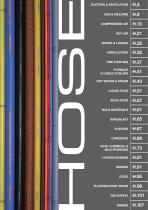
DUCTING & VENTILATION WATER & LIQUIDS FIRE FIGHTING FURNACE & CABLE COOLING LIQUID FOOD BULK FOOD BULK MATERIALS ACID, CHEMICAL & MULTIPURPOSE FLOATING ROOF DRAIN
Open the catalog to page 5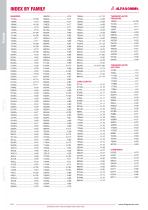
H.2 Dimensions shown may be changed without prior notice
Open the catalog to page 6
DUCTING & VENTILATION
Open the catalog to page 7
Air ducting Construction: Grey PVC - abrasion and ozone resistant Reinforcement: White shock resistant rigid PVC Use: Air, gas, fumes extraction. Air conditioning-ventilation Temperature: -10 °C +60 °C (+14 °F +140 °F) General purpose Construction: Black PVC - abrasion and ozone resistant Reinforcement: White shock resistant rigid PVC Use: General purpose designed for gas vent, air seeder and marine bilge pump applications - ID 51 mm according to AS 1425/2.22 Temperature: -10 °C +60 °C (+14 °F +140 °F) H.4 Dimensions shown may be changed without prior notice
Open the catalog to page 8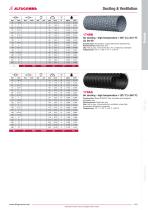
Air ducting - high temperature +100 °C (+212 °F) UL 94 V0 Construction: Textile fabric coated with flame resistant PVC Reinforcement: Steel helix wire Use: Hot air, gas, fumes extraction. Air conditioning-ventilation Temperature: -20 °C +100 °C (-4 °F +212 °F) Air ducting - high temperature +120 °C (+248 °F) Construction: Black EPDM/PP fully recyclable and halogens/ phthalates free Reinforcement: Steel helix wire Use: Hot air, gas, fumes extraction-ventilation where high temperature resistance is required Temperature: -40 °C +120 °C (-40 °F +248 °F) H.5 Dimensions shown may be changed without...
Open the catalog to page 9
Air ducting - polyurethane - gauge 0,4 mm Construction: Transparent polyurethane - abrasion and ozone resistant Reinforcement: Copper plated steel helix wire Use: Air, gas, fumes extraction - ventilation. Also suitable for abrasive material suction - good oil mist resistance Temperature: -40 °C +85 °C (-40 °F +185 °F) Air ducting - polyurethane - gauge 0,8 mm Construction: Transparent polyurethane - abrasion and ozone resistant Reinforcement: Copper plated steel helix wire Use: Air, gas, fumes extraction - ventilation. Also suitable for abrasive material suction - good oil mist resistance Temperature:...
Open the catalog to page 10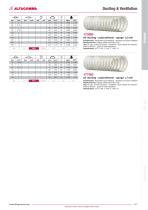
Air ducting - polyurethane - gauge 1,2 mm Construction: Transparent polyurethane - abrasion and ozone resistant Reinforcement: Copper plated steel helix wire Use: Air, gas, fumes extraction - ventilation. Also suitable for abrasive material suction - good oil mist resistance Temperature: -40 °C +85 °C (-40 °F +185 °F) Air ducting - polyurethane - gauge 1,7 mm Construction: Transparent polyurethane - abrasion and ozone resistant Reinforcement: Copper plated steel helix wire Use: Air, gas, fumes extraction - ventilation. Also suitable for abrasive material suction - good oil mist resistance Temperature:...
Open the catalog to page 11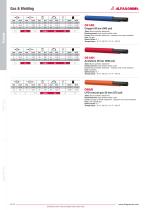
Tube: Black synthetic elastomer Reinforcement: High tensile textile cords Cover: Blue synthetic elastomer - abrasion and ozone resistant Use: Oxygen Safety factor: 3:1 Temperature: -10 °C +60 °C (+14 °F +140 °F) Acetylene 20 bar (300 psi) Tube: Black synthetic elastomer Reinforcement: High tensile textile cords Cover: Red synthetic elastomer - abrasion and ozone resistant Use: Acetylene Safety factor: 3:1 Temperature: -10 °C +60 °C (+14 °F +140 °F) Tube: Black synthetic elastomer Reinforcement: High tensile textile cords Cover: Orange synthetic elastomer - abrasion and ozone resistant Use: LPG-natural...
Open the catalog to page 14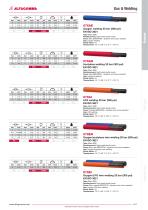
Tube: Black SBR Reinforcement: High tensile textile cords Cover: Blue SBR/EPDM - abrasion and ozone resistant Use: Oxygen welding Safety factor: 3:1 Temperature: -25 °C +80 °C (-13 °F +176 °F) Acetylene welding 20 bar (300 psi) EN ISO 3821 Tube: Black SBR Reinforcement: High tensile textile cords Cover: Red SBR/EPDM - abrasion and ozone resistant Use: Acetylene welding Safety factor: 3:1 Temperature: -25 °C +80 °C (-13 °F +176 °F) Tube: Black NBR Reinforcement: High tensile textile cords Cover: Orange SBR/EPDM - abrasion and ozone resistant Use: LPG welding Safety factor: 3:1 Temperature: -30...
Open the catalog to page 15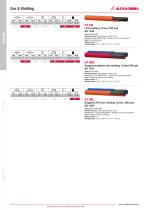
LPG welding 12 bar (180 psi) AS 1335 Tube: Black NBR Reinforcement: High tensile textile cords Cover: Orange SBR/EPDM - abrasion and ozone resistant Use: LPG-natural gas Safety factor: 4:1 Temperature: -25 °C +80 °C (-13 °F +176 °F) Oxygen/acetylene twin welding 12 bar (180 psi) AS 1335 Tube: Black SBR Reinforcement: High tensile textile cords Cover: Blue, red SBR/EPDM - abrasion and ozone resistant Use: Oxygen/Acetylene twin welding Safety factor: 3:1 Temperature: -25 °C +80 °C (-13 °F +176 °F) Oxygen/LPG twin welding 12 bar (180 psi) AS 1335 Tube: Black SBR-NBR Reinforcement: High tensile textile...
Open the catalog to page 16
Compressed air 20 bar (300 psi) - polyurethane pneumatic tools Tube: Black polyurethane - oil mist resistant Reinforcement: High tensile textile cords Cover: Light blue synthetic elastomer - abrasion and ozone resistant Use: Compressed air. Specially designed for pneumatic tools and paint spray Safety factor: 3:1 Temperature: -20 °C +60 °C (-4 °F +140 °F) Compressed air 16 bar (240 psi) - PVC AS/NZS 2554/B Tube: Black PVC - oil mist resistant Reinforcement: High tensile textile cords Cover: Blue PVC - abrasion and ozone resistant Use: Compressed air and general industrial applications. Good flexibility...
Open the catalog to page 18All ALFAGOMMA catalogs and technical brochures
 AG-Flyer-Plug-in
4 Pages
 AGHO_Catalogue_Hydraulic_Hose
31 Pages
Archived catalogs
 Alfabbiotech
4 Pages
 Hammer Union
4 Pages
 OIL WELL CEMENTING
1 Page
 HYDRAULIC HOSE FITTINGS & ADAPTERS
450 Pages
 INDUSTRIAL HOSE & FITTINGS
389 Pages
 HIGH TEMPERATURE RANGE
6 Pages
 Evolution
24 Pages
 LOW TEMPERATURE RANGE
6 Pages
 OIL & GAS PRODUCT RANGE
128 Pages
 QUICK RELEASE COUPLINGS
82 Pages
 LIGHT SERIE CLAMPS - DIN 3015
14 Pages
 Hose in 61m
1 Page
 hydraulic hoses fittings & adapters
261 Pages
 hydraulic hoses
68 Pages
 OIL & MARINE DIVISION
42 Pages
