
- Catalogs
- Alfa Laval
- WideGap 200

WideGap 200

WideGap 200
The WideGap 200 plate heat exchanger is designed for general heating, cooling, and heat recovery applications, particularly for media containing fibers, coarse particles, and highly viscous fluids.
Standard Design
The exchanger consists of corrugated metal plates with portholes for fluid passage. These plates are assembled between a fixed frame plate and a movable pressure plate, compressed by tightening bolts. Gaskets seal the interplate channels and direct fluids into alternate channels. The number of plates is determined by flow rate, fluid properties, pressure drop, and temperature program. The corrugations enhance fluid turbulence and support against differential pressure. The WideGap plates have coarse corrugations with a cross-section width of approximately 11 mm and flat portholes for product channels. Configurations include Wide-gap/Narrow-gap and Medium-gap/Medium-gap.
Technical Specifications
- Liquid flow rate: Up to 150 kg/s, depending on media, pressure drop, and temperature program.
- Plate types: Wide-gap plates
- Frame types: FG
- Maximum heat transfer surface: 425 m²
- Mechanical design pressure/temperature: FG PED 1.6 MPa / 180 °C, FG ASME 150 psig / 350 °F
- Standard materials: Frame plate (Mild steel, Epoxy painted), Nozzles (Carbon steel, Stainless steel, Titanium), Plates (Stainless steel Alloy 316 or Titanium), Gaskets (Nitrile, EPDM)
Working Principle
Channels are formed between plates, with corner ports arranged for alternate media flow. Heat is transferred through the plate, creating complete counter-current flow for maximum efficiency. Plate corrugation enhances turbulence and supports plates.
Dimensions
- Type T20S-FG: Height 2145 mm, Width 780 mm, Height 285 mm
Quotation Requirements
- Flow rates or heat load
- Temperature program
- Physical properties of liquids (if not water)
- Desired working pressure
- Maximum permitted pressure drop
- Available steam pressure
Contact Information
For up-to-date contact details, visit Alfa Laval's website at www.alfalaval.com.
Catalog excerpts
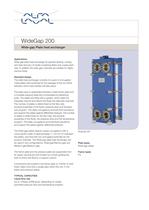
Wide-gap Plate heat exchanger WideGap 200 Applications Wide-gap plate heat exchanger for general heating, cooling and heat recovery of media containing fibres and coarse particles. In addition the wide-gap channels are suitable for highly viscous fluids. Standard design The plate heat exchanger consists of a pack of corrugated metal plates with portholes for the passage of the two fluids between which heat transfer will take place. The plate pack is assembled between a fixed frame plate and a movable pressure plate and compressed by tightening bolts. The plates are fitted with a gasket, which seals the interplate channel and directs the fluids into alternate channels. The number of plates is determined by the flow rate, physical properties of the fluids, pressure drop and temperature program. The plate corrugations promote fluid turbulence and support the plates against differential pressure. The number of plates is determined by the flow rate, the physical properties of the fluids, the pressure drop and the temperature program. The plate corrugations promote fluid turbulence and support the plates against differential pressure. The Wide-gap plates feature coarse corrugations with a cross-section width of approximately 11 mm (5/12”) between the plates, and have flat non-corrugated portholes for the product channels. The Wide-gap plate heat exchanger can be used in two configurations, Wide-gap/Narrow-gap and Medium-gap/Medium-gap. The frame plate and the pressure plate are suspended from an upper carrying bar and located by a lower guiding bar, both of which are fixed to a support column. Connections are located in the frame plate or, if either or both fluids make more than a single pass within the unit, in the frame and pressure plates. Typical capa cities Liquid flow rate Up to 150kg/s (2368 gmp), depending on media, permitted pressure drop and temperature program. WideGap 200 Plate types Wide-gap plates Frame types FG
Open the catalog to page 1
PCT00097EN 0904 How to contact Alfa Laval Up-to-date Alfa Laval contact details for all countries are always available on our website at www.alfalaval.com All rights reserved for changes in specifications without prior notification Working principle Channels are formed between the plates and the corner ports are arranged so that the two media flow through alternate channels. The heat is transferred through the plate between the channels, and complete counter-current flow is created for highest possible efficiency. The corrugation of the plates provides the passage between the plates, supports...
Open the catalog to page 2All Alfa Laval catalogs and technical brochures
 kyAlfa Laval LeviMag®
11 Pages
 PureSOx
12 Pages
 Alfa Laval Astepo TAF filler
4 Pages
 yAlfa Laval TJ40G
4 Pages
 Alfa Laval TJ20G
4 Pages
 Alfa Laval AS-H Coplastix®
2 Pages
 Heating and cooling systems
160 Pages
 Brazed plate heat exchanger
2 Pages
 Arctigo HRCD
2 Pages
 Heat exchangers
16 Pages
 Close at hand, spare parts, January 2016
2016 Pages
 LKH UltraPure US 875275
23 Pages
 Tri-Clover LKB UltraPure
7 Pages
 BDB 104
2 Pages
 Product overview
2 Pages
 SolidC Centrifugal Pump
2 Pages
 Pressosmart
4 Pages
 SolarTank
2 Pages
 Crushers and depitters
4 Pages
 OptiLobe Rotary Lobe Pump
4 Pages
 Unique SSV Standard
7 Pages
 Alfa Disc
2 Pages
 AC232DQ / ACH232DQ
2 Pages
 AC112 / ACH112
2 Pages
 ISC II
2 Pages
 AlfaBlue BXM/BXD
2 Pages
 AlfaBlue BCM/BCD & BNM/BND
2 Pages
 PureBallast 3.0
6 Pages
 Alfa Laval Olmi air cooler
2 Pages
 Alcap separation system
4 Pages
 Viscosity control system
4 Pages
 Pressurisation set
4 Pages
 KAB - Sludge filter
2 Pages
 AquaTank EM (7bar)
2 Pages
 Aquastore
4 Pages
 AquaProtect T
2 Pages
 Tank Cover
1 Page
 LKS 105 Tank Sight Glass
2 Pages
 LKFL In-line Sight Glass
2 Pages
 Weighing systems UltraPure
4 Pages
 Toftejorg Sanitary Rotacheck
2 Pages
 Potentiometric level transmitter
3 Pages
 Level switch
3 Pages
 Conductivity sensor
4 Pages
 Rotary jet mixer IM25
3 Pages
 Rotary jet mixer IM20
3 Pages
 PD Sheet - Rotary jet mixer IM10
3 Pages
 ViscoLine Regenerator Unit
4 Pages
 ViscoLine Multitube Unit
4 Pages
 ViscoLine MultiPass Unit
4 Pages
 ViscoLine Dynamic Unit
4 Pages
 ViscoLine Doubletube
2 Pages
 ViscoLine CIP Unit
2 Pages
 Viscoline Annular Unit
4 Pages
 Pharma-line
2 Pages
 Water cooled condensers
24 Pages
 X20 Application Brochure
12 Pages
 S_and_P_Flex_range
9 Pages
 PX 95 Disc stack centrifuge
2 Pages
 PX 80 Disc stack centrifuge
2 Pages
 PX 70 Disc stack centrifuge
2 Pages
 PX 65 Disc stack centrifuge
2 Pages
 PX 55 Disc stack centrifuge
2 Pages
 PX 110 Disc stack centrifuge
2 Pages
 Solids ejecting centrifuge
2 Pages
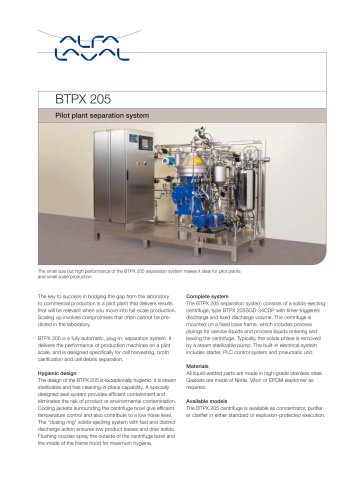 BTPX Separator - BTPX 205
2 Pages
 Alfie500
2 Pages
 Alfapure2000
2 Pages
 AlfaPure Z7
2 Pages
 AlfaPure Z3
2 Pages
 SolidC UltraPure Centifugal Pump
4 Pages
 AlfaCond
2 Pages
 NF series
4 Pages
 FSM series
3 Pages
 Alfa Laval LabUnit M10
2 Pages
 FrontLine Plate Heat Exchanger
3 Pages
 Fuel Conditioning Module
4 Pages
 Lube oil filter T-160 range
4 Pages
 Lube oil filter
4 Pages
 ALF – Alfa Laval Filter
4 Pages
 Alfa Laval Heatpac® Heaters
4 Pages
 WS 40, 60
4 Pages
 WS 10, 20 ,30
4 Pages
 Stnx - decanter centrifuge
4 Pages
 SG2 700
2 Pages
 Foodec 800
4 Pages
 Foodec 600
2 Pages
 Foodec 500
4 Pages
 Foodec 400
4 Pages
 Foodec 300
2 Pages
 Foodec 200
2 Pages
 Foodec 100
2 Pages
 AlfaOliver 500
2 Pages
 ALDEC G2 – Smart Decanter
2 Pages
 WideGap 350
2 Pages
 TS6 Plate heat exchanger
2 Pages
 TS20 - Plate heat exchanger
2 Pages
 TL6
TL62 Pages
 TL35 - Plate heat exchanger
2 Pages
 TL3
TL32 Pages
 TL15
TL152 Pages
 TL10 - Plate heat exchanger
2 Pages
 T50 - Plate heat exchanger
2 Pages
 T5 - Plate heat exchanger
2 Pages
 T45 - Plate heat exchanger
2 Pages
 T20 - Plate heat exchanger
2 Pages
 T2 - Plate heat exchanger
2 Pages
 MX25 - Plate heat exchanger
2 Pages
 M6
M62 Pages
 M30 - Plate heat exchanger
2 Pages
 M3
M32 Pages
 M15
M152 Pages
 M10
M102 Pages
 PD leaflet: AlfaVap System
2 Pages
 AlfaNova 52 / AlfaNova HP 52
2 Pages
 AlfaNova 27 / AlfaNova HP 27
2 Pages
 AlfaNova 14
2 Pages
 Compact frame DOC
2 Pages
 CBXP52
2 Pages
 CB77
CB772 Pages
 CB60 / CBH60
2 Pages
 CB52 / CBH52
2 Pages
 CB400
CB4002 Pages
 CB300 / CBH300
2 Pages
 CB27 / CBH27
2 Pages
 CB200 / CBH200
2 Pages
 CB20
CB202 Pages
 CB18 / CBH18
2 Pages
 CB16 / CBH16
2 Pages
 CB14
CB142 Pages
 CB100 / CBH100
2 Pages
 AXP14 - Gas cooler
2 Pages
 AXP10
AXP102 Pages
 Brazed heat exchangers
16 Pages
 Spiral HE - General Brochure
16 Pages
 AlfaRex - TM20
2 Pages
 The hygienic condenser
2 Pages
 FK(G) - Gravity coils
2 Pages
 Top - Commercial unit cooler
2 Pages
 THOR - Industrial air cooler
2 Pages
 Airmax II DX - Unit cooler
2 Pages
 Centrifugal Unit Cooler ISC
2 Pages
 TYR - Industrial air cooler
2 Pages
 THOR - Industrial air cooler
2 Pages
 AlfaBlue - Power Dry Cooler
2 Pages




Archived catalogs
 AlfaBlast
2 Pages
 Alfa V- Air cooled condenser
2 Pages
 Solar Max G - Dry coolers
2 Pages
 Solar G - Dry coolers
2 Pages
 Solar - Air-cooled condensers
2 Pages


