
- Catalogs
- Alfa Laval
- Large-capacity nozzle centrifuge for starch applications

Large-capacity nozzle centrifuge for starch applications

Large-capacity nozzle centrifuge for starch applications
The Merco CH-36B GOF is a large-capacity nozzle centrifuge designed by Alfa Laval for starch applications, particularly in the maize wet milling process. It is engineered for continuous discharge of solids and is used for classifying, concentrating, and washing solids, as well as clarifying liquids with high solids concentrations.
Applications
This centrifuge is widely used in the maize starch industry for primary starch separation, gluten thickening, millstream thickening, and middling concentration.
Design and Features
The centrifuge features a bowl mounted on a vertical spindle, driven by a motor via V-belts. All metallic parts in contact with process liquids are made of high-grade stainless steel. It includes 30 tungsten carbide nozzles for energy recovery and is equipped with sensors for monitoring speed, vibration, and temperature. A recirculation system allows for efficient separation and process control, enabling the use of large-diameter nozzles to prevent blockages.
Basic Equipment
The centrifuge comes with a motor, self-cleaning strainer, sensors, a hydraulic power unit, special tools, and spare parts. Options include control-torque motors, frequency drive, and different bowl configurations.
Operating Principles
The feed enters the rotating bowl, where separation occurs between discs. The liquid phase is discharged by gravity, while solids are discharged through nozzles. A recirculation system allows for the introduction of wash water to displace impurities.
Technical Specifications
- Max throughput capacity: 225 m3/h
- Max bowl speed: 2900 rpm
- Motor power: 225/260 kW
- Feed temperature range: 0–65ºC
- Sound pressure: 85 dB(A)
Material Data
The bowl body and other critical components are made from stainless steel (s.s. 1.4462 UNS S31803 and s.s. 1.4401 UNS 316 00), with cast grey iron used for the stand and hoist.
Utilities Consumption
- Electric power: max. 260 kW
- Safety water: max. 135 m3/h
- Wash water: max. 90 m3/h
Contact Information
For more details, visit Alfa Laval's website at www.alfalaval.com.
Catalog excerpts

Large-capacity nozzle centrifuge for starch applications Merco CH-36B GOF Alfa Laval separator centrifuges for the starch industry are available in many different sizes and confi gurations, each one designed and adapted for dealing with the widely varying separation tasks required. The Merco CH-36B GOF is a dedicated starch centrifuge, designed for several applications in the maize wet milling process. Applications The Merco CH-36B GOF is a nozzle centrifuge designed for continuous discharge of solids. It is used for classifying, concentrating and washing solids, and for clarifying liquids that contain relatively high solids concentrations. The Merco CH-36B GOF is widely used in the maize starch industry for processes that include primary starch separation, gluten thickening, millstream thickening and middling concentration. Standard design Separation takes place in the bowl, which is mounted on a vertical spindle. The vertically mounted motor drives the spindle near the top via two bound V-belts. All metallic parts that come in contact with the process liquid are made of high-grade stainless steel. Thirty nozzles are placed in the bowl periphery at a narrow angle from the tangent, in order to recover energy from the material being discharged through the nozzles. The nozzles are made of tungsten carbide, suitable for abrasive solids. The centrifuge is equipped with sensors for monitoring the bowl speed, vibration and bearing temperature. The inlet and outlet devices are equipped with fl anges. Circulating oil ensures that the bearings are lubricated. An external pump maintains the necessary pressure. Special features The Merco CH-36B GOF employs a special recirculation system that provides highly effi cient separation. Solids can be recirculated to the nozzles at the same time as wash water is added. Working with the underfl ow draw-off valve, the return fl ow system provides a unique means of controlling the separation process. It allows the operator to control and optimize the separation process by determining how much underfl ow is to be removed, how much is to be recycled back to the rotor and how much wash water is to be added. This makes it possible to use nozzles with a large diameter, which allows variations in feed concentration and prevents blockages. The centrifuge thus becomes more versatile, and can be easily adapted to changes in procedure. The Merco CH-36B Fig. 1 Merco CH-36B GOF with motor GOF has a built-in hydraulic hoist that eliminates the need for an external lifting device, and thus reduces the downtime required for servicing the centrifuge. Basic equipment The centrifuge is equipped with a motor, a self-cleaning strainer for the feed, speed and vibration sensors, oil temperature sensors for the spindle bearings and the motor winding, a hydraulic power unit for the lifting hoist, a set of special tools and a standard set of spare parts. Options Control-torque motors of two different power ratings are available. Frequency drive is also possible. The centrifuge bowl is available in classifi er (PS) or clarifi er (GT, MST, CL) execution, with different disc spacings. A double underfl ow outlet is available for the MST version.
Open the catalog to page 1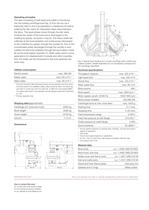
Operating principles The feed consisting of both liquid and solids is introduced into the rotating centrifuge bowl (fi g. 2) from the top via a stationary inlet (1) and is accelerated in a distributor (2) before entering the disc stack (3). Separation takes place between the discs. The liquid phase moves through the disc stack towards the centre of the bowl and is discharged to the overfl ow by gravity, via power a ring (4). The heavy solids are collected at the bowl periphery and continuously discharged to the underfl ow by gravity, through the nozzles (5). Part of the concentrated solids discharged...
Open the catalog to page 2All Alfa Laval catalogs and technical brochures
 kyAlfa Laval LeviMag®
11 Pages
 PureSOx
12 Pages
 Alfa Laval Astepo TAF filler
4 Pages
 yAlfa Laval TJ40G
4 Pages
 Alfa Laval TJ20G
4 Pages
 Alfa Laval AS-H Coplastix®
2 Pages
 Heating and cooling systems
160 Pages
 Brazed plate heat exchanger
2 Pages
 Arctigo HRCD
2 Pages
 Heat exchangers
16 Pages
 Close at hand, spare parts, January 2016
2016 Pages
 LKH UltraPure US 875275
23 Pages
 Tri-Clover LKB UltraPure
7 Pages
 BDB 104
2 Pages
 Product overview
2 Pages
 SolidC Centrifugal Pump
2 Pages
 Pressosmart
4 Pages
 SolarTank
2 Pages
 Crushers and depitters
4 Pages
 OptiLobe Rotary Lobe Pump
4 Pages
 Unique SSV Standard
7 Pages
 Alfa Disc
2 Pages
 AC232DQ / ACH232DQ
2 Pages
 AC112 / ACH112
2 Pages
 ISC II
2 Pages
 AlfaBlue BXM/BXD
2 Pages
 AlfaBlue BCM/BCD & BNM/BND
2 Pages
 PureBallast 3.0
6 Pages
 Alfa Laval Olmi air cooler
2 Pages
 Alcap separation system
4 Pages
 Viscosity control system
4 Pages
 Pressurisation set
4 Pages
 KAB - Sludge filter
2 Pages
 AquaTank EM (7bar)
2 Pages
 Aquastore
4 Pages
 AquaProtect T
2 Pages
 Tank Cover
1 Page
 LKS 105 Tank Sight Glass
2 Pages
 LKFL In-line Sight Glass
2 Pages
 Weighing systems UltraPure
4 Pages
 Toftejorg Sanitary Rotacheck
2 Pages
 Potentiometric level transmitter
3 Pages
 Level switch
3 Pages
 Conductivity sensor
4 Pages
 Rotary jet mixer IM25
3 Pages
 Rotary jet mixer IM20
3 Pages
 PD Sheet - Rotary jet mixer IM10
3 Pages
 ViscoLine Regenerator Unit
4 Pages
 ViscoLine Multitube Unit
4 Pages
 ViscoLine MultiPass Unit
4 Pages
 ViscoLine Dynamic Unit
4 Pages
 ViscoLine Doubletube
2 Pages
 ViscoLine CIP Unit
2 Pages
 Viscoline Annular Unit
4 Pages
 Pharma-line
2 Pages
 Water cooled condensers
24 Pages
 X20 Application Brochure
12 Pages
 S_and_P_Flex_range
9 Pages
 PX 95 Disc stack centrifuge
2 Pages
 PX 80 Disc stack centrifuge
2 Pages
 PX 70 Disc stack centrifuge
2 Pages
 PX 65 Disc stack centrifuge
2 Pages
 PX 55 Disc stack centrifuge
2 Pages
 PX 110 Disc stack centrifuge
2 Pages
 Solids ejecting centrifuge
2 Pages
 BTPX Separator - BTPX 205
2 Pages
 Alfie500
2 Pages
 Alfapure2000
2 Pages
 AlfaPure Z7
2 Pages
 AlfaPure Z3
2 Pages
 SolidC UltraPure Centifugal Pump
4 Pages
 AlfaCond
2 Pages
 NF series
4 Pages
 FSM series
3 Pages
 Alfa Laval LabUnit M10
2 Pages
 FrontLine Plate Heat Exchanger
3 Pages
 Fuel Conditioning Module
4 Pages
 Lube oil filter T-160 range
4 Pages
 Lube oil filter
4 Pages
 ALF – Alfa Laval Filter
4 Pages
 Alfa Laval Heatpac® Heaters
4 Pages
 WS 40, 60
4 Pages
 WS 10, 20 ,30
4 Pages
 Stnx - decanter centrifuge
4 Pages
 SG2 700
2 Pages
 Foodec 800
4 Pages
 Foodec 600
2 Pages
 Foodec 500
4 Pages
 Foodec 400
4 Pages
 Foodec 300
2 Pages
 Foodec 200
2 Pages
 Foodec 100
2 Pages
 AlfaOliver 500
2 Pages
 ALDEC G2 – Smart Decanter
2 Pages
 WideGap 350
2 Pages
 WideGap 200
2 Pages
 TS6 Plate heat exchanger
2 Pages
 TS20 - Plate heat exchanger
2 Pages
 TL6
TL62 Pages
 TL35 - Plate heat exchanger
2 Pages
 TL3
TL32 Pages
 TL15
TL152 Pages
 TL10 - Plate heat exchanger
2 Pages
 T50 - Plate heat exchanger
2 Pages
 T5 - Plate heat exchanger
2 Pages
 T45 - Plate heat exchanger
2 Pages
 T20 - Plate heat exchanger
2 Pages
 T2 - Plate heat exchanger
2 Pages
 MX25 - Plate heat exchanger
2 Pages
 M6
M62 Pages
 M30 - Plate heat exchanger
2 Pages
 M3
M32 Pages
 M15
M152 Pages
 M10
M102 Pages
 PD leaflet: AlfaVap System
2 Pages
 AlfaNova 52 / AlfaNova HP 52
2 Pages
 AlfaNova 27 / AlfaNova HP 27
2 Pages
 AlfaNova 14
2 Pages
 Compact frame DOC
2 Pages
 CBXP52
2 Pages
 CB77
CB772 Pages
 CB60 / CBH60
2 Pages
 CB52 / CBH52
2 Pages
 CB400
CB4002 Pages
 CB300 / CBH300
2 Pages
 CB27 / CBH27
2 Pages
 CB200 / CBH200
2 Pages
 CB20
CB202 Pages
 CB18 / CBH18
2 Pages
 CB16 / CBH16
2 Pages
 CB14
CB142 Pages
 CB100 / CBH100
2 Pages
 AXP14 - Gas cooler
2 Pages
 AXP10
AXP102 Pages
 Brazed heat exchangers
16 Pages
 Spiral HE - General Brochure
16 Pages
 AlfaRex - TM20
2 Pages
 The hygienic condenser
2 Pages
 FK(G) - Gravity coils
2 Pages
 Top - Commercial unit cooler
2 Pages
 THOR - Industrial air cooler
2 Pages
 Airmax II DX - Unit cooler
2 Pages
 Centrifugal Unit Cooler ISC
2 Pages
 TYR - Industrial air cooler
2 Pages
 THOR - Industrial air cooler
2 Pages
 AlfaBlue - Power Dry Cooler
2 Pages




Archived catalogs
 AlfaBlast
2 Pages
 Alfa V- Air cooled condenser
2 Pages
 Solar Max G - Dry coolers
2 Pages
 Solar G - Dry coolers
2 Pages
 Solar - Air-cooled condensers
2 Pages


