
- Catalogs
- Alfa Laval
- Alfa Laval Centralised sampling system

Alfa Laval Centralised sampling system

Alfa Laval Centralised sampling system
A centralised sampling system is designed to facilitate sample collection from beer tanks, whether located indoors or outdoors. This system addresses challenges associated with accessing sampling points on vertical fermenters or bright beer tanks, which often require catwalks or platforms and can be affected by adverse weather conditions.
Application
The system allows for optimal placement of the sampling valve on the middle of the cylindrical part of the vessel, independent of access difficulties. This reduces the risk of unacceptable samples and work-related accidents.
Benefits
- Fully automatic and safe sampling from selected tanks.
- "Fool proof" operation ensuring ease of use.
- Highly sanitary sampling process.
- Cost-effective compared to traditional catwalk installations.
- Optimal sampling point positioning regardless of tank construction and access.
- Capability for simultaneous sampling and CIP (Cleaning in Place).
Design
The system is modular, capable of sampling from up to 12 tanks per section. It uses SCANDI BREW® Pneumatic sample valves, which can be welded or threaded onto tanks. The sampling panel is designed for easy access and operation, with recommended pipe lengths of 100-120 meters to minimize pressure loss. Connections can be made using stainless steel pipes or Teflon hoses.
Working Principle
Sampling can be sterile or non-sterile. For sterile sampling, the pipeline is steam sterilized and dried with sterile air or CO2 before sample collection. Non-sterile sampling skips the sterilization step. The system also supports CIP, which can be initiated manually or via PLC.
Options
- Additional sample module for up to 24 tanks.
- Hot water heater for sterilization up to 90°C.
- Feedback signal from sample valve on tank.
- Multiple valves on the same tank.
Contact Information
For further details, contact Alfa Laval through their website at www.alfalaval.com.
Catalog excerpts
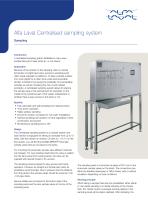
Alfa Laval Centralised sampling system Sampling Introduction A centralised sampling system facilitates in many ways sample taking from beer tanks (in- or out-doors). Application Because of the position of the sampling valve on vertical fermenters or bright beer tanks, access to sampling point often needs catwalks or platforms. To take a sample outdoor from such platforms is often done under less favourable climatic conditions thus giving the possibility of unacceptable samples as well as increasing the risk of work related accidents. A centralised sampling system allows for placing the sample valve at the optimal point for sampling: on the middle of the cylindrical part of the vessel, independent of whether there is easy access to this point or not. Benefits • • • • • Fully automatic and safe sampling from selected tanks “Fool proof” operation Highly sanitary sampling Economic solution compared to “cat-walk” installations Optimal sampling point position on tank regardless of tank construction and access • Simultaneous sampling and or CIP Design The Centralised sampling system is a modular system and each section is equipped for taking out samples from up to 12 tanks. See flow sketch on reverse. On tank no. 1 to 12 on the flow sketch, you will find the SCANDI BREW® Pneumatic sample valves that are mounted on the tanks. For mounting the pneumatic sample valve different methods are foreseen. For new stainless steel tanks the valve is welded into the tank wall and for existing tanks, the valve can be supplied with special thread to fit a socket. The sampling panel is placed for easy access and handy operation. However, as straight and simple pipe mains as possible is recommended. Due to pressure loss the distance from the panel to the sample valves should be maximum 100 –120 pipe metre. Service utilities are connected to the bottom side of the sampling panel and the tank sample valves to the top of the sampling panel. The sampling panel is connected via pipes of Ø10 mm to the pneumatic sample valves on the tanks. The connections can either be stainless steel pipes or Teflon hoses, with or without insulation, depending on local conditions. Working principle When taking a sample there are two possibilities; either sterile or non-sterile sampling. For sterile sampling of the chosen tank, the “sterile” button is pressed and the pipeline to the sampling panel will be steam sterilise
Open the catalog to page 1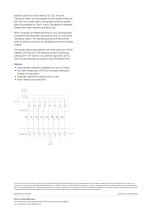
pipeline is blown dry with sterile air or CO2. Now the “sampling” button can be pressed and the sample media will flow from the chosen tank to the sample coil at the sample panel. By pressing the “flush” button, the pipeline is hereafter flushed with water, steamed and blown dry. When choosing non-sterile sampling for non-microbiological samples the first step after choosing the tank, is to press the “sampling” button. The sampling process will then be the same as above but without the sterilisation before the sample is taken. The sample valves and pipelines with other valves are CIP’ed together...
Open the catalog to page 2All Alfa Laval catalogs and technical brochures
 kyAlfa Laval LeviMag®
11 Pages
 PureSOx
12 Pages
 Alfa Laval Astepo TAF filler
4 Pages
 yAlfa Laval TJ40G
4 Pages
 Alfa Laval TJ20G
4 Pages
 Alfa Laval AS-H Coplastix®
2 Pages
 Heating and cooling systems
160 Pages
 Brazed plate heat exchanger
2 Pages
 Arctigo HRCD
2 Pages
 Heat exchangers
16 Pages
 Close at hand, spare parts, January 2016
2016 Pages
 LKH UltraPure US 875275
23 Pages
 Tri-Clover LKB UltraPure
7 Pages
 BDB 104
2 Pages
 Product overview
2 Pages
 SolidC Centrifugal Pump
2 Pages
 Pressosmart
4 Pages
 SolarTank
2 Pages
 Crushers and depitters
4 Pages
 OptiLobe Rotary Lobe Pump
4 Pages
 Unique SSV Standard
7 Pages
 Alfa Disc
2 Pages
 AC232DQ / ACH232DQ
2 Pages
 AC112 / ACH112
2 Pages
 ISC II
2 Pages
 AlfaBlue BXM/BXD
2 Pages
 AlfaBlue BCM/BCD & BNM/BND
2 Pages
 PureBallast 3.0
6 Pages
 Alfa Laval Olmi air cooler
2 Pages
 Alcap separation system
4 Pages
 Viscosity control system
4 Pages
 Pressurisation set
4 Pages
 KAB - Sludge filter
2 Pages
 AquaTank EM (7bar)
2 Pages
 Aquastore
4 Pages
 AquaProtect T
2 Pages
 Tank Cover
1 Page
 LKS 105 Tank Sight Glass
2 Pages
 LKFL In-line Sight Glass
2 Pages
 Weighing systems UltraPure
4 Pages
 Toftejorg Sanitary Rotacheck
2 Pages
 Potentiometric level transmitter
3 Pages
 Level switch
3 Pages
 Conductivity sensor
4 Pages
 Rotary jet mixer IM25
3 Pages
 Rotary jet mixer IM20
3 Pages
 PD Sheet - Rotary jet mixer IM10
3 Pages
 ViscoLine Regenerator Unit
4 Pages
 ViscoLine Multitube Unit
4 Pages
 ViscoLine MultiPass Unit
4 Pages
 ViscoLine Dynamic Unit
4 Pages
 ViscoLine Doubletube
2 Pages
 ViscoLine CIP Unit
2 Pages
 Viscoline Annular Unit
4 Pages
 Pharma-line
2 Pages
 Water cooled condensers
24 Pages
 X20 Application Brochure
12 Pages
 S_and_P_Flex_range
9 Pages
 PX 95 Disc stack centrifuge
2 Pages
 PX 80 Disc stack centrifuge
2 Pages
 PX 70 Disc stack centrifuge
2 Pages
 PX 65 Disc stack centrifuge
2 Pages
 PX 55 Disc stack centrifuge
2 Pages
 PX 110 Disc stack centrifuge
2 Pages
 Solids ejecting centrifuge
2 Pages
 BTPX Separator - BTPX 205
2 Pages
 Alfie500
2 Pages
 Alfapure2000
2 Pages
 AlfaPure Z7
2 Pages
 AlfaPure Z3
2 Pages
 SolidC UltraPure Centifugal Pump
4 Pages
 AlfaCond
2 Pages
 NF series
4 Pages
 FSM series
3 Pages
 Alfa Laval LabUnit M10
2 Pages
 FrontLine Plate Heat Exchanger
3 Pages
 Fuel Conditioning Module
4 Pages
 Lube oil filter T-160 range
4 Pages
 Lube oil filter
4 Pages
 ALF – Alfa Laval Filter
4 Pages
 Alfa Laval Heatpac® Heaters
4 Pages
 WS 40, 60
4 Pages
 WS 10, 20 ,30
4 Pages
 Stnx - decanter centrifuge
4 Pages
 SG2 700
2 Pages
 Foodec 800
4 Pages
 Foodec 600
2 Pages
 Foodec 500
4 Pages
 Foodec 400
4 Pages
 Foodec 300
2 Pages
 Foodec 200
2 Pages
 Foodec 100
2 Pages
 AlfaOliver 500
2 Pages
 ALDEC G2 – Smart Decanter
2 Pages
 WideGap 350
2 Pages
 WideGap 200
2 Pages
 TS6 Plate heat exchanger
2 Pages
 TS20 - Plate heat exchanger
2 Pages
 TL6
TL62 Pages
 TL35 - Plate heat exchanger
2 Pages
 TL3
TL32 Pages
 TL15
TL152 Pages
 TL10 - Plate heat exchanger
2 Pages
 T50 - Plate heat exchanger
2 Pages
 T5 - Plate heat exchanger
2 Pages
 T45 - Plate heat exchanger
2 Pages
 T20 - Plate heat exchanger
2 Pages
 T2 - Plate heat exchanger
2 Pages
 MX25 - Plate heat exchanger
2 Pages
 M6
M62 Pages
 M30 - Plate heat exchanger
2 Pages
 M3
M32 Pages
 M15
M152 Pages
 M10
M102 Pages
 PD leaflet: AlfaVap System
2 Pages
 AlfaNova 52 / AlfaNova HP 52
2 Pages
 AlfaNova 27 / AlfaNova HP 27
2 Pages
 AlfaNova 14
2 Pages
 Compact frame DOC
2 Pages
 CBXP52
2 Pages
 CB77
CB772 Pages
 CB60 / CBH60
2 Pages
 CB52 / CBH52
2 Pages
 CB400
CB4002 Pages
 CB300 / CBH300
2 Pages
 CB27 / CBH27
2 Pages
 CB200 / CBH200
2 Pages
 CB20
CB202 Pages
 CB18 / CBH18
2 Pages
 CB16 / CBH16
2 Pages
 CB14
CB142 Pages
 CB100 / CBH100
2 Pages
 AXP14 - Gas cooler
2 Pages
 AXP10
AXP102 Pages
 Brazed heat exchangers
16 Pages
 Spiral HE - General Brochure
16 Pages
 AlfaRex - TM20
2 Pages
 The hygienic condenser
2 Pages
 FK(G) - Gravity coils
2 Pages
 Top - Commercial unit cooler
2 Pages
 THOR - Industrial air cooler
2 Pages
 Airmax II DX - Unit cooler
2 Pages
 Centrifugal Unit Cooler ISC
2 Pages
 TYR - Industrial air cooler
2 Pages
 THOR - Industrial air cooler
2 Pages
 AlfaBlue - Power Dry Cooler
2 Pages




Archived catalogs
 AlfaBlast
2 Pages
 Alfa V- Air cooled condenser
2 Pages
 Solar Max G - Dry coolers
2 Pages
 Solar G - Dry coolers
2 Pages
 Solar - Air-cooled condensers
2 Pages


