

Casings and HRV Units

Casings and HRV Units
- Product Specifications: The document lists various products such as C4 casings, HRV units, and micro-watt fans designed to meet RT 2012 Thermal Regulations. It highlights the company's innovation in humidity-control units and modulated ventilation systems.
- Product Range: Detailed descriptions of different fan units, heat recovery ventilation units, and electrical accessories are provided, including specific models like the C4 Mono MINI-VEC and VEKITA+ in-line fan.
- Company Overview: Aldes is an international company with a strong presence in over 100 countries. It is committed to environmental protection and energy efficiency, participating in initiatives like the "Effinergie" energy efficiency label.
- Technical Resources: The Aldes Test Centre offers high-performance products and customized solutions, ensuring compliance with energy performance requirements.
- Software Tools: Aldes provides various software tools like Selector DFR and Windevis for product selection and project design, enhancing efficiency in controlling aeraulic ductwork systems.
- Services: Aldes offers diagnostic support, training programs, and maintenance services to ensure optimal system operation and indoor air quality.
- Global Presence: The document lists Aldes' subsidiaries and contact information across Europe, North America, the Middle East, and Asia, emphasizing its extensive sales network and international reach.
- E.60 - Pressure Limit Reached: The fan unit is at maximum capacity and cannot meet the requested pressure. Check if the requested pressure aligns with the fan's airflow-pressure curves and ensure ductwork is leak-tight.
- E.61 - Airflow Limit Reached: Similar to E.60, ensure requested airflow is within the fan's capacity and check for ductwork leaks.
- E.62 - Speed Limit Reached: Verify pressure levels and ductwork integrity as with previous errors.
- E.63 - Torque Limit Reached: Inspect for foreign objects or clogging in the impeller, ensure it is not rubbing against the casing, and check pressure levels and ductwork.
- E.88 - Button Failure: Release any blocked buttons to resolve adjustment issues.
All error codes disappear once the issue is resolved. For persistent problems, contact after-sales service with the identification number on the casing.
- Regular inspection and maintenance by a qualified provider are recommended.
- Access to components like the impeller and motor is facilitated by removable panels.
- Clean fan blades and internal parts regularly, at least annually, without using high-pressure or steam cleaning systems.
- Ensure the fan unit is correctly mounted and check for abnormal noises.
- List of spare parts includes motors, boards, connectors, impellers, pressure sensors, proximity switches, and inductors, with specific part numbers for different models.
- Three-phase C4 exhaust fan units with airflow up to 12,000 m3/h, compliant with French standard NF XP P50-410.
- Construction includes galvanized steel casing, anti-vibration mountings, and adjustable pulley/belt drive systems.
- Various models with different airflow ranges and codes, with options for pressure switches.
- Asynchronous motors with IP 55 protection, three-phase 230/400 V, and built-in thermal protection relay.
- Details on motor speed, power, impeller speed, and maximum power consumption for different models.
- Sound levels measured according to ISO standards, with specific dB levels for different models and conditions.
- Airflow curves established per EN ISO 5801, with static pressure and power consumption details.
- Airflow and Pressure: Airflow curves are established according to French Standard EN ISO 5801. Static pressure (P) is measured in Pascals (Pa) and power consumption (P) in Watts (W).
- Electrical Specifications: The standard power supply is 400V three-phase, 50 Hz. Motors include a thermal probe for fault indication.
- Construction: InoVEC micro-watt models feature galvanised metal casings with vertical or horizontal discharges, motorised fan units, and anti-vibration mountings.
- Airflow Regulation: VEC units have a variable diameter drive pulley for speed adjustment. Factory settings are at a median position.
- Electrical Connection: Single-phase power supply is 230V, 50 or 60 Hz. The InoVEC 12000 model requires a three-phase 400V supply.
- Installation Guidelines: Follow NF P 50-411-1 (DTU 68.2) standards. Ensure proper electrical protection and check belt tension after initial operation.
- Energy Efficiency: InoVEC micro-watt systems can save up to 75% in electricity compared to standard VEC units.
- Acoustic Quality: Reduced airflow results in lower noise levels, improving acoustic performance.
- Application: Suitable for new and renovated multi-family housing and commercial residential buildings.
The document provides detailed specifications for various VIK fan units, including models VIK 4000, 5000, 7000, 8500, and 12000. Each model is available in 1-speed and 2-speed versions, with varying motor powers and dimensions. The fan units are designed for air exhaust and supply in commercial and industrial premises, with options for indoor and outdoor installation.
Installation and Settings:
Important safety instructions are provided, such as cutting power before servicing. The power supply voltage options are 230 V single-phase or 400 V three-phase. The document also includes checks for power-up and rotation direction adjustments.
Field of Application:
The VIK micro-watt units are suitable for air exhaust and supply up to 12000 m3/h, targeting medium to large commercial and industrial premises. They can be installed both indoors and outdoors, and are suitable for new and retrofit applications.
Description:
The casing is made of sheet metal with circular connections and includes a pre-wired electronics box. The fan is belt-driven and mounted on slide rails with anti-vibration mountings. Optional filters (G4 or F5) can be pre-fitted.
Electrical Details:
The fan units use asynchronous motors with IP 55 protection and class F insulation. They are available in single-phase and three-phase power supply options, with integrated thermal protection.
Standards Compliance:
The units comply with CEE: BAT-TH12 standards, emphasizing low energy consumption and optional integrated filters.
Airflow and Acoustic Details:
Airflow curves are provided according to French Standard EN ISO 5801, detailing sound pressure and power levels, static pressure, and power consumption.
Options Available:
Various options are available, including different filters, epoxy casing finishes, and accessories like protective visors and circuit breakers.
TVEC GI In-line Casing:
The TVEC units are designed for air exhaust or supply, with options for 1-speed or 2-speed motors and various installation configurations. They comply with fire regulations and are suitable for commercial premises.
Fan Motor and Filter Details:
Different motor versions (A, B, AB) are available, with specific impeller diameters and rotation speeds. The units include built-in thermal protection and are designed for easy disassembly and maintenance.
Options:
Heat insulation and pre-heating casings are available for air supply ventilation, with electric and hot water coil options for pre-heating.
The document outlines specifications for electric coils and fan units. It details power ratings, stages, and wiring configurations for single-phase 230 V and three-phase 380 V systems. Electric coil C is available in power ratings of 3.8 kW, 8 kW, and 16 kW, with corresponding water flow rates and pressure drops.
Aeraulic and Acoustic Details:
Aeraulic properties of T.VEC fan units are presented, including pressure increase at the fan unit inlet based on airflow. The document notes that pressure losses due to filters or preheating coils must be subtracted from the curve values. Acoustic details include sound pressure levels and corrective coefficients for sound power levels across different frequency bands.
Accessories:
Accessories such as flexible sleeves and silencers are recommended to reduce vibrations and noise. The document provides specifications for these accessories, including dimensions and materials.
Implementation:
Installation guidelines for T.VEC fan units are provided, emphasizing the importance of proper clearance and weather protection. Instructions for wall and ceiling installations are detailed, including the use of mounting braces and wall brackets.
Electrical Accessories:
The document describes protective boxes and control panels for fan units, highlighting the need for proper electrical connections and slaving of components. It also mentions the availability of electrical cabinets for control and regulation functions.
Servicing Advice:
Recommended servicing frequencies for filters, fans, and coils are outlined, along with spare parts information. The document emphasizes the importance of regular maintenance to ensure optimal performance.
TVEC GII Description:
The TVEC GII fan unit is described as suitable for exhaust and air supply applications, with features like galvanized steel casing, adjustable feet, and a robust design. It supports various motor options and arrangements for different airflow requirements.
Options and Accessories:
A range of options and accessories for TVEC GII units are listed, including motor options, proximity switches, and pressure switches. The document provides codes for ordering these components.
The document provides detailed specifications for various electrical components and fan units, including circuit breakers, autotransformers, frequency controllers, and TVEC fan units. Each component is listed with its model number, power ratings, and specific features.
Procedures:
Installation and servicing instructions are provided for the TVEC GII fan units, including airflow regulation and electrical connection guidelines. The document emphasizes the importance of proper installation to avoid overheating and ensure optimal performance.
Standards and Compliance:
The document references compliance with ISO standards for sound levels and airflow measurements, ensuring that the products meet international quality and safety standards.
Recommendations:
Recommendations include operating autotransformers within a specific range to prevent motor overheating and installing frequency controllers indoors to protect them from weather conditions.
Dimensions and Weight:
Detailed dimensions and weight specifications are provided for the TVEC fan units, facilitating proper planning and installation.
Acoustic and Aeraulic Details:
The document includes acoustic details such as sound power levels and pressure levels for different TVEC models, ensuring users can select units based on noise requirements.
Electrical Details:
Information on motor types, power supply requirements, and thermal protection features are outlined for the fan units, ensuring compatibility with existing electrical systems.
Spare Parts:
A comprehensive list of spare parts for the TVEC fan units is provided, including motor types, pulleys, belts, and other components, ensuring easy maintenance and repair.
Field of Application:
The document outlines the suitable applications for the TVEC units, such as air supply or exhaust in various settings, highlighting their versatility and adaptability.
Advantages:
Key advantages of the TVEC units include low energy consumption, modular design, silent operation, and ease of integration, making them suitable for a wide range of applications.
The installation must comply with NF-C 15-100 standards. A proximity switch should be installed for maintenance purposes. It is crucial to consult the installation notice provided with the product and carefully read all recommendations and precautions.
- Annual maintenance includes removing dust from fan blades and internal components to prevent imbalance and wear on bearings.
- Avoid using high-pressure sprays or steam washes for cleaning the fan unit and motor.
- Ensure the motor is correctly mounted and check for abnormal noises.
- The motors are pre-lubricated for their service life and require no specific servicing.
- The document details various models of HRV fan units, including DFE, DFS, and DFR models, with airflow capacities ranging from 0 to 15,000 m3/h.
- Units are available in compact and modular designs with 25 mm double-skin insulation, and some versions include bypass and regulation options.
- Heat exchangers are available in cross-flow, rotary, and counter-flow types, with efficiencies up to 92%.
- Units can be installed indoors or outdoors, with options for horizontal or vertical configurations.
- They feature aluminium structures with removable panels, direct drive fans, and integrated motor protection.
- Models are equipped with G4 and F7 filters, condensate collection trays, and interchangeable panels for adaptable pipe connections.
- Electrical details include single-phase motors with various power ratings and integrated electric or hot water heating coils.
- Acoustic specifications are provided, detailing sound levels at different frequencies and speeds.
- Available accessories include spare filters, circular silencers, rain hoods, and various coil options.
- Regulation options include BA Pilot and BMS Pilot, available on request.
The document outlines specifications for high-efficiency HRV fan units, including DFe compact micro-watt and DFe+ micro-watt models. Airflow curves are established according to French Standard EN ISO 5801, with details on sound pressure levels, static pressure, and power consumption.
Installation:
Units are designed for horizontal installation in technical ceilings with provisions for condensate discharge. Sufficient clearance is required for maintenance access. Vertical installation is also possible for certain models, with specific clearance requirements.
Servicing:
Regular servicing is essential for optimal operation. Filters, fans, and heat exchangers are accessible via removable panels. Filters should be cleaned monthly and replaced annually if necessary.
Field of Application:
HRV ventilation is intended for low-energy commercial buildings, with features for filtration and preheating of blown air. Units can be installed indoors or outdoors, with heat-insulated ductwork and condensate discharge.
Description:
The DFE+ models offer plug-and-play pre-cabled units with a casing structure made of extruded and anodised aluminium. They include high-efficiency counterflow heat exchangers, centrifugal fans with EC motors, and full regulation options. Various models support different maximum airflows, with options for communication via ModBus RTU protocol.
Electrical Details:
Units are powered by EC motors with single-phase or three-phase power supply, depending on the model. Selection software is available to specify full performance details.
Options and Accessories:
Various options are available, including remote control, ModBus communication, rain covers, motorised dampers, and flexible sleeves. Accessories include pressure sensor kits, remote controls, and spare filter kits.
Technical Details:
Details on dimensions, weight, and heat exchangers are provided for each model. Acoustic details comply with ISO standards, with sound power levels specified for different frequencies.
Advantages and Standards Compliance:
Units feature high-efficiency heat exchangers, micro-watt motors, and are eligible for CEE standards. They offer 100% free-cooling and optional integrated coils.
The document describes the DFE+ TOP models, which are high-efficiency heat recovery ventilation (HRV) units. These units are available in four models with airflow capacities up to 2000 m3/h. They feature a plug-and-play design with a casing made of extruded and anodized aluminum, and double-wall panels. The units include a high-efficiency counterflow heat exchanger with over 90% efficiency, centrifugal fans with EC motors, and full regulation capabilities including constant airflow, constant pressure, and 0-10V signal control. Additional features include a built-in timer switch, automatic bypass, and various filter options.
The DFE+ TOP units come in different models, each with specific dimensions and weights. Optional features include communication with BMS via ModBus RTU protocol, various control options, and additional accessories like motorized dampers and flexible sleeves. The units can also be equipped with post-heating coils and frost-protection coils.
The document provides detailed technical specifications for each model, including airflow rates, power consumption, and heat exchanger efficiency. It also outlines the electrical requirements for connecting the units and optional coils. The units are designed for minimal floor occupation and offer free-cooling capabilities.
Regular servicing is essential for optimal operation. The document recommends inspections every three months to check for alarms, filter conditions, and internal cleanliness. Annual maintenance includes cleaning the condensate tray and bypass, servicing the fans, and checking the airtight seals.
The document describes additional heating or cooling coils that can be integrated with the DFE+ units. These coils are available in various models and are designed to control the temperature of the air supplied to the room. Installation can be indoors or outdoors, and the coils require specific accessories for regulation.
- DFE 450 to DFE 2000 models with varying power outputs and temperature regimes.
- Performance metrics such as power (kW), delta temperature (°C), air pressure loss (Pa), water flow (l/h), and water pressure loss (kPa).
- Fan unit control in multiple modes and automatic management of time periods and bypass for free cooling.
- Frost protection and regulation of pre-heating and post-heating coils.
- Communication capabilities with building management systems (BMS) via Modbus and TCP/IP protocols.
- CA mode for constant airflow regulation.
- LS mode for airflow regulation via a 0-10 V signal.
- CPs mode for pressure regulation on air supply and exhaust.
- Free cooling with 100% bypass based on temperature conditions.
- BOOST function to prioritize airflow settings.
- Automatic management of motorized dampers and frost protection mechanisms.
- Heating and Cooling Coils: The document describes the built-in electrical and hot water coils for pre-heating and post-heating, including their regulation mechanisms and frost protection features.
- External Coils: Options for regulating external coils such as hot water, cold water, and electric coils are available, with detailed regulation functions provided by the TAC4 system.
- Fan Units: The DFR range includes models like DFR micro-watt, DFR Top micro-watt, and DFR Flex micro-watt, all EUROVENT certified. These units are designed for energy-efficient commercial buildings.
- Operation Modes: The document outlines various operational modes, including an OFF mode that stops the unit and requires toggling to restart.
- Alarm Management: The TAC4 regulation system includes 14 types of alarms, each with specific triggers and required actions, such as RESET procedures for certain alarms.
- Electrical Connections: Instructions for connecting fan units and regulation power sources are provided, emphasizing factory-installed connections and the need to connect the main switch.
- Dimensions and Weight: Detailed dimensions and weight specifications for different DFR models are included, along with recommendations for installation clearances.
- Maintenance: Regular maintenance is advised, with specific alarms indicating when service is required.
- Configuration: Advanced configuration options are available for adjusting temperature set points and managing alarm settings.
1. Filter Protection: Various manometers are used for filter protection, including U-shape, Kytölä, and Magnehelic types, each with specific measurement ranges.
2. Manometer Type Airflow Meter: Used for airflow measurement with specific dimensions and protection ratings.
3. Rotary Heat Exchanger: Utilizes air-air principle with models like NO, HY, NP, and HP, each offering different efficiencies and features like hygroscopic properties and variable speed regulation.
4. Coils: Hot water and electric coils are available, with specifications for pressure, materials, and safety features.
Procedures:
1. Installation: Units can be installed indoors or outdoors, with specific instructions for connection and regulation.
2. Blow Cleaning and Leak Flow Rates: Procedures for maintaining airflow and preventing exhaust air contamination.
Standards and Norms:
1. Temperature and Pressure: Admissible ranges for dampers and coils, ensuring safety and efficiency.
2. Leak Tightness: Classifications for different damper types to ensure minimal leakage.
Recommendations:
1. Use of Accessories: Includes motorized dampers, silencers, and coils for optimal thermal and acoustic comfort.
2. Energy Efficiency: Emphasis on high-efficiency heat exchangers and energy-saving motors.
Data Summary:
1. Model Sizes and Capacities: Detailed specifications for different model sizes, including power, dimensions, and recommended fuses.
2. Thermal Efficiency Graphs: Illustrate efficiency rates for different airflow rates and rotor types.
Critical Information:
1. Safety Features: Includes double protection against overheating and specific installation requirements for safety switches.
2. Component Materials: Use of corrosion-resistant materials and specific construction details for durability and performance.
- Air Recovery Unit (EBE): Designed for air recirculation during night heating. Features include aluminum dampers, ABS toothed wheel actuation, silicone rubber gaskets, and compliance with C4 corrosion class. Operational temperature range is -40°C to +80°C, with a maximum pressure differential of 1400 Pa.
- Damper Components: EMT-01 and ESET-TR dampers are used for shut-off and regulation, featuring aluminum blades and ABS toothed wheels. They meet leak tight class 3 standards and operate within the same temperature and pressure ranges as the air recovery unit.
- Heating and Cooling Coils: Hot and cold water coils (ESET-VV, ESET-TV, ESET-VK) are made of galvanized steel with copper pipes and aluminum blades. They have specific service pressures and connection requirements.
- Electric Air Heater (ESET-EV): Features stainless steel tube elements, double temperature protection, and requires a separate power supply. It has an IP 43 protection rating.
- Model sizes range from DFR Flex 3000 to DFR Flex 15000, with varying dimensions and weights for each component type.
- Specific dimensions and weights are provided for each model size across different components, including dampers, coils, and silencers.
- Includes filter equipment (MIE-FB/FC), coil equipment (MIE-CL), and silencer equipment (MIE-KL). Each type has specific installation requirements and options for customization based on the application.
- Filter equipment supports various filter types, including synthetic, bag, and charcoal filters, with easy replacement features.
- Coil equipment is available for both water and electric heating/cooling, with specific pressure and connection standards.
- Ensure proper installation of dampers and coils to maintain operational efficiency and safety.
- Regular maintenance and inspection of filters and coils are recommended to ensure optimal performance.
- Follow specific installation guidelines for each component to ensure compliance with safety and operational standards.
- ELEV: 150°C
- ELTV: 100°C
Note: These specifications do not apply to size 100 in power variants 00 and 01.
Various models of the dFR Flex series are listed with their respective dimensions and weights. The dimensions are provided for different module sizes and configurations, indicating the flexibility and scalability of the units.
The document details various functional equipment and accessories available for the dFR Flex series, including air inlet valves, drain valves, and electric coils. The electric coil (ELEE) is designed for high temperatures and includes built-in power regulation equipment with stainless steel tube elements for heating.
Each model size has specific electrical requirements, including minimum airflow, total power, and rated current at 3 × 400 V AC 50 Hz. This section provides detailed power consumption and electrical specifications for each model.
The document includes specifications for silencers, which are designed to minimize pressure loss and provide sound attenuation across various octave bands. The silencers are available in different lengths to meet specific sound attenuation requirements.
A range of accessories is available for the dFR Flex series, including filter protection manometers, siphons, and pre-filters for outside air. These accessories enhance the functionality and efficiency of the units.
Instructions for wiring and safety switches are provided for units equipped with control devices. Electrical diagrams are available for detailed guidance on the control device setup.
The document outlines various models of DFR Flex fan units, detailing their power supply requirements, recommended fuses, and technical specifications. Models range from DFR Flex 3000 to DFR Flex 15000, with power variants and corresponding fuse ratings provided for each.
Procedures:
Wiring instructions are provided for devices without control units, including connection diagrams for different power supplies (1×230V and 3×400V). The document also includes instructions for positioning control cabinets and safety switches.
Standards and Ambient Conditions:
Equipment with factory-fitted control devices bears the CE mark. The ambient temperature for operation should be between -25°C and +55°C.
Regulation Functions:
The fan units are equipped with Siemens Climatix regulation for optimizing airflow and temperature. The regulation functions include temperature regulation, energy optimization (ECO-1 and ECO-2), and pressure regulation of fresh and exhaust air. The system can communicate using various protocols, including ModBus RTU, TCP/IP, BACnet, and more.
Communication and Control Equipment:
The fan units can communicate using ModBus RTU RS-484 and TCP/IP protocols. Optional communication protocols include BACnet, LonWorks, OPC, and SMS alarms via GSM modem. The control device can regulate up to four different zones with different smoke/fire functions.
Airflow and Pressure Regulation:
The document details methods for maintaining constant pressure and airflow in fresh and exhaust air ducts using pressure sensors and fan speed regulation. It also covers air quality inspection using CO2 sensors and various room regulation alternatives.
Recommendations:
For electric condenser coils, recommended fuses are provided. The document advises on the use of safety switches and the importance of maintaining ambient conditions for optimal operation.
- IP 54 box construction for electrical machines.
- Equipped with auxiliary NO and NF contacts for three-phase models.
Advantages
- Compatible with single-phase or three-phase fan units, both single-speed and dual-speed.
Proximity Switches
- Various models available for different power ratings and configurations, including single-phase and three-phase options.
- Dimensions and codes provided for each model.
Thermal-Magnetic Circuit Breakers
- Applicable to all fan units or roof fans.
- Provides protection against phase faults with a variable intensity range.
- Surface-mounted installation with IP 55 box and two cable glands.
- Lockable and can perform proximity switch functions.
- Range includes various current ratings with specific codes for each.
Pressure Switches
- Safety devices for detecting pressure drops in fan units or ductwork.
- Supplied as a complete kit ready for installation.
- Includes time delay feature from 0.3 to 3 seconds.
Casings and Fan Units
- Over 6,000,000 homes equipped with air management solutions.
- Includes humidity-control units and modulated ventilation systems.
- Micro-watt fans designed to meet RT 2012 Thermal Regulations.
- Heat Recovery Ventilation (HRV) units available for residential and commercial use.
Catalog excerpts

COMPULSOR Casings and HRV units COMPULSOR Casings and HRV units C4 casings Air Exhaust / Supply casings Fan units without casings Heat Recovery Ventilation Units VC 101,278 - RCS Lyon (company registered under the no.) 956 506 828 - Hautefeuille
Open the catalog to page 1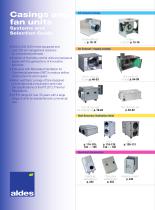
Systems and Selection Guide C4 Mono C-VEC unit p. 13-16 C4 Mono MINI-VEC unit p. 10-12 • Over 6,000,000 homes equipped and over 200 air management solutions for commercial premises. • Inventor of Humidity-control units and perpetual leader with ve generations of innovative products. • Precursor with Modulated Ventilation for Commercial premises (VMT) to reduce airow when a room is unoccupied. • Micro-watt fans: a range of fans designed to limit electrical consumption and meet the specications of the RT 2012 Thermal Regulations. • A HRV range for over 30 years with a large range of units for residential...
Open the catalog to page 2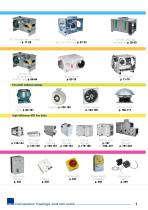
C4 C.VEC micro-watt+ low-energy unit p. 17-26 C4 inoVEC micro-watt low-energy unit p. 35-35 VIK micro-watt low energy in-line fan unit in casing p. 60-64 Fan units without casings THELIA roof fans p. 106-111 High Efficiency HRV Fan Units Compulsor Casings and fan units Thermal-magnetic circuit breaker p. 248 Alarm pressure switch p. 249
Open the catalog to page 3
A sales network at your service Agencies Aldes Bordeaux The Aldes Sales network employs 200 people and boasts 18 sales agencies, storage warehouses and 6 regional distribution hubs. Aldes Nantes Aldes Clermont Aldes Nice Aldes Grenoble ZAC des Ruires - Secteur A 1, rue Irène Joliot Curie - 38320 Eybens Tel. +33 (0)4 76 14 74 50 - Fax +33 (0)4 76 25 26 33 Departments: 38-73-74 Aldes Lille Rue Jean Monnet - ZA du Grand Logis - Lompret 59840 Pérenchies Tel. +33 (0)3 20 22 40 42 - Fax +33 (0)3 20 22 28 79 Departments: 02-08-10-51-59-62-80 Aldes Montpellier Central Warehouse in Mions (69) • National...
Open the catalog to page 4
Aldes without borders. There is a universal need to breathe air of high quality and the requirement for high energy performance in buildings is equally important. Therefore, Aldes uses its vast sales network to export its know-how to more than 100 countries in Europe, the Middle East/Indian Ocean, Asia and America. In total, there are over one thousand employees who are part of the Aldes success story all over the world. Aldes subsidiaries From single and multi-family housing to commercial premises, Aldes excels in five business activities: • Ventilation • Heating/Cooling • DHW • Aeraulic ductwork...
Open the catalog to page 5
Be more efficient with Aldes software. With solutions that have been developed specifically for each player in the building industry, Aldes offers tools that help you to be more efficient in controlling the parameters for aeraulic ductwork systems. For further information, contact your nearest Aldes agency (see p. 2) Selection software for heat recovery units DFR range • election of the type of heat recovery unit. S • omplete configuration. C • ccess to all technical data. A • erformance calculation. P Helps with the design of air distribution systems in small and medium sized commercial...
Open the catalog to page 6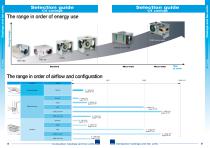
Selection guide C4 casings The range in order of energy use Energy savings Selection guide CVEC micro-watt+ InoVEC micro-watt The range in order of airflow and configuration 0 Installation CVEC Equipment room CVEC mw+ RH Mini VEC CVEC Outdoors Technical ceiling Compulsor Casings and fan units Compulsor Casings and fan units
Open the catalog to page 7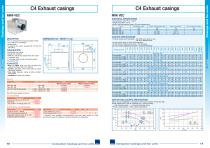
MINI VEC Electrical specifications • synchronous motor IP 44 - class F. A • ingle phase 230V - 50 Hz. S • uilt-in thermal protection relay (PTO) with exposed wires. B Type Ø Impeller (mm) Power consumption (W) Mini VEC 160 160 125 Mini VEC 180 180 170 Mini VEC 160 AB 160 80 / 200 Mini VEC 180 AB 180 90 / 240 Designation Circuit breaker 0.4 to 0.6 A Circuit breaker 0.63 to 1.0 A * Compliant with COPREC recommendations The time delay serves to avoid shut-downs caused by variations in pressure resulting from wind gusts. Airflow curves established in accordance with French Standard NF EN ISO 5801....
Open the catalog to page 8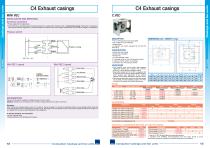
C4 Exhaust casings C.VEC INSTALLATION AND SERVICING Electrical connection • ower supply 230 V single-phase. P • he motors have a thermal probe with exposed wires (red or orange) which indicate a fault. In multi-family housing, if this probe is connected, it T must only be used as a signal and in no event be used to cut off the motor power supply, otherwise the unit will lose its category 4 classification. Pressure switch Description • For C4 exhaust fans except dual speed. • Up to 2500 m3/h (15 dwellings). • Single-phase. • Compliant with French standard NF XP P50-410 (DTU 68-1). G alvanised...
Open the catalog to page 9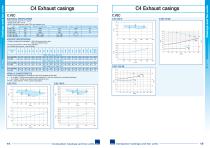
Electrical specifications • Asynchronous motor IP 44 - class B. • Single phase 230V - 50 Hz. • Built-in thermal protection relay (PTO) with exposed wires. Ø Impeller (mm) 180 241 270 180 241 Aeraulic characteristics A irflow curves established in accordance with French Standard EN ISO 5801. = Lp in dB(A) – Overall sound pressure levels measured 4 m from fan casing with unconnected discharge. = Lw in dB(A) – Overall sound power levels measured in duct. P (Pa) = static pressure - P (W) = power consumption. • Criteria complying with standards: ISO 5136 sound levels in duct, - ISO 3741 radiated sound....
Open the catalog to page 10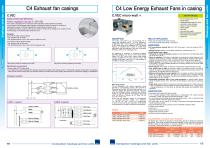
INSTALLATION AND SERVICING Airflow regulation (except C. VEC AB) • C4 fire protection rating - Ø 160. • Energy savings. • Single-phase power supply 50 or 60 Hz. • Horizontal or vertical discharge. • Choice of 3 types of regulation. • Airflow readout. • Short ROI. • Low sound level at grille • Minimum intervention and easy adjustment. • Overvoltage & surge protection. • Expert level. The C.VEC is equipped with an exclusive airflow regulation system (patented by Aldes). A flap located in the discharge outlet regulates the pressure inside the casing by recycling air. Adjusting the position of the...
Open the catalog to page 11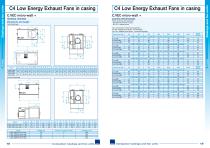
C.VEC micro-watt + Acoustic specifications Criteria complying with standards: - ISO 5136 sound levels in ducts, - ISO 3741 radiated sound. Lwc: sound power in ducts during aspiration. Lwr free: radiated sound power - free discharge. Lwr Conn: radiated sound power - connected discharge. C.VEC 1000 micro-watt + C.VEC 2500 micro-watt + Model C.VEC 1000 micro-watt + C.VEC 2500 micro-watt + Model CVEC 1000 RV micro-watt + C.VEC 1000 RH micro-watt + C.VEC 2500 RV micro-watt + C.VEC 2500 RH micro-watt + Number of aspiration inlets 2 1 2 1 Compulsor Casings and fan units Compulsor Casings and fan units...
Open the catalog to page 12All Aldes catalogs and technical brochures
 Air Distribution
229 Pages
 Air Diffusion
270 Pages
 General catalogue Aldes
580 Pages
Archived catalogs
 Fire Protection
176 Pages
 Fire Dampers
48 Pages
 Air Diffusion Compulsor
270 Pages
 Air inlets
32 Pages
 Axpir range
12 Pages
 Axpirtech
12 Pages

