1. Catalogs
  2. Aldes
  3. Air Distribution

Air Distribution

Air Distribution
1 / 229 PagesView full catalog

Air Distribution

Product catalog summary
Overview
Aldes, a prominent French manufacturer, offers a wide range of circular ductwork solutions, including galvanised steel, aluminium, stainless steel, and insulated options. The catalogue details the advantages, production, storage, and installation of these products.
Specifications
The ductwork is available in various materials and diameters, with galvanised steel ranging from 80 mm to 1250 mm. Products comply with European standards like EN 15-06 and EN 12337, ensuring quality and performance.
Advantages of Circular Ductwork
Circular ductwork is preferred for its lower pressure losses, reduced leakage, better acoustics, and easier maintenance compared to rectangular ductwork. It also offers cost advantages in supply and installation.
Production and Storage
Aldes operates multiple production sites and warehouses across France, adhering to ISO 9001-2000 standards for high-quality raw materials and consistent product quality.
Installation Guidelines
Installation involves simple interlocking of ducts and accessories, with mechanical fastening using screws or rivets. Airtight seals are achieved using accessories with seals or appropriate sealants, complying with EN 12097 standards.
Standards and Regulations
The products meet standards such as EN 15-06 for sizing and EN 12337 for material thickness. Materials are classified as A1 for fire resistance, ensuring safety and compliance.
Pressure Loss and Equivalences
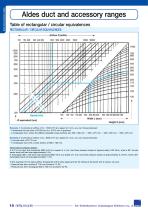
Tables for pressure loss calculations and equivalences between circular and rectangular ducts aid in selecting appropriate duct sizes for specific airflow requirements.
Corrosion Resistance
Galvanised steel offers strong resistance to atmospheric corrosion but is sensitive to acidic and saline environments. The zinc coating's thickness and regularity are crucial for maintaining corrosion resistance.
Field of Application
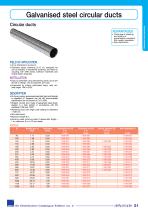
The ductwork is suitable for all air distribution systems, particularly in residential buildings, and is designed for easy assembly with interlocking parts, complying with EN standards 1506 and 12237.
Installation
The ducts are easy to assemble using interlocking parts, supported by collars, perforated strips, and rails. They are non-oiled and have a maximum length of 6 meters.
Range and Codes
The document lists various duct sizes, weights, thicknesses, and corresponding product codes for standard and non-standard lengths.
Accessories
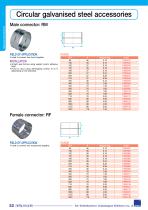
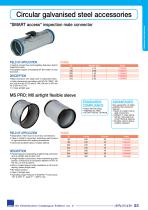
Details on various accessories such as connectors, inspection connectors, flexible sleeves, and bends with their respective specifications and codes.
Advantages
The ductwork offers uniform quality of galvanisation, non-oiled ducts, and compliance with quality standards. The new generation of patented fan-ductwork sleeves is quick to install, airtight, and durable.
Standards Compliance
The ductwork and accessories comply with Class M0 fire rating and other relevant standards, ensuring safety and performance.
Corrosion Resistance
The document provides a chart showing the thickness of galvanisation coating and its years of protection against rust in different atmospheres.
Field of Application
The accessories are designed for connecting ducts in air distribution systems, ensuring leak-free installations with minimal pressure loss.
Installation
Installation is facilitated by interlocking parts, with ducts being female and accessories male. The document emphasizes easy assembly and the importance of using silicone sealant for airtight seals.
Standards Compliance
The products comply with French technical reports and DTU regulations, ensuring they meet acoustic and pressure loss requirements.
Advantages
Key advantages include space-saving designs, fewer ducts needed, and patented products. The connectors are designed to ensure efficient air distribution while maintaining acoustic regulation requirements.
Servicing
Servicing involves using a chemical product like Réseanet, a biodegradable, non-corrosive detergent with high grease-removal properties.
Recommendations
It is recommended to use specific connectors for different applications to ensure optimal performance and compliance with regulations.
Technical Document Summary
1. Specifications
  • The document provides detailed specifications for oblong ductwork made from galvanized steel, including dimensions, thickness, and weight per meter.
  • Various sizes are listed, such as 360 x 80 mm with a thickness of 0.60 mm and a weight of 4.30 kg per meter.
2. Field of Application
  • These ducts are designed for air distribution systems requiring high airflow in reduced spaces, such as suspended ceilings.
  • They can also be used for visible, decorative ductwork.
3. Installation
  • The ducts are easy to assemble using interlocking parts, with ducts being female and accessories male.
  • Support is provided by collars, strips with holes, and rails.
4. Range and Accessories
  • The document lists a range of oblong ducts and accessories, including horizontal and vertical bends, concentric reducers, and tangent reducers.
  • Each accessory type is detailed with dimensions, radius, weight, and product codes.
5. Key Data from Tables
  • Tables provide specific measurements for each duct and accessory, such as length, height, radius, and weight.
  • Product codes are provided for easy identification and ordering.
6. Recommendations
  • For installations where no height reduction is needed, an RCO (Oblong Concentric Reducer) is recommended.
Overview This document is an air distribution catalogue focusing on galvanized steel and aluminum ductwork, detailing various accessories and components used in ventilation systems. It includes specifications, field applications, installation guidelines, and product ranges for different types of connectors, dampers, and ducts.
Galvanized Steel Ductwork
  • Oblong Accessories Includes circular 90° and oblique branch connectors, oblong 90° branch connectors on flat sections, and balancing dampers. Each section provides field applications, installation warnings about pressure losses, noise, and leaks, and detailed product ranges with dimensions and codes.
  • Oblong Male Plug Used to close oblong ductwork, featuring easy assembly with interlocking parts.
  • Oblong Ring Mounting Connects oblong ductwork to rectangular Isone fire dampers, with specific dimensions and codes provided.
Aluminum Ductwork
  • General Information Aluminum ducts are suitable for gas CMEV and saline environments, with a temperature rating of 200°C continuous and 300°C peak. They offer excellent corrosion resistance and comply with EN 15-06 standards.
  • Aluminum Circular Ducts Available in diameters from 100 mm to 630 mm, made of 1050A-H18 aluminum. They are easy to assemble with interlocking parts and supported by various mounting options.
  • Aluminum Circular Accessories Includes connectors, bends (30°, 45°, 60°, 90°), and reducers. Each accessory is detailed with field applications, descriptions, and product ranges with dimensions and codes.
Installation and Standards The document emphasizes the importance of proper installation to avoid pressure losses, noise, and leaks. It also highlights compliance with relevant standards and regulations, ensuring the products meet safety and performance requirements.
Overview This document is an air distribution catalogue focusing on aluminium ductwork accessories. It includes specifications for various connectors and branch pieces used in duct systems, emphasizing ease of installation and performance efficiency.
Concentric Conical Reducing Connector (RCC)
  • Used to connect ducts of different diameters.
  • Easy assembly with interlocking parts; ducts are female, accessories are male.
  • Specifications include diameter, height, and weight for various models.
Offset Conical Reducing Connector (RCE)
  • Similar application as RCC, connecting ducts of different diameters.
  • Specifications provided for different sizes, focusing on weight and dimensions.
Concentric Flat Reducer (RPC)
  • Connects ducts with different diameters using a flat design.
  • Specifications include diameter, height, and weight.
Offset Flat Reducer (RPE)
  • Used for connecting ducts at different diameters with an offset design.
  • Specifications focus on dimensions and weight.
Standard CRE Multiple-Branch Piece
  • Connects up to four branches to a header, ensuring leak-free installation.
  • Recommended for gas CMEV systems for airtight seals.
  • Specifications include weight and dimensions for various configurations.
Chimney T-piece: CP and CP2A
  • Designed for headers opening into attics or roofs, compliant with DTU 68-2.
  • CP2A version offers reduced pressure loss and noise attenuation.
  • Specifications include acoustic and aeraulic performance details.
90° T-piece Branch Connector (TE 90°)
  • Connects two ducts at a 90° angle, ensuring leak-free installation.
  • Specifications include dimensions and weight for various sizes.
Technical Details
  • Focus on ease of installation, performance efficiency, and compliance with industry standards.
  • Emphasis on reducing pressure loss and noise in duct systems.
Overview This document is a technical catalogue for aluminium circular accessories used in air distribution systems. It includes specifications, field of application, installation procedures, and product ranges for various ductwork components.
1. Specifications and Product Range
  • 45° Branch Connector Used to connect two aluminium ducts at a 45° angle, ensuring leak-free installation with minimal pressure loss. Easy assembly with interlocking parts.
  • Square Cross CXE Diverts a duct to three branches at 90° angles. Ensures leak-free connections and easy assembly.
  • Oblique Cross Piece CXO Diverts a duct to three branches at 45° angles. Similar installation benefits as other connectors.
  • Y-piece CS 90° and CS 180° Facilitates the confluence of ductwork branches at 90° and 180°, respectively, with limited pressure loss.
  • Flat 90° Branch Connector PEP Used on flat duct sections, with caution advised for potential pressure losses and noise.
  • Circular 90° Branch Connector PEC Similar application as the flat connector, with emphasis on careful installation.
  • Circular Oblique Branch Connector POC 45° connector on circular ducts, with installation considerations for pressure and noise.
  • Damper RG and RGP Perforated Damper Provides pressure regulation in ductwork, with specific use limitations and temperature constraints.
  • Male-Female Plug BMF Used to close ducts or accessories, with options for condensate drainage in gas systems.
2. Installation and Standards
  • All accessories are designed for easy assembly using interlocking parts, with ducts being female and accessories male.
  • Installation guidelines emphasize the importance of avoiding pressure losses, noise, and leaks.
  • Products comply with relevant standards, ensuring compatibility and performance in specified applications.
3. 3CE System
  • Designed for collective evacuation of gases from room-sealed boilers using natural air draft.
  • Standard system serves up to 20 boilers with specific power ratings, compliant with EN 13384.
  • Available in various configurations, including indoor and outdoor installations, with special dimensions on request.
Field of Use The 3CE system is designed for up to 20 condensation or low-temperature boilers with power ratings up to 35 kW. It can be installed indoors or outdoors with special dimensions available on request.
Sizing and Specifications The system uses 316L stainless steel for condensation or low-temperature boilers. The number of boilers and their power determine the duct diameters and roof outlet model. The system complies with EN 13384 standards and does not allow re-routing.
General Description The 3CE system consists of two concentric flues for air supply and combustion gas exhaust. The external flue is made of aluzinc or stainless steel, while the internal flue is made of stainless steel. The system includes a pressure balance device and a condensate release plug.
Installation The system is installed in service shafts with specific fire safety ratings. The roof outlet must be positioned according to specific guidelines to avoid recirculation and ensure safety. The system is assembled from the bottom up, with pressure balancing devices used to manage air and gas flow.
Roof Outlet The roof outlet is made of stainless steel and is designed to prevent recirculation. It can be painted and comes with a protective grille. The outlet is certified by Gastec and must be mounted on an airtight base.
Base Units Base units for roof outlets are available in flat, 5/30°, and 30/45° models. They provide an airtight seal and are delivered with necessary components for installation.
Connection T-Pieces T-pieces connect boilers to the 3CE system. They are available in single and double branch models, with specific connectors for standard and condensation boilers.
Overview This document is a technical catalogue detailing the specifications, applications, and installation procedures for various air distribution components, specifically focusing on aluminum and stainless steel ductwork systems.
Specifications
  • The document provides detailed specifications for 3CE systems, including connection T-pieces and straight sections, with dimensions and weight codes for each component.
  • Stainless steel ductwork is described with a focus on its food-grade quality, resistance to corrosive atmospheres, and high-temperature applications. The ducts are available in diameters ranging from 100 mm to 800 mm.
Field of Application
  • 3CE systems are used for connecting T-pieces on each storey and balancing pressure in the system.
  • Stainless steel ductwork is suitable for commercial buildings, especially in food-grade applications and environments with corrosive atmospheres or high temperatures.
Installation Procedures
  • 3CE systems feature pre-assembled elements for time-saving installation, with male insert connections on the bottom and female socket connectors at the top.
  • Stainless steel ducts are designed for easy assembly using interlocking parts, supported by collars and strips.
Standards and Regulations
  • Stainless steel ductwork complies with French standard NF Z2 CN 18-10 and is classified as A1 for fire resistance.
  • The airtight properties of the ducts exceed Class C requirements, ensuring no specific testing is required.
Advantages
  • 3CE systems offer adjustable elements to adapt to storey height and pre-assembled concentric elements for efficient installation.
  • Stainless steel ductwork provides excellent resistance to urban, rural, and industrial atmospheric conditions, though it is not recommended for saline environments.
Key Components
  • Various connectors, bends, reducers, and branch pieces are detailed, each with specific codes and weight information.
  • Pressure balancing and drain plugs, as well as suspension elements, are included to ensure system integrity and functionality.
Overview This document is an air distribution catalogue focusing on stainless steel ductwork and accessories. It includes specifications, installation procedures, and product ranges for various duct components such as branch connectors, dampers, and plugs. The catalogue also covers insulated ductwork and compliance with thermal regulations.
Specifications The document provides detailed specifications for stainless steel ductwork components, including dimensions, weight, and product codes. The components are designed for use in ventilation and air conditioning systems, ensuring leak-free installations and compliance with thermal regulations.
Installation Procedures Installation guidelines emphasize the importance of proper assembly to prevent pressure losses, noise, and leaks. Components are designed with interlocking parts for easy assembly, and specific attention is given to the potential challenges during installation.
Product Range The catalogue lists a wide range of products, including 45° and 90° branch connectors, circular oblique branch connectors, and dampers. Each product is detailed with its field of application, installation notes, and technical specifications.
Standards and Regulations The document highlights compliance with various standards, such as EN 10142 for galvanised steel and RT 2005 thermal regulation requirements. It also mentions the classification of materials for fire resistance and the importance of maintaining airtight properties.
Insulated Ductwork The catalogue includes a section on dual-wall insulated ducts, detailing their construction, insulation properties, and compliance with thermal regulations. It emphasizes the use of mineral wool insulation and the benefits of maintaining performance over time.
Key Data from Tables The tables provide detailed measurements and weights for each product, allowing for precise selection based on project requirements. The data includes dimensions for both internal and external components, ensuring compatibility and efficiency in system design.
General Information The document provides detailed specifications and installation guidelines for dual-wall insulated ductwork and accessories. It emphasizes the ease of assembly due to interlocking parts and chamfered edges, ensuring airtight seals with gaskets.
Specifications The ducts are made from galvanized steel with mineral wool insulation, offering a thermal conductivity coefficient of 0.040 W/m°C at 10°C. The maximum length of each duct is 3 meters. The document includes a table for determining the thermal resistance coefficient (K) based on duct diameter and airspeed.
Thermal Loss Estimation The document outlines the process for estimating thermal losses in dual-wall insulated ducts. It provides formulas for calculating temperature change and heat dispersion over a specified duct length, using parameters such as ambient and fluid temperatures, airspeed, and duct length.
Field of Application The insulated ductwork is suitable for air distribution or air conditioning systems requiring thermal insulation, complying with RT 2005 thermal regulations.
Installation and Accessories The document details various accessories, including insulated connectors, bends, and T-pieces, each designed for specific applications such as changing duct direction or connecting ducts of different diameters. Accessories are easy to assemble with interlocking parts and provide leak-free installations.
Product Range The document lists a comprehensive range of dual-wall insulated ducts and accessories, including dimensions, weights, and product codes for each item. It covers insulated bends (30°, 45°, 60°, 90°), branch pieces, reducing connectors, and dampers.
Advantages The dual-wall insulated ducts offer fast and simple installation compared to manual insulation methods, with good long-term resistance both inside and outside.
Insulated Ductwork and Insulation Overview
Field of Application Designed for air distribution in heating and air conditioning systems within commercial and industrial premises, these products are intended for indoor use only. They offer built-in thermal-acoustic insulation and can be connected circularly using specific spigots.
Product Description The panels consist of multiple layers including aluminium films and glass wool, providing a fire rating of class A2 s1 d0. They are suitable for continuous use at temperatures up to 80°C, airspeeds of 20 m/s, and pressures of 800 Pa. The panels have a thermal conductivity of 0.032 W/(m.°C) and a density of 85 Kg/m3.
Precautions for Use Use micro-serrated blades for scoring, handle panels by edges, and store them in sheltered locations.
Double Aluminium Self-Supporting Ducts These ducts are quick to install, provide built-in thermal and acoustic insulation, and offer advantages over rectangular ductwork. They ensure air quality, are easy to clean, and have low pressure loss.
Installation Procedures Transforming panels into ducts involves tracing, scoring, folding, stapling, and sealing with adhesive tape. Duct connections require airtight seals and may need reinforcements for larger sections.
Accessories Includes circular spigots, connection clips, profiles, and a full set of tools for panel cutting and assembly.
Insulation Rolls Mineral wool rolls provide thermal insulation for ductwork, preventing condensation. They are compliant with fire safety standards and offer a thermal resistance of 0.67 m2K/W.
Compact Insulation This double-thickness reflective insulation is easy to handle and complements mineral wool insulation. It is non-allergenic and UV-resistant, with an M1 fire rating.
Standards Compliance All products comply with relevant fire safety and thermal regulations, ensuring safe and efficient operation in HVAC systems.
Specifications The document outlines the specifications for duct systems used in residential and commercial premises. For conventional CMEV systems, semi-rigid galvanized steel or aluminum ducts with specific thicknesses are required. Gas CMEV systems require thicker aluminum ducts. Alflex and RT Flex ducts are recommended for terminal connections in multi-dwelling buildings, while Algaine ducts are reserved for commercial premises or specific terminal connections within a dwelling.
Procedures For commercial premises, the choice between semi-rigid and flexible ducts depends on the required length. Algaine flexible ducts are used for lengths under 1.5 meters, while Alflex semi-rigid or rigid ducts are used for longer lengths. The installation of RT Flex involves fitting onto a spigot piece, extending through plasterboard, and securing with a sleeve.
Standards and Compliance The document specifies compliance with DTU regulations for gas CMEV systems and mentions Qualigaz approval for certain connections. It also highlights the importance of using the correct duct type and diameter to meet regulatory requirements.
Recommendations Aluminum is preferred over galvanized steel for its flexibility, but it should not be used in long flues or without sleeves. Heat-insulated or sound-proofed ducts are recommended for specific applications to manage thermal loads or noise attenuation.
Technical Details The document provides detailed descriptions of various duct types, including their construction, operating temperatures, and compatibility with different grille types. It also includes pressure loss tables for different duct sizes and airflow rates.
Installation Guidelines Installation involves fitting ducts onto connections and ensuring airtight seals using appropriate methods such as sealant or vulcanizable tape. Specific instructions are provided for different duct types and applications.
Specifications The document outlines the specifications for Algaine aluminium ducts, which include mechanical resistance, airtightness, and compliance with Class M0 standards. The ducts are designed for use in ventilation, air conditioning, and forced air heating systems, with operating temperatures ranging from -30°C to +250°C. The ducts feature heat insulation with a 25 mm layer of glass wool and a steam barrier made of an aluminium/polyester complex.
Procedures Installation involves slotting the duct onto the connection to the spigot or plenum ring, pushing glass wool between the internal and external ducts, and bonding them with RAA aluminium tape. The ducts are fixed using a multi-purpose or CSF clamp collar. Bends should be minimized to avoid pressure losses and noise regeneration.
Standards Compliance The ducts comply with Class M0 internal and M1 external standards, suitable for commercial premises as per administrative decision dated 14 February 2000.
Advantages The Algaine aluminium ducts offer advantages such as simple installation, practical packaging, and effective terminal heat insulation. They are soundproofed and provide noise attenuation, with actual static insertion loss measured according to ISO 7235.
Field of Application The ducts are used for terminal connections with heat insulation from spigot to grille in ventilation, air conditioning, and forced air heating ductwork. They are suitable for commercial premises and ensure reduced noise generation with air speeds less than 2 m/s.
Packaging The ducts are packaged in lengths of 10 m compacted to 1.25 m for easy handling and installation.
Range and Dimensions The document provides a detailed range of duct sizes, weights, and codes for both Algaine aluminium and heat-insulated variants. It also includes dimensions for roof outlets and pressure loss tables for various duct sizes.
Roof and Wall Outlets The document describes various roof and wall outlets, including standard roof outlets, rain visors, exhaust grilles, and aesthetic roof outlets. It provides specifications, installation procedures, and pressure loss data for each type.
Installation Details Installation instructions for roof outlets include ensuring an airtight seal with a lead apron kit, attaching support sheets, and connecting ducts using rivets and sealant. The document emphasizes the importance of proper sealing to prevent leaks and ensure efficient operation.
Roof and Wall Outlets
  • Specifications The document outlines the installation and specifications for roof and wall outlets used in air distribution systems. It includes details on components such as the roof outlet, ventilation duct fastening collar, and sealing base.
  • Installation Procedures Instructions are provided for sealing between the fibro duct and the ring using sealant, and for mounting various components like tiles, slates, and ducts.
Rain Visors
  • Field of Application Standard wall outlets for ventilation and air conditioning ductwork, with rain visors for horizontal discharge to prevent access by birds.
  • Installation Notes Male accessories are not directly compatible with fan unit outlets; specific visors or female connectors are recommended.
  • Range A detailed table lists various sizes and weights of rain visors, with codes for ordering.
Exhaust Grilles
  • Field of Application Exterior circular grilles for air intake or fan unit exhaust, available in diameters from 125 to 630 mm.
  • Description Features include rain guard vanes, aluminium construction, and anodised finish. Options for anti-insect screens and paint finishes are available.
  • Advantages Circular connection ideal for ventilation airflows.
Acoustic Attenuation
  • Circular Range The ACTA and OCTA silencers are designed for acoustic attenuation in ventilation systems, with options for active and passive noise reduction.
  • ACTA Silencer Features active noise reduction technology for low frequencies and passive insulation for medium and high frequencies. Suitable for variable-airflow systems and easy to install.
  • Installation and Servicing Recommendations for mounting, ductwork dimensioning, and servicing are provided to ensure optimal performance.
  • Electrical Details Includes specifications for power supply, connection instructions, and safety features.
Overview This document provides detailed specifications and performance data for various anti-vibration collars and silencers used in air distribution systems. It includes information on attenuation, pressure loss, and regenerated noise for both circular and rectangular ductwork applications.
Anti-Vibration Collars The document lists several models of anti-vibration collars, each identified by a unique code. These collars are designed to reduce noise and vibration in duct systems.
Attenuation Data A table presents attenuation values in decibels (dB) for different models under specific conditions, such as upstream noise of 90 dB(A) and airflow speed of 4 m/s. The data is categorized by central frequency of octave bands ranging from 63 Hz to 8000 Hz.
Pressure Loss Pressure loss is measured in Pascals (Pa) according to ISO 7235 standards. The document provides pressure loss data for various models at different airflow speeds.
OCTA with Baffle This section describes the OCTA with baffle, a circular passive silencer designed for ventilation and air conditioning systems. It highlights its efficiency in attenuating medium and high-frequency noise with minimal pressure loss. The design includes a galvanised steel casing and rock wool insulation.
Performance and Specifications Detailed tables provide performance data for the OCTA with baffle, including pressure loss and static insertion loss across different frequencies. Regenerated noise levels are also provided for various airflow speeds.
ECTA Rectangular Range The document describes the ECTA range, designed for rectangular ductwork. It includes specifications for ECTA 100 and ECTA 200 baffles, detailing their construction, field of application, and acoustic performance. The design features rock wool panels and galvanised steel frames.
Installation and Options Installation guidelines and available options for coatings, baffle frames, and casings are provided. The document emphasizes the importance of selecting the right configuration for optimal acoustic performance.
Advantages The document highlights the advantages of these products, including efficient noise attenuation, low pressure loss, and ease of installation.
Air Distribution Catalogue Overview
This document provides detailed specifications and applications for various air distribution components, focusing on mounting accessories and noise reduction solutions.
1. Acoustic Attenuation and Noise Reduction
- Total pressure loss is measured in Pa according to ISO 7235.
- Acoustic power level of noise regenerated by airflow is measured in dB according to standard 7235.
- Elastomer mountings are used for vibration insulation in duct supports and small ventilation units, with specifications including black neoprene material, dimensions, and maximum load capacity.
2. Mounting Accessories and Ingredients
- Various adhesive tapes (aluminium, fabric, PVC) are detailed for airtight sealing of junctions, each with specific temperature resistance and stretch factors.
- Silicone and acrylic sealants are described for fixation and sealing, with temperature resistance and drying times provided.
- Cold-vulcanised sealant tape offers excellent weather resistance and is ideal for outdoor ductwork.
3. Supports and Suspension Systems
- Support bases for flat roofs and threaded rods for suspending ductwork are outlined, including specifications for dimensions and load capacities.
- Quick suspension cables and brackets are described for easy installation and secure support of ductwork, with details on installation procedures and load capacities.
- Wall brackets and mounting rails are provided for supporting ducts, with specifications on dimensions, load capacities, and installation methods.
4. Fastening Accessories
- Self-tapping screws, rivets, and bit kits are detailed for attaching ductwork components, with specifications on sizes and packaging.
- Collars made of galvanized and stainless steel are described for supporting ducts, with a focus on vibration reduction and practical closure mechanisms.
Conclusion
This catalogue serves as a comprehensive guide for selecting and installing air distribution components, emphasizing noise reduction, secure mounting, and efficient installation practices.
Specifications and Accessories in Corrosive Atmospheres
  • Includes amortisation of vibrations using isogaine gasket.
  • Supplied with stainless steel fastenings, M8 base nut, and M6 screw.
Clamp Closures
  • Used for clamping flexible ducts on rigid accessories without shearing.
  • Pre-cut circular collar available in four models covering diameters from 80 mm to 500 mm.
Locking Straps and Collars
  • 9 mm crimped band available in rolls of 25 m and locking collars in sets of 50.
Wire Clamp Collar CSF
  • Used for clamping flexible ducts, supplied in bags of 10.
Connection and Separation
  • Slab penetration seals provide a barrier between ducts and floor slabs, amortising structure-borne vibrations.
  • Foam adhesive sealing tape ensures airtight seals between ducts and accessories.
Anti-Vibration Mountings
  • Used to amortise vibrations of fan units or central units, available in different diameters and densities.
Flexible Sleeves
  • Used for connecting ductwork elements and isolating fan units from the rest of the ductwork.
Access Hatches
  • SMART access hatches enable quick access for servicing ductwork, ensuring airtight properties with an internal gasket.
Ductwork Cleaning Products
  • Réseaunet is a chemical cleaner and disinfectant for aeraulic ductwork, available in various packaging options.
Smoke Cartridge
  • Used for detecting leaks in CMEV systems, releasing grey smoke for approximately 4 minutes.
Specific Regulations
  • Includes residential and commercial regulations, thermal regulations, and standards for ductwork servicing and performance.
Technical Specifications for Ductwork
  • Applies to new CMEV installations in residential buildings, detailing materials, diameters, and thicknesses for ducts.
Technical Specifications for Ductwork
  • Field of Application Installation of new CMEV systems in residential buildings, including humidity-controlled systems, for new constructions, retrofits, or restorations.
  • Design Rules
    • Connection ducts can serve multiple exhaust grilles within the same dwelling.
    • Acoustic design allows connection of ducts from different dwellings if vertical distance is over 1.20 m.
    • Layout must allow verification of vacuity, with access hatches if length exceeds 2 m.
    • Balancing devices are not permitted on combustion product routes but may be used on accessible sections of horizontal ducts.
Fire Safety in Residential Buildings
  • General Specifications Ducts and flues must maintain fire resistance properties when penetrating walls or floors.
  • Ventilation Ducts Must limit smoke transmission and be made of non-flammable materials with specific fire ratings depending on building type.
Servicing CMEV and Gas CMEV Systems
  • Inspection and Servicing Building owners must ensure periodic inspection and servicing of CMEV systems, including cleaning, inspection, and verification of system components.
  • Certificate Issuance Certified professionals must issue a certificate post-inspection to confirm compliance with regulations.
Fire Safety in Public Buildings
  • Ventilation Systems Must adhere to specific safety principles, including the use of M0 class materials and maintaining fire ratings for ducts and access hatches.
RT 2005 Thermal Regulations
  • Ventilation Airflows must meet minimum health and safety regulations, with adjustments for uncertainties in grille characteristics and ductwork leakage.
  • Insulation Requirements Ventilation networks must be insulated in specific cases, particularly for heated or cooled forced air ductwork.
Heating and Insulation Requirements
When air is heated above the set temperature, specific insulation requirements apply to ductwork. For ducts inside heated rooms, thermal resistance must be ≥ 0.6 m²K/W. For ducts outside heated rooms, thermal resistance must be ≥ 1.2 m²K/W and meet the Acondext ratio requirements.
Fire Protection Ratings
Products classified as A1 or A1FL must be made from specific materials like iron, steel, and rock wool, with adhesive content ≤ 0.1% by weight or volume.
Air Distribution Standards
NF EN 1506 specifies dimensions for circular ducts in ventilation systems. Tolerances for duct diameters are detailed in a table, ensuring proper fit and function.
Resistance and Airtightness
NF EN 12237 outlines resistance and airtightness for circular ducts. Ducts must withstand specified pressures without deformation, and airtightness must meet class-specific limits.
Maintenance Access Requirements
NF EN 12097 specifies access panel dimensions for duct maintenance. Panels must be placed strategically to ensure accessibility for cleaning and servicing.
Performance Requirements
EN 13779 addresses airtight properties for ventilation systems, emphasizing the importance of maintaining airflow and minimizing leaks to prevent power losses.
Ductwork Supports
NF EN 12236 provides specifications for duct supports, requiring a safety coefficient of at least 3 for structural fastening and specific design criteria for support elements.
Acoustic Regulations
Acoustic comfort is ensured by imposing maximum sound pressure levels. Noise sources from ventilation systems include external noise insulation, crosstalk, vibrational noise, and regenerated noise. Proper design and installation can mitigate these issues.
Acoustic Regulations Overview
1. Residential Buildings
- Minimum acoustic insulation between dwellings: DnT,A values specified in tables.
- Maximum sound pressure levels: <30 dB(A) in principal rooms, <35 dB(A) in kitchens.
- Exterior noise insulation: DnT,A,tr < 30 dB.
2. Educational Buildings
- Minimum acoustic insulation values between rooms specified.
- Maximum sound pressure levels for libraries, medical rooms, etc.: <33 dB(A) continuous, <38 dB(A) intermittent.
- Exterior noise insulation: DnT,A,tr at least 30 dB.
3. Nursery Schools
- Specific insulation values between various rooms.
- Special considerations for connecting doors and adjacent educational buildings.
4. Healthcare Buildings
- Minimum acoustic insulation values between rooms specified.
- Maximum sound pressure levels for accommodation and medical areas: <30-40 dB(A) depending on the area.
- Exterior noise insulation: DnT,A,tr at least 30-35 dB.
5. Hotels
- Minimum acoustic insulation values between rooms specified.
- Maximum sound pressure levels for guest rooms: <30-35 dB(A).
- Exterior noise insulation: DnT,A,tr at least 30-35 dB.
6. Commercial Buildings
- Recommended noise levels for various environments like studios, theatres, and offices.
- Specific noise level values for air conditioning systems.
7. Neighbourhood Noise
- Regulations for maximum noise levels during day and night.
- Specific provisions for establishments broadcasting amplified music.
8. Funeral Homes
- Minimum sound insulation for public façades: 41 dB(A).
9. ISO 7235 Test Standard
- Methodology for measuring silencer properties in ducts, including insertion loss and pressure loss.
This document provides detailed specifications and regulations for acoustic insulation and noise levels across various types of buildings, ensuring compliance with European standards.
See more

Catalog excerpts

Air Distribution-1

Edition n° 2 Air distribution range Galvanised steel ductwork Aluminium ductwork Stainless steel ductwork Insulated ductwork and insulation Flexible ducts Acoustic attenuation Roof and wall outlets Balancing and measurement Mounting accessories and ingredients Recommendations and specific regulations

 Open the catalog to page 1

Air Distribution-2

Breathe in! Christian Califano French rugby international

 Open the catalog to page 2

Air Distribution-3

Duct and accessory ranges Duct and accessory ranges General information and technical details - p 12 Air Distribution Catalogue Edition no. 2

 Open the catalog to page 3
Air Distribution-4

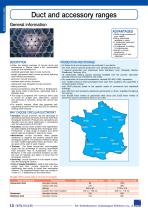
Duct and accessory ranges Duct and accessory ranges General information ADVANTAGES • ide range covering all W your needs. • any references M available in stock. • production sites and 7 storage hubs. • 9 agencies, including 1 18 warehouses. • xpert in-house E production. • igh quality of raw H materials. • ldes, the leading producer of circular ducts and A accessories in France, offers a full, unmatchable range for the installation of: - standard galvanised steel circular ductwork, - irtight galvanised steel circular ductwork featuring a seal-mounted accessories, - aluminium circular ductwork,...

 Open the catalog to page 4
Air Distribution-5

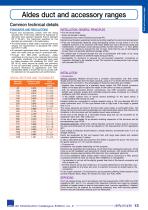
Duct and accessory ranges Aldes duct and accessory ranges Common technical details STANDARDS AND REGULATIONS • ucts and accessories comply with the sizing D standard EN 15-06 which defines the tolerances of diameters (this standard replaces French standard NF P 50-401). The tolerances specified by this standard are presented in the table below. • he thicknesses of steel used to manufacture ducts T respect the requirements of standards EN 12337 and NF E 51-260. • ll materials (galvanised steel, aluminium, stainless A steel, rock wool) used are class A1 (previously M0). • hrough ISO 9001-2000 certification,...

 Open the catalog to page 5
Air Distribution-6

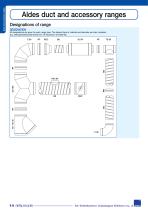
Designations of range DESIGNATION All designations are given for each range type. The desired type of material and diameter are then indicated. E.g. C90 galvanised steel Ø125 mm, TE Aluminium 315/200 etc. Duct and accessory ranges Aldes duct and accessory ranges Air Distribution Catalogue Edition no. 2

 Open the catalog to page 6
Air Distribution-7

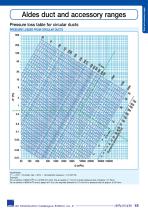
( Aides duct and accessory ranges ) Pressure loss table for circular ducts PRESSURE LOSSES FROM CIRCULAR DUCTS T° = +15°C / Humidity rate = 50% / Atmospheric pressure = 101,325 Pa. For an airflow of 8000 m^/h in a 0 630 mm duct, the air speed is 7 m/s for a linear pressure loss of approx. 0.7 Pa/m. For an airflow of 6000 m^/h and a speed of 4 m/s, the required diameter is 710 mm for a pressure loss of approx. 0.25 Pa/m. Air Distribution Catalogue Edition no. 2

 Open the catalog to page 7
Air Distribution-8

( Aides duct and accessory ranges ) Table of rectangular / circular equivalences RECTANGULAR / CIRCULAR EQUIVALENCES Example 1: to provide an airflow of Q = 1000 m3/h at a speed of 4 m/s, you can choose between: - A theoretical circular duct of 0 300 mm (i.e. 0 315 mm in practice). - A rectangular duct, where the different possible cross-sections are: 300 x 300 mm / 350 x 275 mm / 400 x 250 mm / 500 x 225 mm. Example 2: to provide an airflow of Q = 6000 m3/h at a speed of 4 m/s, you can choose between: - A rectangular duct with a cross-section of 800 x 700 mm. Given that for pressure losses:...

 Open the catalog to page 8
Air Distribution-9

Galvanised steel ductwork Galvanised steel ductwork Standard circular ducts and accessories - p 19 Circular accessories with seals - p 53 Oblong ducts and accessories - p 63 Air Distribution Catalogue Edition no. 2

 Open the catalog to page 9

Air Distribution-10

Air Distribution Catalogue Edition no. 2

 Open the catalog to page 10
Air Distribution-11

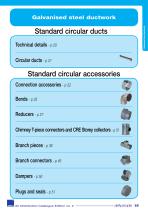
Galvanised steel ductwork Galvanised steel ductwork Standard circular ducts Technical details - p 20 Circular ducts - p 21 Standard circular accessories Connection accessories - p 22 Bends - p 25 Reducers - p 27 Chimney T-piece connectors and CRE Storey collectors - p 31 Branch pieces - p 38 Branch connectors - p 45 Dampers - p 50 Plugs and seals - p 51 Air Distribution Catalogue Edition no. 2

 Open the catalog to page 11
Air Distribution-12

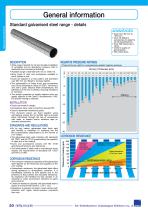
Standard galvanised steel range - details ADVANTAGES • izes from 80 mm to S 1250 mm. • ver 40 different O accessories to adapt to all site specifications. • ver 300 references in O stock. • niform quality of U galvanisation. • Non-oiled ducts. • ide range intended for full and durable installation W of ventilation and air distribution systems, both in residential and commercial buildings. • vailable range of diameters 80 mm to 1250 mm. A • any types of duct and accessories available in M stock (codes in red). • ucts are stapled in a helix pattern and diameters D over 630 mm are ribbed to increase...

 Open the catalog to page 12
Air Distribution-13

Circular ducts Advantages • hickness of sheeting T and quality of galvanisation compliant with quality standards. • on-oiled ducts. N • All air distribution ductwork. • tandard storey elements (2.47 m), designed for S use as headers in residential buildings, are ideal for coupling with CRE storey collector manifolds and enable faster assembly. • asy to assemble using interlocking parts: ducts are E female in design, the accessories are male. • upported by collars, perforated strips, rails, etc. S (see pages 199 to 205). • y its very nature, galvanised steel (both rigid and flexible) B is classified...

 Open the catalog to page 13
Air Distribution-14

• Used to connect two ducts together. • irtight seal formed using sealant and/or adhesive A tape. • ixed to duct using self-tapping screws (4 to 6 F depending on the diameter). Galvanised steel ductwork Circular galvanised steel accessories • Used to connect two accessories together. Air Distribution Catalogue Edition no. 2

 Open the catalog to page 14
Air Distribution-15

Circular galvanised steel accessories • Used to connect two ducts together, features a built-in inspection hatch. • Simplifies respect of standard NF EN 12097 on new ductwork. Galvanised steel ductwork "SMART access" inspection male connector • Male connector with seals, built-in inspection hatch. • Hatch dimensions compliant with NF EN 12097: 185 mm x 85 mm for Ø 125 and Ø 160; 300 mm x 100 mm for Ø 200 to Ø 315. • C Class airtight seal. MS PRO: M0 airtight flexible sleeve STANDARDS COMPLIANCE • lass M0 fire rating. C • atented by Aldes. P • ETIAT Trial No. 2914020. C • eparation of fan-duct...

 Open the catalog to page 15

All Aldes catalogs and technical brochures

  1. Air Diffusion

    270  Pages

Archived catalogs

  1. Fire Protection

    176  Pages

  2. Fire Dampers

    48  Pages

  3. Air inlets

    32  Pages

  4. Axpir range

    12  Pages

  5. Axpirtech

    12  Pages

*Prices are pre-tax. They exclude delivery charges and customs duties and do not include additional charges for installation or activation options. Prices are indicative only and may vary by country, with changes to the cost of raw materials and exchange rates.