
- Catalogs
- Airmar Technology
- In-Hull Chirp Transducers

- Company
- Products
- Catalogs
- News & Trends
- Exhibitions
In-Hull Chirp Transducers

In-Hull Chirp Transducers
AIRMAR's Chirp-ready transducers offer a broad frequency range, covering up to 117 kHz of bandwidth. This allows for enhanced fish detection in the water column, superior resolution for distinguishing between baitfish and gamefish, and improved bottom definition to resolve targets near structures or wrecks. The transducers also provide detailed recognition of haloclines and thermoclines and maintain a high signal-to-noise ratio, even at high boat speeds.
Benefits of In-Hull Transducers
In-Hull transducers are installed inside the boat hull, transmitting sonar through the solid fiberglass hull. They offer several advantages, including no need for hull drilling, the ability to perform installation and service while the boat is in water, no exposure to marine growth, and suitability for trailered and multi-hulled boats.
Frequency Selection and Transducer Types
Choosing the right frequency is crucial for maximizing the performance of your fishfinder. AIRMAR offers various frequency combinations:
- Dual Band: Low/High (LH), Low/Medium (LM), Low/High Wide (LHW), Low Wide/Medium (LWM), Medium Ultra Wide/High Wide
- Single Band: Low, Medium, Medium Ultra Wide (MW), High, High Wide
Transducer Models and Specifications
The document details several transducer models, including M265LH, M265LM, R111LH, R111LM, R599LH, and R599LM, each with specific frequency ranges, beamwidths, and maximum depths. These models are designed for different hull types and engine configurations, providing options for various marine applications.
The Chirp Advantage
Traditional sounders operate at limited frequencies, whereas AIRMAR's Chirp-ready transducers cover a wide frequency band, enhancing target detection, detail, and range resolution. Wide beam Chirp transducers maintain a fixed beam width across the frequency band, offering extensive coverage under the boat.
Mounting Options
Mounting options for transducers include tank mount, pocket mount, keel mount, and thru-hull, depending on the hull design and material, intended boat use, and desired performance level.
Catalog excerpts

In-HullUnlock the true potential of your fishfinder with the superior quality and performance of an AIRMAR Chirp-ready transducer. P75M screenshot courtesy of Navico The Benefits of AIRMAR's Chirp-ready Transducers • One broadband transducer covers up to 117 kHz of bandwidth - greater opportunities to detect fish in the water column • Superior resolution - precise separation between baitfish and gamefish represented on the display with crisp images • Enhanced bottom definition - resolve targets close to the bottom or near structure/wrecks • Amazing detail - recognize haloclines and thermoclines • Improved signal to noise ratio - find fish and track bottom at high boat speeds Benefits of In-Hull Transducers In-Hull transducers are installed inside the boat hull. The transducer is suspended in a liquid filled tank and transmits sonar directly through the solid fiberglass hull. And, the wide frequency band of a Chirp transducer allows you to select the best frequency for your hull's thickness. Other Advantages: • No holes to be drilled through the hull • Installation and service can be performed while the boat is in the water • No exposure to marine growth; no drag • Ideal for trailered boats and tough to fit, multi-hulled boats TECHNOLOGY CORPORATION
Open the catalog to page 1
• Single Band: - Medium Ultra Wide (MW) - High Wide Selecting the best frequency for your specific application is very important. The good news is that once you know what frequency will work best for the type of fishing you do, there's an AIRMAR transducer designed to maximize the performance of your sounder. AIRMAR Chirp transducers are available in various frequency combinations: • Dual Band: - Medium Ultra Wide/High Wide • Sound waves will not present as clear a picture of the bottom on the display, but will sound down in very deep areas where high frequency sound waves cannot reach • Provides...
Open the catalog to page 2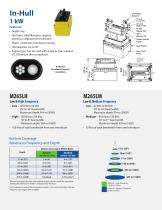
• Depth only • Hull Type: Solid fiberglass stepped, planing or displacement hull types • Plastic / Urethane transducer housing • Engine type: Can be used with single or twin inboard, I/O, OB and jet drive propulsion 4X Flat Washer (SS) Allen Wrench (SS) Gasket (Nitrile) Inside Tank (Plastic) Broadband Ceramic Assemblies 25° to 16° beamwidth Maximum depth 914 m (30001) 10° to 6° beamwidth Maximum depth 304 m (10001) • 103 kHz of total bandwidth from one transducer 25° to 16° beamwidth Maximum depth 914 m (30001) 16° to 11° beamwidth Maximum depth 457 m (15001) • 73 kHz of total bandwidth from...
Open the catalog to page 3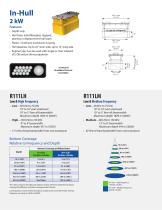
• Depth only • Hull Type: Solid fiberglass stepped, planing or displacement hull types • Plastic / Urethane transducer housing • Hull deadrise: Up to 22° short side, up to 12° long side • Engine type: Can be used with single or twin inboard, I/O, OB and jet drive propulsion 16-Internal Broadband Ceramic Assemblies 19° to 10° port-starboard 10° to 5° fore-aft beamwidth Maximum depth 1829 m (6000') 8° to 4° beamwidth Maximum depth 457 m (1500') • 117 kHz of total bandwidth from one transducer 19° to 10° port-starboard 10° to 5° fore-aft beamwidth Maximum depth 1829 m (6000') 13° to 8° beamwidth...
Open the catalog to page 4
• Depth only • Hull Type: Solid fiberglass stepped, planing or displacement hull types • Plastic / Urethane transducer housing • Hull deadrise: Up to 22° short side, up to 12° long side • Engine type: Can be used with single or twin inboard, I/O, OB and jet drive propulsion 25-Internal Broadband Ceramic Assemblies 23° to 9° port-starboard 11° to 5° fore-aft beamwidth Maximum depth 3048 m (10000') 8° to 4° beamwidth Maximum depth 457 m (1500') • 112 kHz of total bandwidth from one transducer 23° to 9° port-starboard 11° to 5° fore-aft beamwidth Maximum depth 3048 m (10000') 13° to 8° beamwidth...
Open the catalog to page 5
The Chirp Advantage Traditional sounders operate at only two discrete frequencies – typically 50 kHz and 200 kHz. This results in limited depth range, resolution, and ultimately what targets can be detected in the water column. In contrast, AIRMAR’s game-changing Chirp-ready transducers provide over 70+ kHz of bandwidth. Transmitting over a wide frequency band results in a greater opportunity to detect what is in the water column. As a result, all targets detected in the entire bandwidth will be seen on the display–even those fish holding close to the bottom–ultimately improving target detection,...
Open the catalog to page 6All Airmar Technology catalogs and technical brochures
 Thru-Hull Chirp Transducers
6 Pages
 AR50
AR501 Page
 ATK200
1 Page
 ATK120
1 Page
 ATK75
ATK751 Page
 ATK50
ATK501 Page
 AT300
AT3001 Page
 AT225
AT2251 Page
 AT200
AT2001 Page
 AT120
AT1201 Page
 AT75
AT751 Page
 AT50
AT501 Page
 ART15
ART151 Page
 ARK120-THD
1 Page
 ARK75-THD
1 Page
 ARK50-THD
1 Page
 ARK50
ARK501 Page
 ARK41
ARK411 Page
 ARK30
ARK301 Page
 AR50CH
1 Page
 T1
T11 Page
 AR30
AR301 Page
 DX900+
2 Pages
 CAST App
2 Pages
 DST810 Smart™ Multisensor
4 Pages
 HT200
HT2002 Pages
 G2183
G21832 Pages
 GH2183
2 Pages
 EchoRange™ Smart™ Sensors
4 Pages
 AR41
AR411 Page
 1 MHz - 17 mm
1 Page
 1 MHz - 29 mm
1 Page
 B765LH / B765LM Thru-hull
2 Pages
 NMEA 0183 to USB
2 Pages
 NMEA SMART™ SENSORS
3 Pages
 110WX, 200WX
4 Pages
 220WXH
4 Pages
 WXS Series
2 Pages
 200WX-IPX7
2 Pages
 CM510L
2 Pages
 P39 P79 Smart Sensors
2 Pages
 B122
B1222 Pages
 UST800/UST850/UDST800
4 Pages
 ST900 ST950
2 Pages
 TDT1000
2 Pages
 SS82 SS134
2 Pages
 B17-HP
2 Pages
 DT800
DT8002 Pages
 DST800
2 Pages
 P39
P392 Pages
 T80 T42
2 Pages
 ST69
ST692 Pages
 ST63
ST632 Pages
 ST61
ST612 Pages
 ST300
ST3002 Pages
 M563
M5632 Pages
 Wet Box/ Tank-Mount
1 Page
 SINGLE BAND CHIRP
3 Pages
 TM260
TM2602 Pages
 TM258
TM2582 Pages
 SS264N Pair
2 Pages
 M260
M2602 Pages
 B260 SS260
2 Pages
 B258
B2582 Pages
 B164 SS164
2 Pages
 P79
P792 Pages
 P74
P742 Pages
 B60 SS60
2 Pages
 B45
B452 Pages
 P319 B117
2 Pages
 P7
P72 Pages
 P19
P192 Pages
 P72
P722 Pages
 P23
P232 Pages
 P8 P208
2 Pages
 T42
T422 Pages
 P66
P662 Pages
 P58
P582 Pages
 B744V B744VL
2 Pages
 M190
M1902 Pages
 SS549
SS5492 Pages
 M42
M422 Pages
 CS229
CS2292 Pages
 M192
M1922 Pages
 M159
M1592 Pages
 M153
M1532 Pages
 M194
M1941 Page
 M157
M1572 Pages
 H2183
H21832 Pages
 SS538
SS5382 Pages
 SS510
SS5102 Pages


- Temperature probe
- Resistance temperature sensor
- Portable tester
- Stainless steel temperature transducer
- AIRMAR ultrasonic transducer
- Precision temperature transducer
- Digital temperature sensor
- Water temperature transducer
- Diagnostic tester
- Magnetic speed sensor
- High-precision temperature sensor
- Performance tester
- AIRMAR piezoelectric ultrasonic transducer
- Handheld tester
- Fast-response temperature sensor
- AIRMAR level measurement ultrasonic transducer
- AIRMAR high-frequency ultrasonic transducer
- AIRMAR obstacle detection ultrasonic transducer
- AIRMAR proximity ultrasonic transducer
- Immersible ultrasonic transducer