
- Catalogs
- Aida S.r.l.
- Transfer Technology Systems


- Products
- Catalogs
- News & Trends
- Exhibitions
Transfer Technology Systems

Transfer Technology Systems
Transfer technology systems are essential in modern manufacturing, particularly in the automotive industry, to produce complex parts from thinner and stronger materials. These systems offer flexibility and reduce material waste compared to traditional methods.
Choosing the Right Transfer System
The selection of a transfer system depends on part complexity and production volume. It is crucial to partner with a press builder that provides comprehensive services, including automation and post-installation support.
Transfer Presses
Transfer presses are ideal for large, complex parts and just-in-time manufacturing. Key features include the ability to eliminate production stoppages, enhance productivity, and facilitate quick die changes. Advanced features like electronic servo transfer mechanisms and crank/link motion options increase efficiency and flexibility.
Straightside Presses
Straightside presses are preferred for automated systems, offering high productivity in tandem lines. They can operate individually or as a synchronized system, providing flexibility and increased tonnage capacity without the cost of dedicated systems.
Gap Frame Presses
Gap frame presses offer a cost-effective alternative with flexibility for certain applications. They are suitable for parts that do not require high accuracy or large tonnage. The system's modularity allows for easy expansion and adaptation to different stamping needs.
Conclusion
Transfer systems provide adaptable solutions to meet evolving industry demands. The choice of system should align with budget constraints and specific part requirements, offering the flexibility to handle additional jobs.
Catalog excerpts
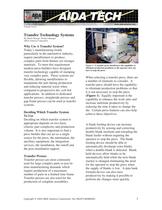
Volume Seven Transfer Technology Systems By Dennis Boerger, Product Manager AIDA-America Corporation Why Use A Transfer System? Today’s manufacturing trends particularly in the automotive industry, require metalformers to produce complex parts from thinner yet stronger materials. To meet this requirement modern press builders have designed transfer technology capable of stamping very complex parts. These systems are flexible, allowing metalformers to manipulate the part during production and reducing material waste when compared to progressive die, coil-fed applications. In addition to dedicated transfer presses, straightside presses and gap frame presses can be used as transfer systems. Deciding Which Transfer System To Use Deciding on which transfer system is appropriate depends on two basic criteria; part complexity and production volume. It is also important to find a press builder that can act as a single source for the press, the automation, the ancillary equipment, the integration services, the installation, the runoff and the post-installation support. Transfer Presses Transfer presses are most commonly used for large complex parts or just-intime-manufacturing demands which require production of a maximum number of parts in a limited time frame. Transfer presses are also used for the production of complete assemblies. Figure 1- A transfer press should have the capability to eliminate production problems so the operator does not have to stop the press. When selecting a transfer press, there are a number of elements to consider. A transfer press should have the capability to eliminate production problems so that it is not necessary to stop the press (Figure 1). Equally important is the capability to enhance the work ratio and increase unit/time productivity by reducing the time it takes to change the die. Certain press features can also help achieve these objectives. A blank feeding device can increase productivity by sensing and correcting double-blank misfeeds and reloading the blank feeder without requiring the operator to stop the press. The blank feeding device should be able to automatically discharge extra blanks when a double-blank is detected. Blank hold devices allow blanks to be automatically held while the next blank stacker is changed eliminating the need for the operator to stop the press when the supply of blanks is low. A data bank formula device can also raise productivity by making it possible to perform die changes more quickly. Copyright © 2004 AIDA-America Corporation. ALL RIGHTS RESERVED. 1
Open the catalog to page 1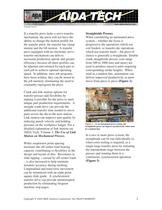
Volume Seven If a transfer press lacks a servo transfer mechanism, the press will not have the ability to change the motion profile for the transfer pitch, the transfer bar clamp motion and the lift motion. A transfer press equipped with an electronic servo transfer mechanism can deliver increased production speeds and greater efficiency because all three profiles can be adjusted and retimed for each part or each job to achieve optimal operating speed. In addition, once job programs have been written, they can be stored in the job memory eliminating the need to constantly reprogram the press....
Open the catalog to page 2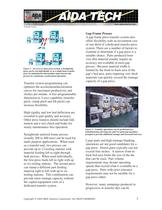
Volume Seven Figure 3 – In a two or more press system, a straightside press can be run individually or as a single large transfer press by initiating the intermediate stage between the presses for continuous, synchronized operation. Transfer system programming can optimize the acceleration/deceleration curves for maximum productivity and strokes per minute. A free programmable dimension in 3-axes capability (transfer pitch, clamp pitch and lift pitch) can increase flexibility. High rigidity and low bed deflection are essential to part quality and accuracy. Other press features should include...
Open the catalog to page 3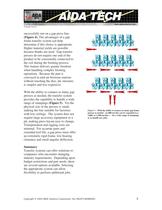
Volume Seven successfully run on a gap press line. (Figure 4). The advantages of a gap frame transfer system can help determine if this choice is appropriate. Higher material yields are possible because blanks are used. Gap transfer presses do not require one end of the product to be consistently connected to the coil during the forming process. This feature delivers greater freedom when handling complex forming operations. Because the part is conveyed in mid-air between stations without touching the dies, die structure is simpler and less expensive. With the ability to connect as many gap presses...
Open the catalog to page 4Archived catalogs
 NC Specs
2 Pages
 DSF-C1-A
1 Page
 CHI
CHI2 Pages
 AIDA - Blanking line
9 Pages
 Total transfer knowledge
3 Pages
 Transfer press
2 Pages
 dsf-c1-n1-n2-specs
6 Pages
 Servo Mechanical Presses
1 Page
 Slide Suspension Designs
4 Pages
 Press Balancing Systems
3 Pages
 Slide guide systems
4 Pages
 Reverse tonnage
8 Pages
 NC2 Gap Frame Presses
4 Pages
 NC1 Gap Frame Presses
6 Pages
 AIDA Srl COMPANY PROFILE
8 Pages
 AIDA PRODUCT BROCHURE
6 Pages



- Aida industrial press
- Aida forming press
- Aida hydraulic press
- Automatic press
- Aida electric press
- Vertical press
- Cutting press
- Aida stamping press
- Aida mechanical press
- PLC-controlled press
- Bending press
- Compression press
- Aida sheet metal press
- Straightening press
- Four-pillar press
- Aida straight-side press
- Press for the automotive industry
- Press for industrial applications
- C-frame press