
- Catalogs
- Aida S.r.l.
- Total transfer knowledge


- Products
- Catalogs
- News & Trends
- Exhibitions
Total transfer knowledge

Total transfer knowledge
This document discusses the evolution and features of transfer press technology, particularly in the context of the automotive industry. It highlights the advancements in automation and the flexibility of transfer systems in manufacturing large, complex parts.
Transfer Press Evolution
Historically, stamping job shops had limited options for automated press systems, primarily relying on progressive-die or transfer-die operations. The emergence of gap-frame presses with automated transfer systems has expanded these options. Industry demands, particularly from the automotive sector, have driven the development of large-capacity transfer presses and side-by-side two-press systems.
Current Trends
There is a growing trend towards using single-press and multiple-press transfer systems with capacities ranging from 800 to 3,000 tons. These systems are particularly favored for producing large parts in the automotive industry. Advances in automation have increased output speeds and reduced changeover times, enhancing production efficiency.
Transfer Press Features
Transfer presses are designed to produce large, complex parts and support just-in-time manufacturing. Key features include:
- Blank Feeding Devices: These systems improve productivity by automatically correcting double-blank misfeeds and facilitating quick die changes.
- Servo Transfer Mechanisms: Allow for adjustable motion profiles, enhancing production speed and efficiency.
- Crank and Link Slide Motions: Improve part quality by reducing punch velocity and maintaining pressure longer.
- Wide Suspension Point Spacing: Increases load-bearing capacity and maintains accuracy during press operations.
Straight-side Presses
Straight-side presses are commonly used in automated systems, offering capacities from 300 to over 3,000 tons. They are suitable for large-part production and can be used individually or as part of a synchronized multiple-press system.
Gap-frame Transfer Presses
Gap-frame transfer presses offer flexibility at a lower investment cost compared to dedicated transfer systems. They are suitable for factories with low ceilings and do not require large accessory equipment. However, they have limitations regarding material width and part depth.
Conclusion
Transfer systems provide a versatile solution for modern manufacturing needs, allowing customization based on budget and production requirements. They offer significant advantages in terms of flexibility, efficiency, and cost-effectiveness.
Catalog excerpts
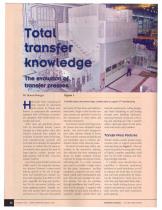
shop required an automated press system, us choices were limited to progressive-die operations equipped with roil feeders or transferdie operations wi th transf...r feeds on a straight-side press. Some years ago gap-frame presses with an automated transfer system emerged as a third option, Since then in dustry demands have pushed the evolution of transfer press technology. Lean manufacturing practices and moreand moredemand for specialized processes III markets like the automouve industry hav spurred the need for e largc-cepacuy transfer presses and large-capacity side-by-sde. two-press transfer systems. Gap-frame press transfersystems are widely used m the transplant autornotin- industry However, cum-ru trends indicate growth in the 1.JS(' of singlepress and multiple-press transfer systems with capacities from 800 10 3,000 tons, especially for large-part production for the automotive industry and some apphancemakers, Transfer systems and tandem lines are producing such uems as A Class outer skin panels WWW.STAIoI PIII GJOURliA L COIol Figure 1 A transfer press can produce large, complex parts or supportJIT maoofacturing. and many B Class inner and reinforcement pans, Smgle or side-by-side twopress systems are preferred choices for the manufacture of other frame and internal components. Automationadvancesforlarge transfer presses also have increased output speeds. and pan-to-pan changeover now takes minutes instead or hours. Tcdays rranslcr systems are flexible and can manipulate pans to increase producuon output wlule reducing W3.Sl.C. Evolution of technology trends. particularly in the automotive industry. also mdicues that most sampmg job shops no longer maintain in-house expense for designand layout of manufactunng cells. As a result. stampers may want to consider a single source for the pres.'>, automation, ancillary equtpmcru. integration SCf\ll"CS , installation. runoff, and posunsallanon supjXln. This not only simplifies the selection p rot.1.'S.<; , but also the purchase through installation and runoff procedure for the stamper. A supplier with knowledge of each factor that aflects a stampers transfer system-from raw material requirements, toolingdesigns, and blank desecking or coil feeding through press handling, lubrication. and scrap removal to pan exit com't:)·· ing and sacking-can help a stamper achieve optimum output in the pressroom and avoid costly mistakes. Transfer Press Features Transfer presses usually produce large. complex parts or suppon j us-m-urre manufacturing (see Figure 0, They are suited. for production usmg tailor welded. blanks; complete assemblies: small pan lots for niche markets; and thin, high-strength materials. A transfer pl't'SS should have the capability to chmmate producuon problems to aVOId shutdowns, as well as enhance the work ratio to increase unit and time productivity by reducing die changeovers. Some press featurcs that may help meet these objectives are blank feeding devices, servo transfer mechanisms, crank and Imk slide motions. and wide suspension potru spacing, STAMPI NG JOU RNA L • Ali FiolA PUBLICATIO N
Open the catalog to page 1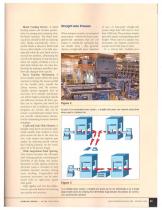
Blank Feeding, Device. A blank lccdmg system can increase producnvuy by sensing and corrcctmg double-blank misfeeds. The blank feeding deviceshould be able to discharge extra blanks automatically when a double blank is dete ted. Blank hold c devices allow blanks to be held automatically while the next blank stac k is moved into position, chnunaung the need for the operator to stop the press when the supply of blanks is low. A data bank feature also can raise prod ucuvuy by making it possible to p re form die changes more quickly Stra ight-side Presses When stampersconsder an automated presssystem...
Open the catalog to page 2
system (.see Figure 2). each press can be run individually or, when extra tooling stations are required, as a sin- gle, large transfer press by initiating the intermediate stage between the presses and running them in a con- tinuous, synchronized operation (see Figure 3). Transfer system program- ming can optimize acceleration and deceleration curves for maximum productivity and strokes per minute. A free programmable dimension m three axes (transfer pitch, clamp pitch, and lift piichl can increase flex- Tie-rod straight-side presses rang- ing from 300 tons to 1,200 tons can be selected with...
Open the catalog to page 3Archived catalogs
 NC Specs
2 Pages
 DSF-C1-A
1 Page
 CHI
CHI2 Pages
 AIDA - Blanking line
9 Pages
 Transfer press
2 Pages
 dsf-c1-n1-n2-specs
6 Pages
 Servo Mechanical Presses
1 Page
 Slide Suspension Designs
4 Pages
 Press Balancing Systems
3 Pages
 Transfer Technology Systems
4 Pages
 Slide guide systems
4 Pages
 Reverse tonnage
8 Pages
 NC2 Gap Frame Presses
4 Pages
 NC1 Gap Frame Presses
6 Pages
 AIDA Srl COMPANY PROFILE
8 Pages
 AIDA PRODUCT BROCHURE
6 Pages



- Aida industrial press
- Aida forming press
- Aida hydraulic press
- Automatic press
- Aida electric press
- Vertical press
- Cutting press
- Aida stamping press
- Aida mechanical press
- PLC-controlled press
- Bending press
- Compression press
- Aida sheet metal press
- Straightening press
- Four-pillar press
- Press for the automotive industry
- Press for industrial applications
- C-frame press