
- Catalogs
- Aida S.r.l.
- Slide Suspension Designs


- Products
- Catalogs
- News & Trends
- Exhibitions
Slide Suspension Designs

Slide Suspension Designs
Introduction
The document discusses the design of press slide suspension systems, focusing on two types: ball and socket, and wrist pin. These systems are crucial for transmitting force from the press drive to the slide and die.
Slide Suspension Requirements
Four primary requirements for slide suspension systems are outlined: sufficient size for force transmission, ability to handle high reverse loads, reduction of off-center load effects, and minimal maintenance needs.
Comparison of Designs
Compressive Load: The ball and socket design offers a larger load-carrying area, reducing wear and maintenance compared to the wrist pin design.
Tension Load: The ball design provides a greater area for reverse load capacity, enhancing durability.
Off-Center Load: The ball seat design maintains full load-carrying capacity during slide tipping, unlike the wrist pin design, which suffers from reduced load area and increased wear.
Wear and Maintenance: The ball design offers superior performance due to its larger area and better support, especially when the slide adjustment is down.
Conclusion
While both designs have been reliable, the ball and socket design is deemed superior due to its larger load-supporting areas, better handling of off-center loads, and reduced maintenance needs.
Catalog excerpts
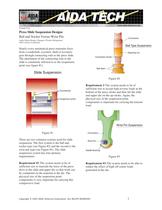
Volume Five Press Slide Suspension Designs Ball and Socket Versus Wrist Pin: Author Dennis Boerger, Manager of Product Management, AIDA-America Corporation Nearly every mechanical press transmits force from a crankshaft, eccentric shaft or eccentric gear through connecting rods to the press slide. The attachment of the connecting rods to the slide is commonly referred to as the suspension point (see figure #1). Figure #2 Requirement 2-The system needs to be of sufficient size to accept high reverse loads at the bottom of the press stroke and then lift the slide and upper die on the up-stroke. Again, the physical size of the suspension point components is important for carrying the tension load. Figure #1 There are two common systems used for slide suspension. The first system is the ball and socket type (see Figure #2) and the second is the wrist pin type (see Figure #3). The slide suspension system has four primary requirements: Requirement #1-The system needs to be of sufficient size to transmit the force of the press drive to the slide and upper die so that work can be completed on the material in the die. The physical size of the suspension point components is very important for carrying this compressive load. Figure #3 Requirement #3-The system needs to be able to reduce the effect of high off-center loads generated in the die. Copyright © 2002 AIDA-America Corporation. ALL RIGHTS RESERVED. 1
Open the catalog to page 1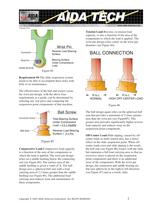
Volume Five Tension Load-Reverse, or tension load capacity, is also a function of the area of the components to which the load is applied. The wrist pin design relies solely on the wrist pin diameter (see Figure #4). Figure #4 Requirement #4-The slide suspension system needs to be able to accomplish these tasks with little or no maintenance. The effectiveness of the ball and socket versus the wrist pin design, with the above four requirements as a guide, can be determined by selecting any size press and comparing the suspension point components of that machine. Figure #6 The ball design again...
Open the catalog to page 2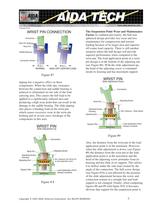
Volume Five The Suspension Point Wear and Maintenance Factor-As outlined previously, the ball seat spherical design provides less wear and less maintenance for compression and tension loading because of its larger area and superior off-center load capacity. There is still another situation where the ball design will provide superior performance when compared to the wrist pin. The load application point in a wrist pin design is at the bottom of the adjusting nut (see Figure #8). With the slide adjustment up, the head of the adjusting screw is contained inside its housing and has maximum support....
Open the catalog to page 3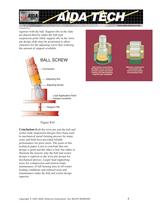
Volume Five superior with the ball. Support ribs in the slide are placed directly under the ball type suspension point while support ribs in the wrist pin design slide must be positioned to allow clearance for the adjusting screw thus reducing the amount of support available. Figure #10 Conclusion-Both the wrist pin and the ball and socket slide suspension designs have been used in mechanical metal forming presses for many years and both have provided reliable performance for press users. The point of this technical paper is not to conclude that one design is good and the other is bad, but rather...
Open the catalog to page 4Archived catalogs
 NC Specs
2 Pages
 DSF-C1-A
1 Page
 CHI
CHI2 Pages
 AIDA - Blanking line
9 Pages
 Total transfer knowledge
3 Pages
 Transfer press
2 Pages
 dsf-c1-n1-n2-specs
6 Pages
 Servo Mechanical Presses
1 Page
 Press Balancing Systems
3 Pages
 Transfer Technology Systems
4 Pages
 Slide guide systems
4 Pages
 Reverse tonnage
8 Pages
 NC2 Gap Frame Presses
4 Pages
 NC1 Gap Frame Presses
6 Pages
 AIDA Srl COMPANY PROFILE
8 Pages
 AIDA PRODUCT BROCHURE
6 Pages



- Aida industrial press
- Aida hydraulic press
- Automatic press
- Aida electric press
- Vertical press
- Cutting press
- Aida stamping press
- Aida frame press
- PLC-controlled press
- Bending press
- Compression press
- Aida sheet metal press
- Straightening press
- Four-pillar press
- Aida straight-side press
- Press for the automotive industry
- Press for industrial applications
- C-frame press