
- Catalogs
- Aida S.r.l.
- Servo Mechanical Presses


- Products
- Catalogs
- News & Trends
- Exhibitions
Servo Mechanical Presses

Servo Mechanical Presses
Aida's ServoPro is a servo-mechanical press designed to meet the demands of stamping operations involving exotic materials and specialty steels. It features large, high-torque, low-rpm servomotors developed for capacities up to 300 tons per drive motor, with plans for future capacity increases.
Specifications and Features
The ServoPro offers the benefits of a mechanical press with added features for cost-conscious operations. It replaces traditional flywheel, clutch, and main motor systems with servomotors directly attached to the press drive shaft. This design maintains stroke length, torque, and energy levels comparable to standard mechanical press drives.
Energy Efficiency
Aida has worked to reduce the ServoPro's power consumption, making it comparable to standard mechanical press drives for most applications.
Applications and Market Position
The ServoPro is not intended to replace all hydraulic and mechanical presses but is expected to gain significant market share due to its ability to control forming operations, especially with exotic materials and high-strength steels. It is particularly suited for materials like magnesium, which require precise control and heating for quality stamping.
Technological Evolution
The development of the ServoPro has been an evolutionary process, beginning with the first servo-driven mechanical press in 1995. Earlier generations used high-speed, low-torque servomotors, which were limited in forming applications. The latest technology allows for increased tonnages and more widespread use.
Future Prospects
As ServoPro moves to larger capacity presses, it will use multiple servomotors in the drive system to maintain parallel slide motion during operations with high off-center loads. This technology is expected to gain strength as exotic materials become more common in automotive and appliance applications.
Catalog excerpts
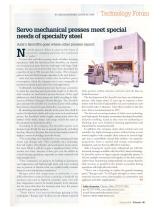
BY LINCOLN BRUNNER. EDITOR-IN-CHIEF Technology Forum Servo mechanical presses meet special needs of specialty steel Aida's ServoPro goes where other presses cannot ■o doubt about it: When it comes to the future of automotive stamping materials, the watchword To meet thai and other pressing needs of today"-, skimping operations. Aida has introduced Ihc ServoPro. an electric servo-mechanical press thai sets itsell apart with large, higli- torque, low-rpm servomotors thai have been developed for capacities of up to 300 tons per drive motor. ('Hie company plans to increase those tonnage capacities in the near future.) Aida also has worked to reduce the ServoPro's power consumption, which the cnuipam savs is now comparable to standard mechanical press drives for most applications. Traditionally, mechanical press users had to pa\ a premium to adjust the operating speed and stroke length or lo alter the slide motion on mechanical presses because of the rigid platforms on which those presses are built, according to Aida- Amcrica Product Manager Dennis Boerger. The ServoPro gives stampers the benefits of a mechanical press while adding those features that in the past eluded the cost-conscious. By attaching servomotors directly to the press drive shaft to replace the flvwheel. clutch and main motor in its mechanical presses, llie ServoPro's stroke lengths, rating poinLs above the bottom of the stroke, torque and energy remain the same as the standard mechanical press drive. According to the company, the ServoPro motors were designed specifically for use in genera] prcsswork, including forming. However, the press line was not necessarily created lo displace current technology across the board. " This technology isn't intended for every stamping job that comes up . Boergei said. " I his is probabi] DOl a technology that will replace all hydraulic and mechanical presses down the road. What it will do is gain a significant share of the market over time, because it does give you the ability to control forming operations, especially in exotic materials and high-strength steels. They [customers] are going to be looking to aluminums and magnesiums and high-strength steels, and we're working now in projects in titanium that you couldn't really consider doing on conventional press equipment." Boerger noted that magnesium, in particular, is one difficult-to-form material that is gaining a foothold for premium uses such as high-end computer cases. Not only does magnesium need to be heated properly to be stamped, but the press that does the forming must have the proper controls to get a quality product, " That's where I see servo technology gaining in the marketplace" Buerger said, "hallows you llie infinite control of slide position within microns, and you can't do that on hvdraulic presses." The development of the ServoPro lias been an evolutionary process. Aida l>egan about 12 years ago to engineer a drive system with the kind of adjustabilitv end users wanted at a cost that would make it attractive. Ilial effort resulted in the first servo- driven mechanical press in 1997. The first and second generations of Aida's servo technology used high-speed, low-torque servomotors dev eloped for plastic injection molding. Good as they were for embossing or blanking, they were limited in forming applications and impractical fornomial prcsswork. In addition, the company notes, these motors were not available for higher-tonnage presses without tying several motors together with complex drive systems to convert high rpiu into a controllable vertical slide motion—an expensive proposition from a capital and energy consumption standpoint, and one that was difficult to maintain. Aida is hoping for much more widespread use with the increased tonnages available with ServoPro's latest technology. As ServoPro moves to larger capacity straight-side presses, it will use multiple servomotors tied together in the drive system i rather than functioning independently) to ensure that the slide remains as parallel to the bolster as possible during operations with high off-center loads "This is not a technology to replace the general stamping press." Boerger said. "It will gain strength as more exotic materials become more commonplace in automotive and appl ia nee and other (a ppl i cat ions ]." FF J e-mail: [email protected]. Circle no. 109 on reader service caret.
Open the catalog to page 1Archived catalogs
 NC Specs
2 Pages
 DSF-C1-A
1 Page
 CHI
CHI2 Pages
 AIDA - Blanking line
9 Pages
 Total transfer knowledge
3 Pages
 Transfer press
2 Pages
 dsf-c1-n1-n2-specs
6 Pages
 Slide Suspension Designs
4 Pages
 Press Balancing Systems
3 Pages
 Transfer Technology Systems
4 Pages
 Slide guide systems
4 Pages
 Reverse tonnage
8 Pages
 NC2 Gap Frame Presses
4 Pages
 NC1 Gap Frame Presses
6 Pages
 AIDA Srl COMPANY PROFILE
8 Pages
 AIDA PRODUCT BROCHURE
6 Pages



- Aida industrial press
- Aida forming press
- Aida hydraulic press
- Automatic press
- Vertical press
- Aida electric press
- Cutting press
- Aida stamping press
- Aida frame press
- PLC-controlled press
- Bending press
- Compression press
- Aida sheet metal press
- Four-pillar press
- Straightening press
- Press for the automotive industry
- C-frame press
- Press for industrial applications