
- Catalogs
- Aida S.r.l.
- Reverse tonnage


- Products
- Catalogs
- News & Trends
- Exhibitions
Reverse tonnage

Reverse tonnage
Reverse tonnage, or "snap through," is a critical issue in metal stamping, occurring when a punch breaks through metal, releasing energy that causes negative forces potentially damaging press components.
Causes and Symptoms
Primarily caused by cutting and blanking operations, reverse tonnage severity is influenced by material type, punch velocity, and press deflection. Symptoms include high noise, loose components, and fatigue failure of press parts.
Impact on Presses
Both gap and straightside presses suffer from frame oscillations due to reverse tonnage, leading to premature wear and potential component breakage.
Acceptable Levels and Monitoring
Industry standards recommend reverse tonnage not exceed 10% of a press's forward capacity. Accurate measurement of reverse load levels requires tonnage monitors.
Reducing Reverse Tonnage
Strategies to mitigate reverse tonnage include using softer materials, maintaining sharp punches and dies, reducing punch velocity, minimizing press deflection, and employing shock dampers. Shock dampers notably reduce reverse tonnage and enhance die life.
Conclusion
Addressing reverse tonnage is vital for press integrity and operator safety. Proper press selection and shock dampers can mitigate adverse effects, improving production quality and reducing maintenance costs.
Catalog excerpts
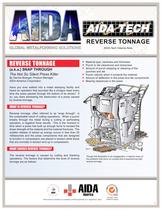
REVERSE TONNAGE AIDA-Tech Volume Nine REVERSE TONNAGE (a.k.a.) SNAP THROUGH The Not So Silent Press Killer By Dennis Boerger, Product Manager AIDA-America Corporation Material type, hardness and thickness Punch to die clearances and sharpness Amount of punch stepping or shearing of the punches and die Punch velocity when it contacts the material Amount of deection in the press and die components Bearing clearances in the press Have you ever walked into a metal stamping facility and heard an operation that sounded like a shotgun blast every time the press passed through the bottom of its stroke? If so, you were witnessing the destruction of a press caused by reverse tonnage. WHAT IS REVERSE TONNAGE? Reverse tonnage, often referred to as “snap through”, is the undesirable result of cutting operations. When a punch breaks through the metal during a cutting or perforating operation, a negative force results. This is the moment in time when a press has built up enough force to exceed the shear strength of the material and the material fractures. The sudden release of stored up energy occurs in less than 20 milliseconds and the press components that are designed to function in compression are placed in tension while those that are normally in tension end up in compression. WHAT CAUSES REVERSE TONNAGE? The reverse tonnage is caused by cutting and blanking operations. The factors that determine the level of reverse tonnage are as follows: gure 1 Though this illustration is an exaggeration, it depicts many of the problems that occur on a press that is experiencing high reverse tonnage. AIDA-America Corporation is a subsidiary of AIDA Engineering LTD., Sagamihara, Japan ISO 9001: 2000 Certied Company 1
Open the catalog to page 1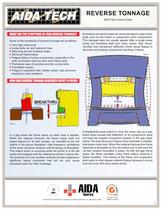
REVERSE TONNAGE AIDA-Tech Volume Nine WHAT ARE THE SYMPTOMS OF HIGH REVERSE TONNAGE? Some of the symptoms of reverse tonnage are as follows: Very high noise level Loose bolts, air and hydraulic lines Recurring air and hydraulic leaks Electrical malfunctions Fatigue failure of press components, especially in the slide connection area but also main frame parts Premature wear of punches and die components Foundation issues Fatigue in operators feet, ankles, knees, hips and even resulting in back problems Excessive reverse tonnage can cause damage to major press parts such as the frame or suspension...
Open the catalog to page 2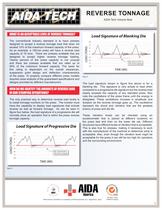
REVERSE TONNAGE AIDA-Tech Volume Nine WHAT IS AN ACCEPTABLE LEVEL OF REVERSE TONNAGE? The conventional industry standard is to have presses designed to accept a reverse tonnage load that does not exceed 10% of the maximum forward capacity of the press. As an example, a 100-ton press will have a reverse load capacity of 10 tons. There are presses available that are designed to accept higher reverse tonnage loading. Twenty percent of the press capacity is not unusual and there are presses available that are rated up to 50% of the maximum forward capacity. The basis for this rating is dependant...
Open the catalog to page 3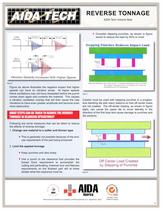
REVERSE TONNAGE AIDA-Tech Volume Nine Consider stepping punches, as shown in gure seven to reduce the load by 50% or more gure 6 Figure six above illustrates the negative impact that higher speeds can have on vibration levels. At higher speeds frame oscillations may not have dissipated before the punch comes down again and contacts the material. This causes a vibration oscillation overlap that will then cause the new vibrations to have even greater amplitude and become even more destructive. WHAT STEPS CAN BE TAKEN TO REDUCE THE REVERSE TONNAGE IN BLANKING OPERATIONS? gure 7 Caution must be used...
Open the catalog to page 4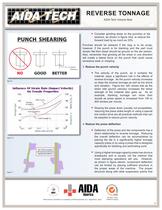
REVERSE TONNAGE AIDA-Tech Volume Nine Consider grinding shear on the punches or die sections, as shown in gure nine, to reduce the forward load by as much as 33%. Punches should be sheared if the slug is to be scrap, however, if the punch is for blanking and the part must remain at then shear should be ground on the die section. Also, remember that grinding all the shear in one direction will create a lateral force on the punch that could cause excessive wear or chipping. 3. Reduce the punch velocity The velocity of the punch, as it contacts the material, plays a signicant role in the effects...
Open the catalog to page 5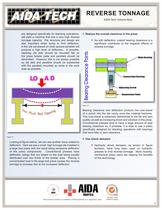
REVERSE TONNAGE AIDA-Tech Volume Nine are designed specically for blanking operations, will yield a machine that has a very high reverse tonnage capacity. Die structure and design are also important when trying to limit deection. A thin die set placed on wide spaced parallels will produce a high level of deection. If possible, blanking die sets should be mounted at on the press bolster plate and parallels should be eliminated. However, this is not always possible so die sets and parallels should be substantial with the parallels mounted as close to the work area as possible. 5. Reduce the overall...
Open the catalog to page 6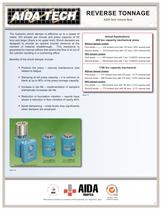
REVERSE TONNAGE AIDA-Tech Volume Nine The hydraulic shock damper is effective up to a speed of nearly 100 strokes per minute and press capacity of 50 tons and larger (there is no upper limit). Shock dampers are designed to provide an upward counter pressure at the moment of material breakthrough. This resistance is generated by internal orices that restrict the ow of oil out of the cylinder resulting in a cushioning effect. Benets of the shock damper include: Protects the press – reduces maintenance cost related to fatigue. Actual Applications 400 ton capacity mechanical press Without damper...
Open the catalog to page 7
REVERSE TONNAGE AIDA-Tech Volume Nine Although the forward tonnage increases with the use of shock dampers, the reverse tonnage reduction will increase die life, improve part quality and save the press from serious damage. These examples show operations that were or would have caused serious problems. The installation of shock dampers nearly eliminated the reverse tonnage and the resulting damage. Figure sixteen shows a typical installation of four shock dampers on a straightside press. From this we can see that the dampers consume bolster area that cannot be used as die space. So the slight...
Open the catalog to page 8Archived catalogs
 NC Specs
2 Pages
 DSF-C1-A
1 Page
 CHI
CHI2 Pages
 AIDA - Blanking line
9 Pages
 Total transfer knowledge
3 Pages
 Transfer press
2 Pages
 dsf-c1-n1-n2-specs
6 Pages
 Servo Mechanical Presses
1 Page
 Slide Suspension Designs
4 Pages
 Press Balancing Systems
3 Pages
 Transfer Technology Systems
4 Pages
 Slide guide systems
4 Pages
 NC2 Gap Frame Presses
4 Pages
 NC1 Gap Frame Presses
6 Pages
 AIDA Srl COMPANY PROFILE
8 Pages
 AIDA PRODUCT BROCHURE
6 Pages



- Aida industrial press
- Aida forming press
- Aida hydraulic press
- Automatic press
- Aida electric press
- Vertical press
- Cutting press
- Aida stamping press
- Aida frame press
- PLC-controlled press
- Bending press
- Compression press
- Aida sheet metal press
- Straightening press
- Four-pillar press
- Aida straight-side press
- Press for the automotive industry
- Press for industrial applications
- C-frame press