
- Catalogs
- Aida S.r.l.
- Press Balancing Systems


- Products
- Catalogs
- News & Trends
- Exhibitions
Press Balancing Systems

Press Balancing Systems
The document discusses the importance of press balancing systems, particularly pneumatic counterbalancers, in mechanical presses. These systems are crucial for the suitability and quality of a press, impacting both its performance and maintenance.
Types of Balancing Systems
Press balancing systems are categorized into reciprocating and rotary systems. This document focuses on reciprocating systems, highlighting their features, functions, and benefits.
Slide Counterbalance
The slide counterbalance is a common system used to offset the weight of the slide and upper tool portion. It typically consists of air cylinders attached to the slide, using compressed air to generate an upward force. Proper adjustment of air pressure is essential during setup and operation to prevent wear and ensure efficient functioning.
Benefits of Proper Counterbalance
A well-adjusted counterbalance system reduces friction on adjusting screws, prevents slide creep, and minimizes motor load, leading to energy savings and quieter operation. It also reduces gear wear and maintenance costs.
Dynamic Considerations
Dynamic factors include handling displaced air during press operation. Systems with surge tanks or dynamic balancers efficiently manage air displacement, reducing heat and conserving energy.
Conclusion
Understanding and maintaining air counterbalance systems are vital for press evaluation and operation. Properly maintained systems offer benefits such as lower repair and power costs, and reduced downtime.
Catalog excerpts
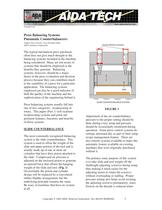
Volume Four Press Balancing Systems Pneumatic Counterbalancers: Author: Steve Overly, Vice President Sales, AIDA-America Corporation The typical mechanical press purchaser often does not give much thought to the balancing systems included in the machine being considered. Many are not aware of systems that should be employed or the benefits they generate. Balancing systems, however, should be a major factor in the press evaluation and decision process because they can contribute much to the suitability of a press for a particular application. The balancing systems employed can also be a good indicator of both the quality of the machine and the sophistication of the engineering behind it. Press balancing systems usually fall into one of two categories: reciprocating or rotary. This paper (Part 1) will examine reciprocating systems and point out pertinent features, functions and benefits of those systems. SLIDE COUNTERBALANCE The most commonly recognized balancing system is the slide counterbalance. This system is used to offset the weight of the slide and upper portion of the tool and is usually made up of one or more air cylinders that have their piston attached to the slide. Compressed air pressure is adjusted on the enclosed piston to generate an upward force that offsets the hanging weight of the slide and tool. (Fig. 1) Occasionally the piston and cylinder design will be replaced by a convoluted rubber bladder arrangement, but the underlying principle remains the same. Be wary of machines that have no system at all. FIGURE 1 Adjustment of the air counterbalance pressure to the proper setting should be done during every setup and pressure should be occasionally monitored during operation. Some press control systems do settings automatically as part of their setup recipe management feature. There are also retrofit systems available to make this automatic feature available on existing machines that were originally purchased without it. The primary static purpose of this system is to take slide and tool weight off the shutheight adjusting screw(s) during setup, thus making it much easier for the adjusting motor to rotate the screw(s) without overloading or stalling. Proper pressure setting also helps avoid wearing the adjusting screw(s) prematurely, since friction on the threads is reduced when Copyright © 2002 AIDA-America Corporation. ALL RIGHTS RESERVED. 1
Open the catalog to page 1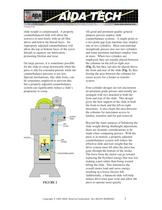
Volume Four slide weight is compensated. A properly counterbalanced slide will allow the screw(s) to turn freely with an oil film above and below the thread faces. An improperly adjusted counterbalance will allow the top or bottom faces of the screw threads to squeeze out lubrication, promoting friction and wear. On large presses, it is sometimes possible for the slide to creep downwards when the press is idle for extended periods while the counterbalance pressure is too low. Special mechanisms, like slide locks, can be sometimes employed to prevent this, but a properly adjusted counterbalance...
Open the catalog to page 2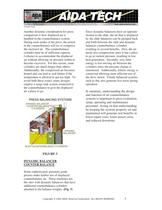
Volume Four Another dynamic consideration for press comparison is how displaced air is handled in the counterbalance system. During each stroke of the press, the piston in the counterbalance will try to compress the enclosed air. The counterbalance cylinder must be of sufficient capacity (volume) to accommodate the displaced air without allowing air pressure within to become excessive. For this reason, some cylinders are much longer than others. Additionally, the compressed air becomes heated and can lead to seal failure if the temperature is allowed to get too high. To avoid both these issues,...
Open the catalog to page 3Archived catalogs
 NC Specs
2 Pages
 DSF-C1-A
1 Page
 CHI
CHI2 Pages
 AIDA - Blanking line
9 Pages
 Total transfer knowledge
3 Pages
 Transfer press
2 Pages
 dsf-c1-n1-n2-specs
6 Pages
 Servo Mechanical Presses
1 Page
 Slide Suspension Designs
4 Pages
 Transfer Technology Systems
4 Pages
 Slide guide systems
4 Pages
 Reverse tonnage
8 Pages
 NC2 Gap Frame Presses
4 Pages
 NC1 Gap Frame Presses
6 Pages
 AIDA Srl COMPANY PROFILE
8 Pages
 AIDA PRODUCT BROCHURE
6 Pages



- Aida industrial press
- Aida forming press
- Aida hydraulic press
- Automatic press
- Vertical press
- Aida electric press
- Cutting press
- Aida stamping press
- Aida frame press
- PLC-controlled press
- Bending press
- Compression press
- Aida sheet metal press
- Four-pillar press
- Straightening press
- Aida straight-side press
- Press for the automotive industry
- C-frame press
- Press for industrial applications