
- Catalogs
- Aida S.r.l.
- Hydraulic Overload Protection - HOLP


- Products
- Catalogs
- News & Trends
- Exhibitions
Hydraulic Overload Protection - HOLP

Hydraulic Overload Protection - HOLP
Hydraulic Over Load Protection (HOLP) is a system designed to prevent damage to mechanical presses by sensing overload conditions and releasing hydraulic pressure in a collapsible cylinder. This allows the slide to be pushed upward by the overload force, protecting the press.
Functions of HOLP
Besides protecting press components, HOLP can:
- Protect a die
- Stop operation in dangerous conditions
- Release a press stuck at the bottom
- Sense when a die needs sharpening
- Reduce connection clearances
- Detect extreme off-center loads
Location and Importance
HOLP is typically located near the lower end of each connection. It is crucial for preventing damage due to overloads, which can occur from various conditions such as incorrect shutheight settings, excessive tonnage requirements, or material misfeeds.
Types of HOLP Systems
HOLP systems vary by actuation mechanism:
- Check Valve: Oldest method, spring-loaded, slow to react, prone to leakage.
- Solenoid Valve: Common, uses a pressure sensor, faster and more accurate than check valves.
- Direct Valve: Fastest and most efficient, used by Aida, eliminates sponginess and is suitable for multi-point presses.
Consequences of Not Having HOLP
Without HOLP, an overloaded press can suffer severe damage, including stretched tie-rods, bent shafts, or cracked components.
Retrofit and Comparison
HOLP systems are best when integrated into the press design and are not easily retrofitted. The Aida direct valve system is noted for its speed and efficiency.
Speed and Effectiveness
Speed is critical for HOLP systems to prevent damage. The Aida system is highlighted for its rapid response, reducing the risk of damage during overloads.
Additional Features
HOLP systems can be adjusted and are designed to prevent sponginess. The Aida system maintains a pressure of 71 psi and resets automatically after an overload.
Conclusion
The Aida HOLP system is a patented design, offering fast activation and reliability without the need for rubber seals or electronic components. It is field-proven in over 10,000 machines worldwide, providing effective overload protection.
Catalog excerpts
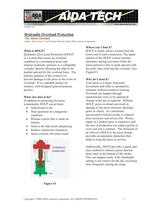
Volume Two Hydraulic Overload Protection The Silent Sentinel Author: Steve Overly, Vice President Domestic Sales, AIDA-America Corporation What is HOLP? Hydraulic Over Load Protection (HOLP) is a system that senses an overload condition in a mechanical press and releases hydraulic pressure in a collapsible cylinder, thereby allowing the slide to be pushed upward by the overload force. The primary purpose of the system is to prevent damage to the press in the event of overload. It is a standard feature on modern, well-designed general-purpose presses. What else does it do? In addition to protecting the press components, HOLP can at times: • Help protect a die • Stop operation in a dangerous condition • Release a press that is stuck on bottom • Sense a die that needs sharpening • Reduce connection clearances • Sense extreme off-center loads Where can I find it? HOLP is nearly always located near the lower end of each connection. The upper portion of the HOLP system remains stationary during activation while the lower portion is free to push upward with the slide, thus relieving the overload. (See Figure#1) Why do I need it? Your press is a major long-term investment and often is operated by someone without extensive training. Overload can happen through unintentional error or by unnoticed change in the die or material. Without HOLP, press overload can result in damage to the press structure, bearings, gears or clutch. At a minimum, uncorrected overload results in reduced press accuracy and service life. Worse, repair of a broken press is expensive and the loss of production can reduce profits or even cost you a contract. The inclusion of an effective HOLP in the press design provides an automatic protection that helps to keep the press in service. Additionally, HOLP provides a quick and easy method to release a press that has been stuck at the bottom of the stroke. This can happen easily if the shutheight setting is not correct for the die, occurring most frequently during die setup. Figure #1 Copyright © 2000 AIDA-America Corporation. ALL RIGHTS RESERVED. 1
Open the catalog to page 1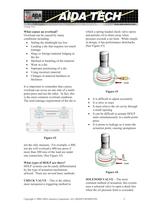
Volume Two What causes an overload? Overload can be caused by many conditions including: • Setting the shutheight too low • Loading a die that requires too much tonnage • Slugs or foreign material lodging in the die • Misfeed or buckling of the material • Wear in a die • Improper positioning of a die • Using incorrect material • Changes in material hardness or thickness It is important to remember that a press overload can occur on one side of a multipoint press and not the other. In fact, this is the most common overload condition. The total tonnage requirement of the die is which a spring-loaded...
Open the catalog to page 2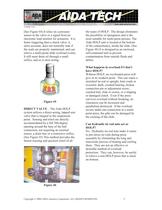
Volume Two (See Figure #4) It relies on a pressure sensor in the valve or a signal from an electronic load monitor for actuation. It is faster triggering than a check valve, is more accurate, does not normally leak if the seals are properly maintained, and can relieve a multi-point slide overload evenly. It still must drain oil through a small orifice, and so is slow acting. Figure #5 DIRECT VALVE – The Aida HOLP system utilizes a direct-acting, lapped seat valve that is integral to the suspension point. Sensing and relief are directly accommodated by a full 360-degree opening around the base...
Open the catalog to page 3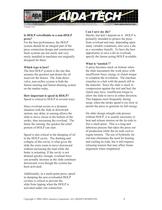
Volume Two Is HOLP retrofitable to a non-HOLP press? For the best performance, the HOLP system should be an integral part of the press connection design and construction. Such systems are not easily and very rarely installed in machines not originally designed for them. Which type is best? The best HOLP system is the one that actuates the quickest and drains the oil reservoir the fastest. The Aida direct valve, non-orifice system is both the fastest reacting and fastest draining system on the market today. How important is speed in HOLP? Speed is critical to HOLP in several ways. Since overload...
Open the catalog to page 4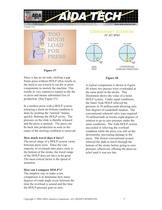
Volume Two Figure #7 Since it has no tie-rods, sticking a gap frame press without HOLP often results in the need to use a torch to cut die or press components to unstick the machine. This results in very expensive repairs to the die or press and means substantial loss of production. (See Figure #7) In a modern press with a HOLP system, releasing a stuck-on-bottom condition is done by pushing the “unstick” button, quickly draining the HOLP cavity. The pressure on the slide is thereby released and the press is unstuck. The press can be back into production as soon as the cause of the sticking condition...
Open the catalog to page 5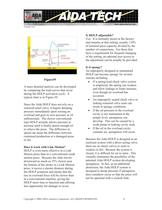
Volume Two Is HOLP adjustable? Yes. It is normally preset at the factory and remains at that setting, usually 110% of nominal press capacity divided by the number of connections. For those that have a requirement for frequent changing of the setting, an optional user access to the adjustment can be usually be provided. Figure#9 A more detailed analysis can be developed by comparing the load curves that occur during the HOLP activation cycle. A typical chart is in Figure #9. Since the Aida HOLP does not rely on a solenoid relief valve, it begins dumping pressure immediately upon sensing an overload...
Open the catalog to page 6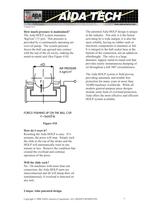
Volume Two How much pressure is maintained? The Aida HOLP system maintains 5kgf/cm2 (71 psi). This pressure is provided by a continuously operating airover-oil pump. The system pressure forces the ball cup upward into contact with the top of the oil cavity, making the metal-to-metal seal (See Figure #10). The patented Aida HOLP design is unique in the industry. Not only is it the fastest activating by a wide margin, it is also the most reliable, having no rubber seals or electronic components to maintain or fail. It is integral to the ball socket base at the bottom of the connection, not an added-on...
Open the catalog to page 7Archived catalogs
 NC Specs
2 Pages
 DSF-C1-A
1 Page
 CHI
CHI2 Pages
 AIDA - Blanking line
9 Pages
 Total transfer knowledge
3 Pages
 Transfer press
2 Pages
 dsf-c1-n1-n2-specs
6 Pages
 Servo Mechanical Presses
1 Page
 Slide Suspension Designs
4 Pages
 Press Balancing Systems
3 Pages
 Transfer Technology Systems
4 Pages
 Slide guide systems
4 Pages
 Reverse tonnage
8 Pages
 NC2 Gap Frame Presses
4 Pages
 NC1 Gap Frame Presses
6 Pages
 AIDA Srl COMPANY PROFILE
8 Pages
 AIDA PRODUCT BROCHURE
6 Pages



- Aida industrial press
- Aida forming press
- Aida hydraulic press
- Automatic press
- Vertical press
- Aida electric press
- Cutting press
- Aida stamping press
- PLC-controlled press
- Bending press
- Compression press
- Aida sheet metal press
- Four-pillar press
- Straightening press
- Aida straight-side press
- Press for the automotive industry
- C-frame press
- Press for industrial applications