
- Catalogs
- Aida S.r.l.
- High speed Needs for Stamping Electrical Components


- Products
- Catalogs
- News & Trends
- Exhibitions
High speed Needs for Stamping Electrical Components
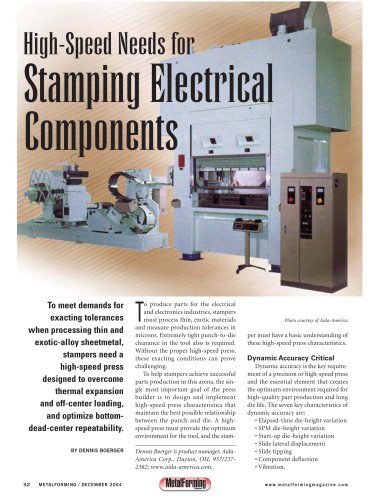
High speed Needs for Stamping Electrical Components
This document discusses the requirements for high-speed presses used in processing thin and exotic-alloy sheet metal, particularly for the electrical and electronics industries. The focus is on overcoming challenges such as thermal expansion, off-center loading, and optimizing bottom-dead-center repeatability.
Dynamic Accuracy
Dynamic accuracy is crucial for high-speed presses to ensure high-quality part production and long die life. The seven key characteristics of dynamic accuracy include elapsed-time die-height variation, SPM die-height variation, start-up die-height variation, slide lateral displacement, slide tipping, component deflection, and vibration.
Thermal Expansion
Thermal expansion during press operation can lead to changes in die height and part dimensional variations. A high-speed press should incorporate a lubrication system with a high-performance oil heater/chiller to maintain a stable die space and prevent changes in shut height.
SPM Die-Height Variation
As press speed increases, shut height can shrink due to increased inertia and stress on components. The ideal solution is a high-speed press that combines anti-friction and oil-film bearings to improve bottom-dead-center repeatability and extend bearing life.
Start-Up Die-Height Variation
This variation occurs when starting and stopping the press, potentially leading to production of defective parts. A high-speed press should be capable of rapid acceleration and deceleration to minimize this issue.
Lateral Displacement and Slide Tipping
Off-center loads can cause lateral displacement and slide tipping, affecting die life and part quality. A high-speed press with a preloaded roller-bearing slide-guide system and wide-spaced connections can mitigate these effects.
Component Deflection and Vibration
Component deflection under load can be minimized with a rigid press structure. Reducing vibration through design and material selection also enhances die life and part quality.
Conclusion
Dynamic accuracy is essential for precision metalforming, optimizing part quality and die life. High-speed presses must be designed to address various challenges, including thermal expansion, die-height variation, and component deflection, to ensure successful production of electrical components.
Catalog excerpts
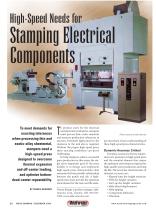
Stamping Electrical Components To meet demands for exacting tolerances when processing thin and exotic-alloy sheetmetal, stampers need a high-speed press designed to overcome thermal expansion and off-center loading, and optimize bottomdead-center repeatability. BY DENNIS BOERGER o produce parts for the electrical and electronics industries, stampers must process thin, exotic materials and measure production tolerances in microns. Extremely tight punch-to-die clearance in the tool also is required. Without the proper high-speed press, these exacting conditions can prove challenging. To help stampers achieve successful parts production in this arena, the single most important goal of the press builder is to design and implement high-speed press characteristics that maintain the best possible relationship between the punch and die. A highspeed press must provide the optimum environment for the tool, and the stam- Dennis Boerger is product manager, AidaAmerica Corp., Dayton, OH, 937/2372382; www.aida-america.com. Photo courtesy of Aida-America per must have a basic understanding of these high-speed press characteristics. Dynamic Accuracy Critical Dynamic accuracy is the key requirement of a precision or high-speed press and the essential element that creates the optimum environment required for high-quality part production and long die life. The seven key characteristics of dynamic accuracy are: • Elapsed-time die-height variation • SPM die-height variation • Start-up die-height variation • Slide lateral displacement • Slide tipping • Component deflection • Vibration. www.metalformingmagazine.com
Open the catalog to page 1
Elapsed-time die-height variation refers to the thermal differences that occur in a press during operation. During production, press components heat up and become larger and longer, causing a change in die height and resulting in part dimensional variations. Since these components are highly susceptible to thermal growth, the press builder must incorporate technology that eliminates thermal expansion. The stamper should consider a high-speed press with a lubrication system that contains a high-performance oil heater/chiller. The lubrication system is pretimed and should run heated oil through...
Open the catalog to page 2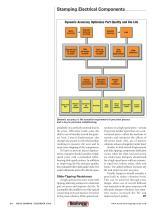
Stamping Electrical Components Dynamic Accuracy Optimizes Part Quality and Die Life Static accuracy Elapsed time die-height variation Dynamic accuracy (no load) Vertical resistance (movement) Slide-drive type Machine parts strength Dynamic accuracy Start-up die-height variation Slide lateral displacement Inclination resistance (parallelism) Slide guide Slide deflection Position shift resistance Clutch brake capacity Lubrication system Control system Dynamic accuracy is the essential requirement of precision presses and is key to precision metalforming. possibility of a perfectly centered load...
Open the catalog to page 3Archived catalogs
 NC Specs
2 Pages
 DSF-C1-A
1 Page
 CHI
CHI2 Pages
 AIDA - Blanking line
9 Pages
 Total transfer knowledge
3 Pages
 Transfer press
2 Pages
 dsf-c1-n1-n2-specs
6 Pages
 Servo Mechanical Presses
1 Page
 Slide Suspension Designs
4 Pages
 Press Balancing Systems
3 Pages
 Transfer Technology Systems
4 Pages
 Slide guide systems
4 Pages
 Reverse tonnage
8 Pages
 NC2 Gap Frame Presses
4 Pages
 NC1 Gap Frame Presses
6 Pages
 AIDA Srl COMPANY PROFILE
8 Pages
 AIDA PRODUCT BROCHURE
6 Pages



- Aida industrial press
- Aida forming press
- Aida hydraulic press
- Automatic press
- Vertical press
- Aida electric press
- Cutting press
- Aida stamping press
- Aida mechanical press
- Aida frame press
- PLC-controlled press
- Bending press
- Compression press
- Aida sheet metal press
- Four-pillar press
- Straightening press
- Aida straight-side press
- Press for the automotive industry
- C-frame press
- Press for industrial applications