

high Strength Glass Fibers

high Strength Glass Fibers
The paper is authored by David Hartman, Mark E. Greenwood, and David M. Miller from Owens Corning Corp. It discusses the evolution of continuous glass fibers since 1935, focusing on their applications in aerospace and commercial sectors due to their strength, durability, and cost-effectiveness.
Introduction
The introduction outlines the history of glass fiber production, starting with the Egyptians and advancing significantly in the 1930s by Owens Corning. The process involves melting raw materials into glass and forming them into fibers.
Glass Fiber Chemical Compositions
This section details the chemical compositions of various glass fibers like A Glass, C Glass, D Glass, E Glass, ECRGLAS®, AR Glass, R Glass, and S-2 Glass®, each designed for specific applications based on chemical stability and resistance.
Glass Fiber Properties
- Physical Properties: Discusses density, tensile strength, and Young’s modulus, noting variations by glass type and environmental conditions.
- Chemical Resistance: Resistance to acids, bases, and water is measured by weight loss, with corrosion slowing over time.
- Electrical Properties: Includes dielectric constant, dissipation factor, and dielectric strength, influenced by environmental factors.
- Thermal Properties: Viscosity decreases with temperature, with S-2 Glass fibers having higher use temperatures than E Glass.
Glass Fiber Size Treatments
Covers chemical sizing applied to fibers to enhance processing and performance.
Fiber Composite Utility
- Composite Properties: Integration of glass fibers into composites enhances mechanical and environmental durability.
- Environmental Durability: Highlights resilience in various conditions.
Tables and Figures
Includes tables and figures with detailed data on compositions, properties, and manufacturing processes, illustrating manufacturing processes, fiber strength at different temperatures, and pH effects on fiber weight retention and strength.
Thermal Properties
Discusses thermal properties like the coefficient of thermal expansion, specific heat, and thermal conductivity, noting lower expansion in high-strength glasses for better stability.
Optical Properties
Refractive index measurements show annealed glass has a slightly higher index than as-formed fibers.
Radiation Properties
E Glass and S-2 Glass fibers show excellent resistance to nuclear radiation, with minimal effects on tensile strength and density.
Glass Fiber Size Treatments
Outlines surface treatment chemistry for different applications, including film formers, lubricants, and coupling agents.
Fiber Composite Utility
Utility depends on glass composition, size chemistry, and fiber orientation, with data on mechanical properties and environmental durability.
Disclaimer
Includes a disclaimer of liability, stating data is a guide and users must test applications for suitability.
Catalog excerpts

TECHNICAL PAPER High Strength Glass Fibers Authors . . . . . . . . . . . . . . . . . . . . .2 Abstract . . . . . . . . . . . . . . . . . . . . .2 Introduction . . . . . . . . . . . . . . . . . .2 Glass Fiber Chemical Compositions . . .2 Glass Fiber Properties . . . . . . . . . . .3 – Physical Properties . . . . . . . . . . . .3 – Chemical Resistance . . . . . . . . . . .3 – Electrical Properties . . . . . . . . . . . .3 – Thermal Properties . . . . . . . . . . . .4 – Optical Properties . . . . . . . . . . . . .5 – Radiation Properties . . . . . . . . . . .5 Glass Fiber Size Treatments . . . . . . . .5 Fiber Composite Utility . . . . . . . . . . .5 – Composite Properties . . . . . . . . . .5 – Environmental Durability . . . . . . . . .5 Acknowledgements . . . . . . . . . . . . .6 References . . . . . . . . . . . . . . . . . . .6 Table 1 Composition Ranges for Glass Fibers . . . . . . . . .7 Table 2 Properties of Glass Fibers -Physical Properties . . . . . . .7 Table 3 Properties of Glass Fibers -Chemical, Electrical and Thermal Properties . . .8 Table 4 Glass Fiber Size Chemistry Summary . . . . . . . . . . . . .9 Table 5 S-2 Glass® Fiber Unidirectional Epoxy Composite Properties .9 Figure 1 Continuous Glass Fiber Manufacturing Process . . .10 Figure 2 Fiber Strength at Temperature . . . . . . . . . .10 Figure 3 Fiber Weight Retention vs. pH Exposure . . . . . . . .10 Figure 4 Fiber Strength vs. pH Exposure . . . . . . . . . . . . .11 Figure 5 Glass Viscosity vs. Temperature . . . . . . . . . .11 Figure 6 Thermal Expansion vs. Volume In Epoxy . . . . . . . .11 Figure 7 Dielectric vs. Fiber Volume In Epoxy . . . . . . . .11 Figure 8 Environmental Stress Rupture In Epoxy . . . . . . . .11 Figure 9 Environmental Stress Rupture In Epoxy . . . . . . . .11
Open the catalog to page 1
High Strength Glass Fibers Authors In 1996 this paper was written in collaboration with David Hartman, Mark E. Greenwood, and David M. Miller who were employed at the time by Owens Corning Corp. Mr. Hartman received his degree in chemistry from David Lipscomb University and an M.S. degree in chemistry from Georgia Institute of Technology with emphasis in textile and plastic engineering. Mr. Greenwood received his B.S. and M.S. degrees in Civil Engineering from Purdue University, with an emphasis in structural design. Dr. Miller received his Bachelor’s, Master’s, and Ph.D. degrees in Ceramic Engineering...
Open the catalog to page 2
oxide components and their weight ranges for eight types of commercial glass fibers [1-6]. 3. Glass Fiber Properties Glass fiber properties, such as tensile strength, Young’s modulus, and chemical durability, are measured on the fibers directly. Other properties, such as dielectric constant, dissipation factor, dielectric strength, volume/surface resistivities, and thermal expansion, are measured on glass that has been formed into a bulk sample and annealed (heat treated) to relieve forming stresses. Properties such as density and refractive index are measured on both fibers and bulk samples,...
Open the catalog to page 3
of the material to store an electrical charge. Permittivity values are affected by test frequency, temperature, voltage, relative humidity, water immersion, and weathering. The dissipation factor of a dielectric is the ratio of the parallel reactance to the parallel resistance, or the tangent of the loss angle, which is usually called the loss tangent. It is also the reciprocal of the quality factor, and when the values are small, tangent of the loss angle is essentially equal to the power factor, or sine of the loss angle. The power factor is the ratio of power in watts dissipated in the dielectric...
Open the catalog to page 4
glass [20]. Using this calculation, it is found that the approximate thermal conductivity of C Glass is 1.1 W/mK, E Glass is 1.3 W/m•K, and S-2 Glass fibers is 1.45 W/m•K near room temperature. 3.5 Optical Properties – Refractive index is measured on either unannealed or annealed glass fibers. The standard oil immersion techniques are used with monochromatic sodium D light at 25°C. In general, the corresponding annealed glass will exhibit an index that will range from approximately 0.003 to 0.006 higher than the as-formed glass fibers given in Table 2. 3.6 Radiation Properties – E Glass and S-2...
Open the catalog to page 5
hydroxide solution with a pH of 13. For reference, the initial tensile strength of the composite rod was 2070 MPa. The stress rupture behavior of an S-2 Glass fibers/ epoxy rod in this test indicates a long-term stress capability of 65% of the initial ultimate tensile stress. As expected, the stress rupture behavior of the composite material is affected by the presence of the environment. The long-term stress capability of this material in the high pH environment is roughly 50% of the initial ultimate tensile strength. A second test series compared the stress rupture performance of E glass and...
Open the catalog to page 6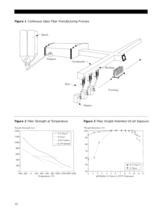
Figure 1 Continuous Glass Fiber Manufacturing Process Figure 2 Fiber Strength at Temperature Figure 3 Fiber Weight Retention VS pH Exposure
Open the catalog to page 10
Tensile Strength (ksi) Viscosity (Poise) pH Buffer (24 hour at 205 °F Exposure) Temperature (°F) Coef Thermal Expansion (10 6/°C) Fiber Volume Fraction Dielectric Constant Fiber Volume Fraction Time to Failure (hours) Time to Failure (hours)
Open the catalog to page 11
WORLD HEADQUARTERS/AMERICAS EUROPEAN OFFICE 2558 WAGENER ROAD 163 BOULEVARD DES ETATS UNIS AIKEN, SOUTH CAROLINA, USA 29801 69008 LYON, FRANCE PHONE: +1.888.434.0945 (toll free] PHONE: +33.4.72.78.1777 This data is offered solely as a guide in the selection of a reinforcement. The information contained in this publication is based on actual laboratory data and field test experience. We believe this information to be reliable, but do not guarantee its applicability to the user's process or assume any liability arising out of its use or performance. The user, by accepting the products described...
Open the catalog to page 12All Agy catalogs and technical brochures
 401 S-2 Glass® Chopped
2 Pages
 AGY Advanced Materials
2 Pages
 463 S-2 Glass® Roving
2 Pages
 933 S-2 Glass® Roving
2 Pages
 S-1 HM®
2 Pages
 365 S-2 Glass® Roving
2 Pages
 493 S-2 Glass® Yarn
2 Pages
 762 S-2 Glass® Yarn
2 Pages
 Technical Product Guide
25 Pages
 S-3 HDI? Yarn
2 Pages
 Ultrafine E-Glass Yarns
2 Pages
 449 S-2 Glass® Roving
2 Pages
 636 S-2 Glass®Yarn
2 Pages
 MATERIAL SAFETY DATA SHEET
11 Pages
 MATERIAL SAFETY DATA SHEET
14 Pages
 S-2 Glass ® Fibers
2 Pages
 Advanced Materials
20 Pages
 S-1 HM GLASS?
2 Pages
 CFM
CFM2 Pages
 636 Yarn
2 Pages
 AGY 947
2 Pages
 L-Glass™Fiber
2 Pages


Archived catalogs
 S-2 GlassArmor Systems
6 Pages
 S-2 Glass® Fiber
12 Pages
 Glassfiber Reference Guide
12 Pages