
- Catalogs
- Afpro Filters
- air filter catalogue

air filter catalogue

air filter catalogue
AFPRO Filters released a new product catalog in 2013, featuring a wide range of standard and new products, including the HD-series and HQ-series filters. The company has been a leader in air filtration for over 30 years, focusing on innovation and global availability.
AFPRO Filters emphasizes energy reduction and environmental care, participating in ISO and Eurovent committees to establish air filtration standards. Energy labels have been introduced for product comparison based on performance and energy consumption.
The catalog discusses the new EN779:2012 standard, highlighting the importance of air quality in work environments and the impact of fine dust.
Filters are crucial for trapping harmful particles while allowing air to pass through. Fine particles pose health risks, especially to vulnerable populations. Adequate filtration can mitigate the effects of poor indoor air quality.
AFPRO Filters provides solutions for various industries, including nuclear, gas turbines, semiconductor manufacturing, and pharmaceuticals, each with specific filtration requirements.
Air filters reduce airborne particles through adsorption and various effects: sieve, inertial mass, interception, and diffusion.
Filters are classified under EN779:2012 for coarse and fine filters and EN1822:2009 for HEPA and ULPA filters. AFPRO Filters ensures compliance with these standards.
- Particle Size Efficiency: Efficiency percentages for different particle sizes across various standards such as Eurovent, ASHRAE, and EN 1822.
- ASHRAE Standards: Discusses ASHRAE 52.1 and 52.2 standards, highlighting classifications based on average efficiency and MERV.
- EN 1822: Focuses on initial efficiency based on the Most Penetrating Particle Size (MPPS).
- Eurovent Certification: Ensures filters meet design specifications and energy consumption levels through independent testing.
- Energy Labels: Help identify energy-efficient filters, classified from A to G based on energy consumption.
- EN779:2012 Revision: Introduces Minimum Test Efficiency (MTE) for fine filters, affecting classifications.
- Importance of Energy-Efficient Filters: Highlights cost implications of energy consumption in air filtration.
- Calculation of Energy Costs: Provides equations for calculating energy consumption.
The document underscores the significance of adhering to updated standards and certifications to ensure filter efficiency, energy savings, and compliance with international norms.
- Application: Prefilters for HVAC, industry, spray booths.
- Frame: Firm cardboard or galvanized steel.
- Media: Synthetic or glass fiber paper.
- Filter Class: G2, G3, G4, M5, M6, F7, F9 according to EN 779:2012.
- Maximum Pressure Drop: 250 Pa for G4, 450 Pa for M5 and above.
- Temperature and Humidity: Max 70°C and 90% RH.
- Application: Pre- or fine filters in HVAC systems.
- Frame: Plastic, steel, or aluminum.
- Media: Polymer and glass fibers.
- Filter Class: G3 to F9, certified by EUROVENT.
- Maximum Pressure Drop: 450 Pa.
- Temperature and Humidity: Max 70°C and 95% RH.
- Filters are rated from A (most efficient) to G (least efficient) based on energy consumption.
- Compliance with EN779:2012 ensures improved filter media and efficiency.
- Life Cycle Cost (LCC) analysis is recommended for sustainable choices.
Application: Fine filters for HVAC and industrial use. The filters are made with an aluminum frame and glass fiber media. They are classified according to EN779:2012 standards, with a maximum final pressure drop of 450 Pa, a maximum temperature of 70°C, and a maximum relative humidity of 90%.
Advantages include a lightweight frame, high dust-holding capacity, constant efficiency, and high energy efficiency. The series offers various models with different dimensions, filter classifications, and energy labels, suitable for different airflow and pressure drop requirements.
Similar to the HQ65 series, the HQ85 series also features a lightweight frame and high dust-holding capacity. It includes models with F7 filter classification, offering different pocket numbers, filter surfaces, and energy labels.
This series is designed for fine filtration with F9 classification. It maintains the same advantages as previous series, with models offering various dimensions and energy labels to cater to different airflow and pressure drop needs.
Heavy-duty filters that withstand extreme pressure, are totally combustible, and have a unique self-supporting filter medium. They are available in G4, M5, and M6 classifications, with high dust-holding capacity and lightweight frames.
Prefilters for HVAC and industrial applications, made with plastic frames and synthetic media. They are totally combustible and lightweight, with G3 and G4 classifications according to EN779:2012 standards.
The document provides detailed specifications and advantages of various types of filters used in HVAC and industrial applications. It includes information on bag filters, compact filters, and HPQ filters, highlighting their construction, applications, and performance characteristics.
- Specifications: Used as prefilters in HVAC and industrial settings. They have a plastic frame with optional galvanization, synthetic spacers, and a continuous poured gasket. The filter class is M5 according to EN779:2012, with a maximum pressure drop of 250 Pa, temperature of 70°C, and relative humidity of 90%.
- Advantages: Lightweight, totally combustible, and high dust-holding capacity.
- Qualities: Mini-pleated filters with high filtration efficiency, made using a wet-laid paper technique. They offer large filter areas, are moisture and corrosion-resistant, and have low energy consumption.
- Applications: Used in air conditioning units, industrial systems, and as pre-filters for clean rooms.
- Installation: Proper installation is crucial to avoid leaks and damage. The system should run for a few hours post-installation to achieve optimal results.
- Specifications: Suitable for HVAC and industrial applications, with a plastic frame and fiberglass media. They have a maximum pressure drop of 450 Pa, temperature of 65°C, and relative humidity of 90%. Prefilters are recommended for use with these filters.
- Advantages: Compact design, low pressure drop, and high airflow capacity.
The document includes tables listing various filter models with their dimensions, filter class, airflow, pressure drop, and energy labels. These tables provide a quick reference for selecting the appropriate filter based on specific requirements.
- Application: HVAC, Industry
- Frame: Plastic
- Spacers: Hotmelt
- Bonding: 2-component polyurethane
- Media: Synthetic medium with activated carbon
- Gasket: Continuous poured gasket
- Filter class: M6 according to EN779:2012
- Maximum final pressure drop: 350 Pa
- Maximum temperature: 65°C
- Maximum relative humidity: 90%
- Recommendation: Use a prefilter
- Small construction space
- Low pressure drop
- High efficiency particle air filters (HEPA) provide high air quality.
- Tested according to EN1822 standard.
- Applications include hospitals, nuclear industry, cleanrooms, and more.
- Available in various thicknesses and configurations for different applications.
- Consistent performance
- Large filter surface
- Low energy consumption
- Robust construction
- Avoid touching the pleat package to prevent damage.
- Validate each filter after installation.
- Maintain records of test reports and installation details.
- Do not exceed the flow rate by more than 25%.
- Applications: Cleanrooms, asbestos remediation, operating rooms
- Frame: MDF, galvanized steel, or stainless steel
- Spacers: Aluminium or Hotmelt
- Bonding: Double-component polyurethane
- Media: Glassfiber paper
- Gasket: Frothed polyurethane
- Filter class: E10, E11, H13, H14 according to EN1822
- Maximum pressure drop: 500 Pa
- Maximum temperature: 70°C
- Maximum relative humidity: 90%
- Low pressure drop
- High airflows
- Delivered with a test certificate
HEPA filters are designed for use in cleanrooms and operating rooms, featuring a lightweight construction with extruded aluminum frames, hotmelt spacers, and glass fiber paper media. They are available in filter classes E10, E11, H13, and H14 according to EN1822 standards. The maximum recommended final pressure drop is 500 Pa, with a maximum operating temperature of 70°C and relative humidity of 90%.
- Frame: Extruded aluminum
- Spacers: Hotmelt
- Bonding: 2-component polyurethane
- Media: Glass fiber paper
- Gasket: Frothed polyurethane or knife construction for gelseal mounting
- Lightweight construction
- Each filter comes with a test certificate
- Fitted with two protection grids
This series includes filters with dimensions ranging from 610x1524x110 mm to 915x1830x110 mm, with airflow capacities from 1500 m3/h to 2700 m3/h and pressure drops of 60 Pa for H13 class filters.
Filters in this series have dimensions from 305x305x150 mm to 915x1830x150 mm, with airflow capacities from 150 m3/h to 2700 m3/h and pressure drops of 65 Pa for E10 and E11 class filters, and 120 Pa for H13 class filters.
This series features filters with dimensions from 305x305x102.5 mm to 915x1830x102.5 mm, with airflow capacities from 150 m3/h to 2700 m3/h and pressure drops of 65 Pa for E10 class filters, 80 Pa for E11 class filters, and 120 Pa for H13 class filters.
It is advised to validate the functioning of air handling units after the installation of new HEPA filters due to potential damage during transport or installation.
- Application: Cleanrooms, operating rooms
- Frame: Extruded aluminum
- Spacers: Hotmelt
- Bonding: 2 component polyurethane
- Media: Glasfibre paper
- Gasket: Gelseal
- Filter Class: E10, E11, H13, H14 according to EN1822
- Maximum Pressure Drop: 500 Pa
- Maximum Temperature: 70°C
- Maximum Relative Humidity: 90%
- Lightweight construction
- Delivered with a test certificate
- Excellent seal with gelseal frame
- Fitted with 2 protection grids
- Application: Airports, industry, catering, museums, archives
- Frame: Galvanized or stainless steel
- Activated Carbon: Coal-based carbon (pellets)
- Gasket: Neoprene
- Maximum Temperature: 40°C
- Maximum Relative Humidity: 70%
- Refillable
- High dust holding capacity
- Straightforward assembly
- Designed for museums and archives with a maximum temperature of 40°C and relative humidity of 70%.
- Constructed with neoprene gaskets and activated carbon panels to adsorb gaseous impurities (<100 ppm vol.).
- Firm construction and high dust-holding capacity are key advantages.
- Installation and maintenance instructions are provided separately.
Filter Medium
- AFPRO Filters offer high-quality fibers with high particle interception capacity, available in synthetic and glass fiber media.
- Filter classes range from G2 to F5, suitable for various applications like spray-painting booths.
- Easy installation and customizable sizes are notable benefits.
Synthetic Filter Material
- Used as prefilters in HVAC and industry, made of polyester with filter classes G2 to M5.
- Maximum temperature of 70°C and relative humidity of 90%.
- High dust-holding capacity and easy customization are key features.
Glass Filter Medium
- Applicable for spray booths and gas turbines, made of glass fiber with a filter class of G3.
- Maximum temperature of 80°C and relative humidity of 90%.
- Very high dust-holding capacity is a significant advantage.
Holding Frames
- Facilitate easy and leak-tight installation of filters, made from galvanized or stainless steel.
- Endless gasket and pre-drilled holes ensure robust and swift fitting.
- Used in air treatment cabinets and air inlet systems.
Recommendations and Tips
- EN 13779 standard outlines performance requirements for indoor air quality, considering outdoor air quality levels (ODA1 to ODA3).
- Filter classes M5 to F9 are recommended based on desired indoor air quality (IDA1 to IDA4).
- Filter efficiency is determined by the penetration factor, with recommendations for filter replacement based on economic and hygiene considerations.
Air filtration systems require filters of at least class F5 for return and extraction air to protect systems adequately. The document outlines the initial and terminal resistance for various filter classes (G4, M5, M6, F7, F8, F9) and their corresponding airflow volumes and airspeeds. Replacement frequencies for filters are specified in operating hours and years, with the first filter stage needing replacement every 2000 hours or one year, and the second stage every 4000 hours or two years.
Regular inspection and maintenance of air filters and systems are crucial for optimal operation. Key recommendations include installing the first filter stage close to the air intake, ensuring filter sections are accessible for inspection, and maintaining constant airflow to avoid surges. Filters should be replaced if damaged or saturated, and proper disposal methods should be followed for filters containing harmful substances.
Energy consumption is a significant cost factor in filtration systems, accounting for approximately 70% of overall costs. The document provides a formula to calculate energy consumption based on airflow volume, average resistance, operating hours, and fan efficiency. Filter efficiency is determined by the percentage of particulate matter trapped, with tests available at AFPRO Filters’ laboratory.
The document compares international norms for air quality classification, including ISO standards and US FED standards. It outlines maximum permissible concentrations of particles in cleanrooms and clean zones, providing a framework for maintaining sterile environments.
General conditions for contracts with Afpro Filters B.V. are outlined, including the definition of offers, intellectual property rights, and delivery terms. Price changes, delivery conditions, and the engagement of third parties are also addressed, emphasizing the importance of written confirmation for any contractual changes.
Transport is at the customer's expense and risk, and insurance is recommended. The customer is liable for any loss or damage to goods used in executing an assignment unless they are at Afpro Filters B.V.'s workplace.
Afpro Filters B.V. is not liable for obligations hindered by unforeseen circumstances beyond their control, such as strikes or supplier failures. Contracts can be dissolved if force majeure persists beyond two months.
A six-month guarantee is provided for goods and work, excluding normal wear and tear or misuse. Defects must be reported within 14 days. Afpro Filters B.V. may choose to repair, replace, or credit the customer.
Liability is limited to the insurance payout or €15,000 if uninsured. Afpro Filters B.V. is not liable for consequential damages or third-party claims.
Afpro Filters B.V. retains ownership of goods until all obligations are fulfilled. The customer must provide substitute security if retention of title is unenforceable.
Payment is due upon delivery or within 30 days. Default incurs 1.5% monthly interest and additional costs. Contracts may be dissolved if the customer loses asset control.
All agreements are governed by Dutch law, excluding international regulations. Disputes are resolved in the District Court of Alkmaar. The Dutch text prevails over translations.
Catalog excerpts
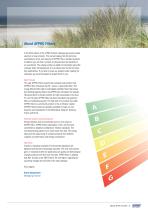
OVERIGE PRODUKTEN About AFPRO Filters In the 2013 edition of the AFPRO Product catalogue we present a wide spectrum of new products. This revised catalog lists the technical specifications of the vast majority of AFPRO Filters’ standard products. In addition you will find a number of enhanced and new products to our assortment. The catalog contains a wealth of information about the company itself, the background of its products and, last but not least, their applications. If you wish to pose any questions after reading the catalogue, we would be pleased to answer them for you. New Products This...
Open the catalog to page 2
About AFPRO Filters Filtration is vitally important The principles of air filtration European filter classification Eurovent-certification Energylabels The Importance of Energy Efficient Filters The power of AFPRO Filters AFPRO Filters’ laboratories AFPRO Filter services Productspecifications Panel filters Bag filters Compact filters HEPA filters Active carbon filters Other products • Filter media • Holding frames Recommendations and tips Guidelines for installation and maintenance Tips for maintenance, replacement and disposal Calculations International norm Terms of delivery
Open the catalog to page 3
OVERIGE PRODUKTEN other gasses and particles Filtration is vitally important The air surrounding us comprises 78% nitrogen, 21% oxygen and 1% various gases and solid particles. This last component listed comprises such elements and compounds as noble gases, carbon dioxide, fine particles, salts and gas emissions from motor traffic and industry. Although one percent sounds like very little, it does determine whether the air quality is considered healthy or unhealthy. Although the operation of a filter may appear very simple in theory, filters are in fact highly complex products. The filter fibres...
Open the catalog to page 4
The principles of air filtration The sieve effect The sieve effect is one most commonly applied in air filters. The principle of the sieve effect is very simple: The particle is larger than the gap between the media fibres and therefore gets trapped. There are two basic types of air filter: Filters for solids and filters for gaseous particles. Both types have the same objective, to reduce the concentration of airborne particles. Gaseous particles can be filtered out by means of adsorption. Adsorption is brought about by London dispersion forces, or Van der Waal’s forces, which act between the...
Open the catalog to page 5
OVERIGE PRODUKTEN SIEVESIEVE EFFECT EFFECT SIEVE EFFECT SIEVE EFFECT filter fibre fibre filter filter fibre fibre filter INERTIAL MASS EFFECT INERTIAL MASS EFFECT INERTIAL MASS EFFECT INERTIAL MASS EFFECT particle particle particle particle airflow airflow airflow airflow particle particle path path particle path path particle DIFFUSION EFFECT DIFFUSION EFFECT DIFFUSION EFFECT DIFFUSION EFFECT filter fibre fibre filter filter fibre fibre filter particle particle particle particle filter fibre fibre filter filter fibre fibre filter particle particle particle particle airflow airflow airflow airflow...
Open the catalog to page 6
European filterclassification How can one establish, as the end-user, whether a filter will provide the envisaged air quality? Throughout Europe, air filters are classified according to two standards: EN779:2012 for course and fine filters, and EN1822:2009 for HEPA and ULPA filters. Filters that are tested for compliance with these standards naturally meet stringent requirements. During such tests, the filters are exposed to circumstances which indicate precisely how they will perform in practice. As the customer, it is a comforting thought to know that all the products AFPRO Filters supplies...
Open the catalog to page 7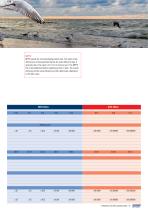
MPPS MPPS stands for most penetrating particle size. This refers to the dimensions of those particles that are the most difficult to trap. It generally lies in the region of 0.1 to 0.2 microns (μm). The MPPS has to be established before subjecting a filter to tests. The overall efficiency and the local efficiency are then determined, depending on the filter class. HEPA Filters ULPA Filters
Open the catalog to page 8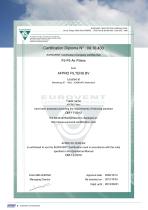
EUROVENT CERTIFICATION COMPANY SCRL 53 rue Turbigo 75003 Paris FRANCE - RCS Paris B 393 363 460 - Code APE : 748K Accreditation # 5-0527 Industrial Product Certification according to ISO/IEC guide 65:1996 or EN 45011:1998 Scope and validity at www.cofrac.fr International recognition EA/IAF Certification Diploma N° : 09.10.433 EUROVENT Certification Company certifies that AFPRO FILTERS BV Located at Berenkoog 67 - 1822, ALKMAAR, Netherland Trade name AFPRO Filters have been assessed according the requirements of following standard The list of certified products is displayed at : is authorised...
Open the catalog to page 9
OVERIGE PRODUKTEN Eurovent certification AFPRO Filters complies with the stringent requirements applicable for Eurovent certification. Eurovent is the European association of air conditioning suppliers, which has developed a certification programme in cooperation with various air filter manufacturers. Eurovent’s aim in introducing certification is to promote fair competition in the filter sector. We are pleased to inform you of the benefits that this significant quality mark offers you. The Eurovent certificate is your guarantee • that your air filters have been tested by independent laboratories...
Open the catalog to page 10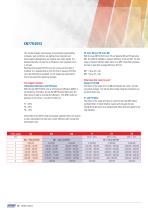
EN779:2012 The society changes continuously. Environmental responsibility increases, work conditions are getting more important and technological developments are chasing each other rapidly. It is therefore that after 10 year the air filtrations’ most important norm is revised. Recently the European EN779 norm for course and fine dust is modified. It is expected that as from the first of January 2013 this norm will officially be accepted. To this respect we would like to inform you about the upcoming changes. Two biggest changes Introduction Minimum Test Efficiency With the new EN779:2012 norm...
Open the catalog to page 11
Energy labels The Eurovent energy labels are used as from the 1 st of January 2012 by all Eurovent members with their G4 till F9 filters. Convenient for you, cause this enables you to select the desired energy classification and its corresponding usage. The energy labels only relate to those filters that are in accordance with the new EN779:2012 and that are in the range G4 till F9 with a nominal debit of 3400m3/h. The energy label can be found on the quotation, the boxes, the filter frame, our The energy consumption is determined using the following equation: t = operating time (hours) Filters...
Open the catalog to page 12All Afpro Filters catalogs and technical brochures
 PARTICULATE MATTER
3 Pages