
- Catalogs
- Advanced Machine & Engineering
- TI-E10 Electropneumatic Module EPM


TI-E10 Electropneumatic Module EPM

TI-E10 Electropneumatic Module EPM
The Electropneumatic Module (EPM) serves as an interface between the electrical power supply/control and the pneumatic SITEMA clamping head. It is suitable for pneumatic clamping heads with an operating pressure up to 5 bar and can be used where no stationary pneumatic system is available.
Function
The EPM operates with a 24 V supply voltage and controls the outlet pressure needed for the pneumatic clamping head. If the voltage fails, the pressure is automatically released. An alarm signal can be integrated into the machine control to monitor functionality.
Structure
The EPM includes components like an oil-free compressor and a pressure control valve. It uses a 24 V input to energize an electromagnetic valve, pressurizing the clamping head. The air is filtered from the environment.
Connection to Clamping Head
The connection requires a pneumatic hose, a dump valve, and a hose connector. A connection kit is recommended for ease of installation.
Technical Data
The EPM requires a 24 V DC power supply with specific current and power requirements. It includes details on the connection kit and dimensions for mounting.
Power Requirement
The EPM needs a 24 V DC voltage with a maximum current of 8 A. It requires a specific fuse for overload protection and a 4-core cable for electrical connection.
Control
Internal pressure regulation and temperature control are included to prevent overheating. The electromagnetic valve is controlled by the machine control input signal.
Operating Conditions
The EPM should be in a dry, clean environment. It is not suitable for explosive areas and should be protected from certain chemicals.
Required Risk Assessment
The EPM must be selected and arranged according to EN ISO 12100:2010 risk assessment standards.
Regular Performance Tests
Functional checks should be conducted regularly.
Maintenance
Maintenance involves regular functional checks. Repairs should be conducted by SITEMA to ensure proper functioning.
Catalog excerpts
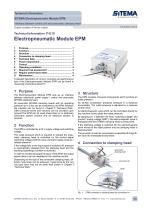
A detailed description of control, mounting and performance test of the Electropneumatic Module EPM can be found in “Assembly Instructions MA-E11". 1 Purpose The Electropneumatic Module EPM acts as an interface between (electrical) power supply / control and pneumatic SITEMA clamping head. All pneumatic SITEMA clamping heads with an operating pressure up to 5 bar can be controlled by the EPM. Admissible volumes can be found in Chapter 5 “Technical Data". Other pressure levels and volumes can be provided upon request.The EPM can be used where there is no stationary pneumatic system present and an electrical solution is required. 2 Function The EPM is controlled by a 24 V supply voltage and switching voltage. The outlet pressure which is required to actuate the pneumatic clamping head is controlled by the control signal (switching voltage) with the input command “apply pressure / release pressure”. If the voltage fails or the input signal is switched off, pressure is automatically released from the clamping head and the resulting (operating) condition is achieved. In order to monitor the proper function of the EPM, the output signal (alarm) can be integrated in the machine control. Depending on the type of the connected clamping head, different cycle times can be achieved. Cycle times for the various type sizes may not be lower than shown in Chapter 5 “Technical Data". 3 Structure The EPM consists of several components which produce an outlet pressure. An oil-free compressor produces pressure in a pressure accumulator. The outlet pressure is adjusted by a pressure control valve. An electromagnetic valve which can be controlled directly by the machine control pilots the outlet pressure. By applying 24 V between the input “switching voltage” and ground (“supply voltage GND”), the electromagnetic valve is energized and the SITEMA clamping head is pressurized. If the switching voltage is switched off, the electromagnetic valve moves to the initial position and the clamping head is depressurized. The air which is used for compression is absorbed through filters from the immediate environment. SITEMA GmbH & Co. KG . G.-Braun-StraUe 13 . D-76187 Karlsruhe . Phone: +49(0)721/98661-0 . Fax: -11 . www.sitema.com
Open the catalog to page 1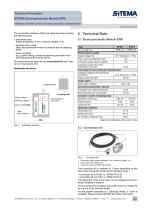
Subject to modification without prior notice The connection between EPM and clamping head requires the following parts : • pneumatic hose (external diameter: 4 mm, maximum length: 3 m) • optional: dump valve (size: see connection thread of pressure port at clamping head) • hose connector (e.g. push-in fitting; connector between pneumatic hose and clamping head or dump valve) We recommend our ready for use connection kit (see Chapter 5.2 “Connection kit”). 1 Pneumatic hose (external diameter: 4 mm, maximum length: 3 m) 2 Dump valve with sealing ring 3 Quick-acting push-in fitting with sealing The...
Open the catalog to page 2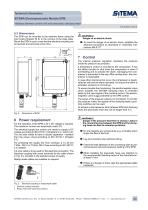
5.3 Dimensions The EPM can be mounted to the machine frame using the bore holes (threads: M 6) in the corners of the base plate. Mount the EPM in such a way that the electrical coupling can be reached and removed at any time. 6 Power requirement For the operation of the EPM a 24 V DC voltage is required. The maximum current can temporarily reach 8 A. The electrical supply and control unit needs to supply a DC voltage according to IEC 61010-1 (Chapters 6.3.1 and 6.3.2). The unit also needs to have a double separation / isolation from the power circuit according to IEC 61010-1 (Chapter 6.7). For...
Open the catalog to page 3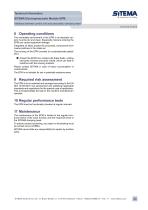
8 Operating conditions The immediate environment of the EPM in its standard version must be dry and clean. Especially moisture entering the EPM can cause equipment damage. Integrated air filters protect the pneumatic components from coarse particles in the intake air. The housing of the EPM consists of a polycarbonate plastic (PC). K Protect the EPM from contact with brake fluids, cooling lubricants, thinners and other media, which can lead to reactions with the housing material. Please contact SITEMA in case of heavy accumulation of contaminants. The EPM is not suitable for use in potentially...
Open the catalog to page 4All Advanced Machine & Engineering catalogs and technical brochures
 KTE40-1000
2 Pages
 P-SERIE
4 Pages
 F-SERIES
4 Pages
 B20 Dimensions Spring base
2 Pages
 F60 Dimensions, type KFHA
6 Pages
 Z10 Auto-Bleeder
3 Pages
 STB10 Rod Attachment STB
3 Pages
 M11 Dimensions MVA
1 Page
 KRM Safety Catcher
3 Pages
 Company Brochure
15 Pages
 F23 KFPD for torque
3 Pages
 Product Brochure
8 Pages
 TI-F50
6 Pages
 TI-S11
1 Page
 TI-B11
1 Page
 TI-A12
1 Page
 TI-A11
2 Pages
 TI-A10
7 Pages
 OppSystem-Section
24 Pages
 Accessories-Section
8 Pages
 tripoxyMINERAL
32 Pages
 aptoCLAMP
22 Pages
 microCLAMP
40 Pages
 triCENTRO
34 Pages
 powerCLAMP & 5axes powerCLAMP
90 Pages
 OTT - Worm Gears
162 Pages
 Shaft-Measurement
4 Pages
 Air-To-Electronic_Columns
4 Pages
 SPIETH Catalog
100 Pages
 SPEEDCUT
4 Pages
 AMLOCK_RLN Pneumatic Rodlock
16 Pages
 AMSAW Rail Saw Brochure
2 Pages
 AMSAW S-Series
6 Pages
 Amsaw P-Series
4 Pages
 AME Company Overview
20 Pages
 AMROK Workholding Solutions
23 Pages
 AMROK Tombstones
16 Pages
 AMROCK Modular Workholding
80 Pages


