


- Company
- Products
- Catalogs
- News & Trends
- Exhibitions
ADDAX IMS

ADDAX IMS
- Scope: The ADDAX IMS addresses modern electricity metering challenges within the AMI framework, offering solutions for meter reading, data collection, processing, communication, and analysis.
- Document Structure: The document outlines the ADDAX Metering Solutions, detailing system features, architecture, communication, key functions, advantages, deployment, and references.
- Main Features: The system is open-standard based, scalable, easy to deploy, secure, business-oriented, supports real-time metering, and is tamper-proof.
- Overall Architecture: Describes the structure and main components of the ADDAX IMS, including smart meters, data concentrators/routers, customer interface units, and the Smart Integrated Metering System (SIMS).
- Channels and Interfaces: Details various communication methods such as PL LV communication, hybrid solutions, M-Bus, and RS485 interfaces.
- Functions: Includes identification, device registration, parameterization, synchronization, manual acquisition, data export, alarm handling, logging, scheduling, repetition mechanism, software platform, task management, network management, and security solutions.
- Features: Anti-fraud protection, balance metering, demand-side management, electricity quality control, and multi-utility metering.
- Deployment: Information on system deployment is provided.
- References: Lists sources and additional documentation.
The document outlines the architecture and components of the ADDAX Advanced Metering Infrastructure (AMI) solution, focusing on its ability to identify potentially fraudulent behavior through energy balance analysis. The system is structured in a three-level architecture, comprising customer devices, communication management, and a data collection system.
- Overall Architecture: The ADDAX IMS solution features a three-level architecture. The lower level includes customer devices like smart meters and interface units. The intermediate level manages communication between endpoint equipment and the Master Station, using technologies such as PLC LV, Hybrid PLC+RF, and 3GPP/Ethernet. The upper level consists of a Data Collection System that interfaces with MDMS and billing systems.
- Smart Meters: ADDAX smart meters are available in various configurations, supporting two-way communication and equipped with PLC-modems or 3GPP modules. They record detailed energy consumption data and support remote parameterization and software upgrades.
- Data Concentrator/Router: Facilitates communication between endpoint devices and the Head-End System (HES), supporting up to 1000 devices and ensuring data synchronization and transmission.
- Customer Interface Unit (CIU): Displays metering data and supports remote load control, providing user information via an LCD and enabling communication with the Master Station.
- Smart Integrated Metering System (SIMS): A software component that manages real-time meter reading, remote parameterization, and data export to billing systems, supporting up to 500,000 meters.
- Communication Channels: The system supports two-way communication, with upstream data transmission from meters to the Master Station and downstream commands for remote operations.
- PL LV Communication: Utilizes existing communication lines for low-cost data transmission, supporting standards like OFDM PRIME and G3-PLC.
- Hybrid Solution: Combines PLC and RF networks for flexible connectivity, using open standards for interoperability.
- M-Bus and RS485 Interfaces: Facilitate communication with home appliances and support multidrop configurations for meter connections.
- Identification: Each meter and measurement value is identified using COSEM standards and various device IDs.
- Device Registration and Parameterization: New meters are automatically registered, and parameterization can be done remotely or manually.
- Synchronization: Continuous remote synchronization of meter clocks is supported, with automatic adjustments logged as events.
- Data Export: Supports automatic and manual data export to external systems, ensuring timely and accurate data availability.
The ADDAX Integrated metering system allows for the management of multiple resources such as electricity, gas, water, and heat within a single metering solution. It integrates meters from external suppliers using M-Bus or USB interfaces, enabling access to metering data for all market players. The system uses ADDAX electricity meters as gateways for both home appliances and high-level distribution systems, equipped with additional communication modules for remote configuration and data management.
The ADDAX IMS is designed for flexible deployment in stages, adaptable to specific conditions. It utilizes S-FSK/OFDM modulations to enhance PL-communications, ensuring reliable data transmission and remote device upgrades. The system comprises plug-and-play devices that automatically register upon installation. Key deployment activities include installing routers/data concentrators, commissioning data collection systems, and integrating with billing and CRM systems. System tools like Network Filters, RML Monitors, and Coupling Units are used to maintain communication quality and stability.
- Network Filters: Improve signal/noise ratio, enhancing communication stability.
- RML Monitors: Test signal/noise ratio, determine phase shifts, and monitor communication logs.
- Coupling Units (CU): Facilitate high-frequency signal transfer between data concentrators and MV lines, using capacitive or inductive coupling based on line type.
- DLMS UA 1000-2: 2007, Sixth Edition - Architecture and Protocols “Green Book”
- Dutch Smart Metering Requirements - P3.2 Companion Standard, DSMR, v2.31
- ADDAX Maintenance documentation - Data Concentrator version 8. Technical Description
- ADDAX Maintenance documentation - ADDAX meters. Technical Description and User Guide
Catalog excerpts

Version Description Author Date Comments 1.0 First edition Keloglu Olga 10.10.16
Open the catalog to page 4
List of Figures Fig.1. Meter-to-cash business processes. Fiq.2. Architecture of ADDAX Solution Fjg.4 ADDAX AMI architecture based on Extra series devices ADDAX IMS Hardware and Software Integrated Metering System based on ADDAX Technology SIMS Smart Integrated Metering System - Software part of ADDAX IMS AMR Automated Meter Reading AMM Advanced Meter Management AMI Advanced Metering Infrastructure MDMS Meter Data Management System CRM Customer Relationship Management CIS Customer Information System DLMS Distribution Line Message Specification PLC Power Line Carrier CIU Customer Interface Unit...
Open the catalog to page 5
1. General 1.1 Scope ADDAX IMS represents a set of solutions of the challenges facing the modern electricity metering technology in the framework of the AMI concepts. ADDAX Metering Solution provides meter reading, data collection, data processing, communication and certain functions of data analysis. ADDAX System offers load control and load shedding, multi-rate metering, fraud protection functions and energy quality control. The system provides all the necessary data for meter-to-cash business processes. 1.2 About this document This document describes the ADDAX Metering Solutions. Some technical...
Open the catalog to page 6
Functionality enhancement- Communication capabilities expansion, Home Area Network (HAN) support. Smart Grid functionality development. Role of the ADDAX IMS in the entire meter-to-cash business processes Figures 1 presents the ADDAX products role in the meter-to-cash business process. ADDAX IMS is hardware and software metering suite, which comprises end point and communication equipment as hardware components and SIMS (Smart Integrated Metering System) as a Data Collection system. SIMS being the software structural element of ADDAX IMS provides data acquisition and initial processing for up...
Open the catalog to page 7
integration of the meters is possible due to their compliance with open standards. The main business processes supported by ADDAX AMI are presented below in brief: Meter reading The ADDAX meters record parameters on consumed electric energy in the registers such as active/reactive energy, active energy import/export, reactive energy 4 quadrants, active/reactive power, max demand, TOU, etc. Data collection and processing Head-End System (HES) supports remote data exchange with end-point devices, data acquisition automatically and on-demand. The HES Repository stores the collected and processed...
Open the catalog to page 8
Load control ADDAX Solution allows effective load management that provides the ability to remotely disconnect or reconnect a customer’s load by use of different type of relays. The basic 80/100A relay allows remote, local (by a function of the meter, e.g. limiter) and manual (by push button) types of control. The remote control can be carried out by address command for a meter and by group command for a group of meters. The extra relays (one of 5A or two of 2.5 A) permit disconnection/reconnection of consumer’s power load from/to supply line via an external contactor in accordance with the specified...
Open the catalog to page 9
2. Architecture and main components of ADDAX Solution 2.1 Architecture of the overall solution ADDAX IMS solution is based on three-level architecture (simplified diagram is presented in Fig.2 and Fig. 3). The lower level comprises customer devices (smart meters, including HAN equipment), and customer interface units). The intermediate level is responsible for managing the communication between endpoint equipment and the Master Station, linking all three layers. The main communication technologies at the meter level are PLC LV, Hybrid PLC+RF, Point to Point communication 2G/3G/4G and 3GPP/Ethernet....
Open the catalog to page 10
ADDAX AMI ARCHITECTURE Public Wireless Networks Dat a M anagement Cent re Home Area Net work heat m eter Data collection Data storage Single-phase m eter consumer interface unit Alarm s m anagem ent Tariffs m anagem ent Load control Three-phase m eter add new tech to your business! Fig.3 Architecture of ADDAX Solution Point to Point ADDAX AMI solution architecture is presented in details of communication and protocols in Annex. ADDAX Smart meters The main components of the metering system are the ADDAX Smart meters, such as a single-phase, 2-wire; 3-phase, 4 wire direct connected (with the maximum...
Open the catalog to page 11
• Active energy in forward direction, import • Active energy, import, tariff 1...6 • Active energy in reverse direction, export • Active energy, export, tariff 1. 6 • Instantaneous active power • Active power for each phase • Reactive power • Reactive power for each phase • Reactive energy in forward direction, import • Reactive energy in reverse direction, export • Reactive energy in quadrants • Instantaneous/average voltage per phase • Instantaneous/average current per phase • The angle between phase voltages • THD, apparent power (KVA) for 3-phase meters Basic consumption data are registered...
Open the catalog to page 12
• Transmitting metering data and alerts to the HES via Ethernet or 2G/3G/4G; • Transmitting commands from the HES to the Smart Meters; • Automatic detection, registration and support of the end-point devices within the network; • Synchronization of Smart meter's clock with the HES system time; • Support of up to 1000 end-point devices. 2.4 Customer Interface Unit Customer Interface Unit (CIU) is intended to visualize metering data, when the meter is installed at an out-of-reach place or if the direct reading-out of the metering data is inconvenient. CIU supports the following functions: • Data...
Open the catalog to page 13
The data stored in non-volatile memory will be automatically requested until the meter sends it or send ‘no data’ answer. The System validates the meter values on collecting. All invalid data are discarded. The data is validated in compliance with DLMS/COSEM requirements (Blue book) using the “doubtful” attribute (AMR statuses, e.g. time error, measurement error etc) received from the meter. SIMS software enables export of accurate information to billing system regularly and on-demand. The system allows tariff planning according to customer needs. SIMS provides interested parties with the necessary...
Open the catalog to page 14All ADD Grup catalogs and technical brochures
 Pure PLC: PRIME & G3-PLC
14 Pages
 Smartphone-to-meter
19 Pages
 Water leakage management
9 Pages
 Adderra electricity submetering
16 Pages
 Ultrasonic water meter
3 Pages
 Three phase submeter
4 Pages
 Single phase submeter
4 Pages
 One phase pole-mounted meter
4 Pages
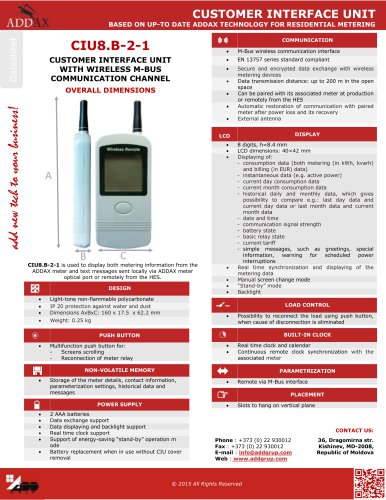 Customer Interface Unit
1 Page
 Head-End Software
4 Pages
 Single phase meter
4 Pages

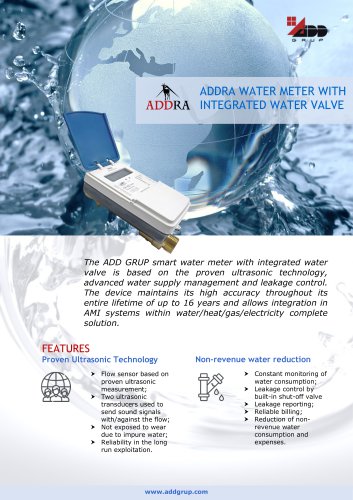


- Valve
- Control valve
- Water valve
- Ball valve
- On/off valve
- Electric valve
- 2-channel valve
- Electrically-actuated valve
- Flow control valve
- DIN rail electric energy meter
- Digital electric energy meter
- Three-phase electric energy meter
- Flow-control valve
- Single-phase electric energy meter
- Electric energy meter with LCD display
- RS-485 electric energy meter
- Automatic valve
- Emergency valve
- Electric energy meter with built-in communication