
- Catalogs
- ACS-Solutions GmbH
- S3740 – Low frequency piezoelectric transducer 250 KHz

S3740 – Low frequency piezoelectric transducer 250 KHz
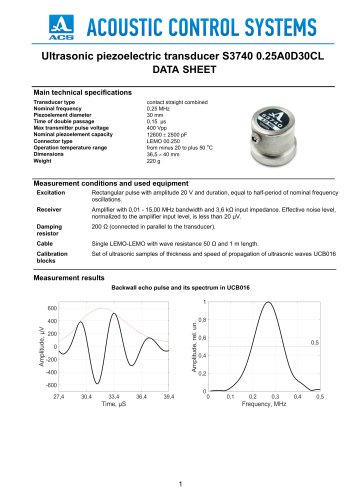
S3740 – Low frequency piezoelectric transducer 250 KHz
- Measurement Conditions and Equipment: The system uses a rectangular pulse with a 20 V amplitude and a duration equal to half the nominal frequency oscillations. The receiver amplifier has a bandwidth of 0.01 - 15.00 MHz and an input impedance of 3.6 kΩ, with an effective noise level below 20 µV. A 200 Ω damping resistor is connected in parallel to the transducer. The cable used is a single LEMO-LEMO with a wave resistance of 50 Ω and a length of 1 m. Calibration blocks consist of ultrasonic samples UCB016.
- Measurement Results: The transducer type is a contact straight combined with a nominal frequency of 0.25 MHz and a piezoelement diameter of 30 mm. The time of double passage is 0.15 µs, with a maximum transmitter pulse voltage of 400 Vpp. The nominal piezoelement capacity is 12600 ± 2500 pF. The connector type is LEMO 00.250, and the operation temperature range is from -20 to +50 °C. Dimensions are 36.5 × 40 mm, and the weight is 220 g.
- The RNC for the transducer without acoustic load and the backwall echo signal level for steel samples are analyzed. The 0 dB level corresponds to the excitation pulse amplitude. The bottom echo signal level in UCB016 from a depth of 50 mm is marked on the RNC graph. A calculated curve shows the dependence of the bottom signal level in steel 20 on depth.
- Work Frequency: 0.27 MHz, within the tolerance of 0.2 to 0.3 MHz.
- Relative Spectrum Bandwidth: 51.9%, exceeding the minimum requirement of 40%.
- Sensitivity: 30.0 dB, less than the maximum allowed 60 dB.
- Amplitude and RNC Difference in CB002-2: 35.0, greater than the minimum required 26.
Catalog excerpts
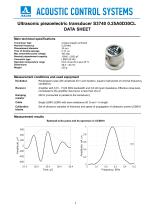
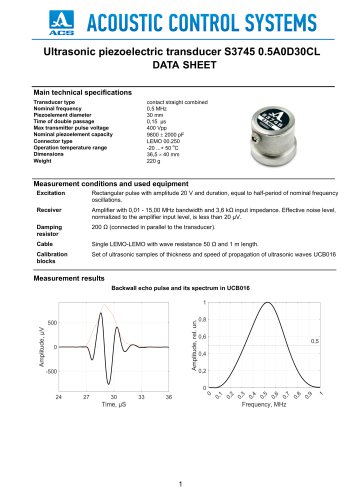
Ultrasonic piezoelectric transducer S3740 0.25A0D30CL DATA SHEET Main technical specifications Transducer type Nominal frequency Piezoelement diameter Time of double passage Max transmitter pulse voltage Nominal piezoelement capacity Connector type Operation temperature range Dimensions Weight contact straight combined 0,25 MHz 30 mm 0,15 µs 400 Vpp 12600 2500 pF LEMO 00.250 о from minus 20 to plus 50 С 36,5 40 mm 220 g Measurement conditions and used equipment Excitation Rectangular pulse with amplitude 20 V and duration, equal to half-period of nominal frequency oscillations. Amplifier with 0,01 - 15,00 MHz bandwidth and 3,6 kΩ input impedance. Effective noise level, normalized to the amplifier input level, is less than 20 µV. Damping resistor 200 Ω (connected in parallel to the transducer). Single LEMO-LEMO with wave resistance 50 Ω and 1 m length. Calibration blocks Set of ultrasonic samples of thickness and speed of propagation of ultrasonic waves UCB016 Measurement results Backwall echo pulse and its spectrum i
Open the catalog to page 1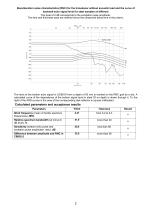
Reverberation noise characteristics (RNC) for the transducer without acoustic load and the curve of backwall echo signal level for steel samples of different The level of 0 dB corresponds to the excitation pulse amplitude. The time and thickness axes are marked minus the ultrasound delay time in the prisms. The level of the bottom echo signal in UCB016 from a depth of 50 mm is marked on the RNC graf by a dot. A calculated curve of the dependence of the bottom signal level in steel 20 on depth is drawn through it. To the right of the ARD curves is the area of the corresponding disk reflector in...
Open the catalog to page 2All ACS-Solutions GmbH catalogs and technical brochures
 MIRA NEO SOFWARE
2 Pages
 Ultrasonic transducer S3850
2 Pages
 A1207D LevelGauge
2 Pages
 А2072 IntroScan
2 Pages


- Analysis software solution
- Process software
- Windows software
- Portable tester
- 3D software solution
- Inspection system
- Measurement software
- Interface software
- Visualization software solution
- Quality software
- Automated software
- Automatic test kit
- ACS-Solutions thickness gauge
- Automatic inspection system
- ACS-Solutions portable thickness gauge
- Liquids level gauge
- ACS-Solutions ultrasonic transducer
- 2D software
- Compact tester
- Data acquisition unit