
- Catalogs
- Acme Electric
- Acme Electric Catalog

Acme Electric Catalog

Acme Electric Catalog
- Selection Guide: Guidance on selecting transformers is provided on pages 83-84.
- General Purpose Low Voltage Transformers: Detailed specifications and wiring diagrams are on pages 84-85.
- Harmonic Mitigating Transformers: Information on transformers for non-linear loads is on pages 34-35.
- Industrial Control Transformers: The Finger/Guard® series is described on pages 76-79.
- Power Conditioning Products: True-Power® Constant Voltage Regulators are introduced on pages 114-116.
- Group F: 316 stainless steel encapsulated transformers with 480 Delta primary volts and 208Y/120 secondary volts.
- Group G: Transformers with 480 Delta primary volts and 240 Delta/120 tap secondary volts.
- Group I: Transformers with 480 Delta primary volts and 480Y/277 secondary volts.
- Group J: Transformers with 600 Delta primary volts and 208Y/120 secondary volts.
- Group M: Transformers with 600 Delta primary volts and 480Y/277 secondary volts.
- Group Q: Transformers with 240 Delta primary volts and 480Y/277 secondary volts.
- Group T: 50 Hz transformers with 380 Delta primary volts and 220Y/127 secondary volts.
- Group U: 50 Hz transformers with 440 Delta primary volts and 220Y/127 secondary volts.
- Group V: Transformers with 190/200/208/220/240 Delta primary volts and 400Y/231 secondary volts.
- Specifications: Lists various models with details on dimensions, weight, and mounting options.
- Construction: Use copper or aluminum windings, with epoxy encapsulated or ventilated enclosures.
- Mounting: Options include wall and floor mounting.
- Purpose: Protect equipment from line disturbances.
- Features: Include gapped iron core inductors and precision wound copper coils.
- Benefits: Protects against voltage drops and reduces harmonic distortion.
- Function: Provide safe control voltage for electromagnetic devices.
- Selection Process: Involves determining supply circuit voltage and frequency.
- Transformers must be dry type, enclosed, and epoxy encapsulated.
- They should be Acme or an approved equivalent.
- Transformers must incorporate an electrostatic shield.
- Sound levels must comply with NEMA Standard ST-20.
- Enclosures must be grounded per the National Electric Code.
- Warranty covers defects for ten years from the date of manufacture.
- Transformers 3.0 - 75 kVA should be compound filled with a 180-degree C insulation system.
- For sizes 15 kVA and larger, transformers should be ventilated.
- Primary taps are provided for voltage adjustment.
- Transformers must handle non-linear loads and harmonics.
- Factory tests must comply with ANSI Test Code C57.12.91.
- Performance data must include no load and full load losses.
- Transformers should be floor-mounted on a concrete pad.
- Vibration isolation pads should be used internally.
- Transformers must be capable of operating under specified conditions.
Catalog excerpts

Acme Electric Acme Electric N85 W12545 Westbrook Crossing Menomonee Falls, WI 53051 800.334.5214 Commercial construction • industrial automation Full Line Product Catalog full line product Catalog ©2013 Electrical Holdings LLC. All rights reserved.
Open the catalog to page 1
ACME ELECTRIC Leadership in Quality Designed Products And Quality Customer Satisfaction For over eighty-eight years, Acme Electric has been manufacturing power conversion and power conditioning equipment for use in industrial, commercial and OEM applications. Acme has built its reputation as a true industry leader by providing superior service, quality and technical expertise to the transformer market. Acme Electric is a full line manufacturer of low voltage (600V and below) dry type distribution transformers, industrial control transformers and power quality equipment. With roughly 1300 catalog...
Open the catalog to page 2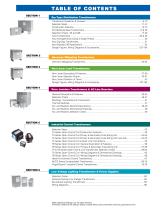
©2013 Electrical Holdings LLC. All rights reserved. Information contained in this catalog is subject to change without notice and therefore cannot be guaranteed by Acme.
Open the catalog to page 3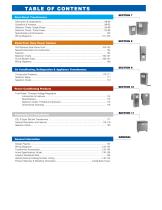
Panel-Tran® Zone Power Centers Air Conditioning, Refrigeration & Appliance Transformers Power Conditioning Products
Open the catalog to page 4
DRY-TYPE DISTRIBUTION TRANSFORMERS Transformer Questions & Answers 1. What is a transformer and how does it work? A transformer is an electrical apparatus designed to convert alternating current from one voltage to another. It can be designed to “step up” or “step down” voltages and works on the magnetic induction principle. A transformer has no moving parts and is a completely static solid state device, which insures, under normal operating conditions, a long and trouble-free life. It consists, in its simplest form, of two or more coils of insulated wire wound on a laminated steel core. When...
Open the catalog to page 6
DRY-TYPE DISTRIBUTION TRANSFORMERS load is 40 amperes, such as a motor, and the secondary voltage is 240 volts, then 240 x 40 equals 9600 VA. A 10 kVA (10,000volt-amperes) transformer is required. ALWAYS SELECT THE TRANSFORMER LARGER THAN THE ACTUAL LOAD. This is done for safety purposes and allows for expansion, in case more load is added at a later date. For 3 phase kVA, multiply rated volts x load amps x 1.73 (square root of 3) then divide by 1000. (4) Determine whether taps are required. Taps are usually specified on larger transformers. (5) Use the selection charts in Section I. 11. What...
Open the catalog to page 7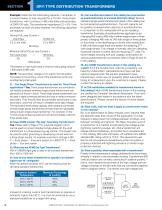
DRY-TYPE DISTRIBUTION TRANSFORMERS Example: Determine the interrupting capacity, in amperes, of a circuit breaker or fuse required for a 75 kVA, three phase transformer, with a primary of 480 volts delta and secondary of 208Y/120 volts. The transformer impedance (Z) = 5%. If the secondary is short circuited (faulted), the following capacities are required: Normal Full Load Current = Volt Amps √ 3 x Line Volts 90 Amps Maximum Short Circuit Line Current = Full Load Amps = 90 Amps 5% 5% 1,800 Amps The breaker or fuse would have a minimum interrupting rating of 1,800 amps at 480 volts. NOTE: The...
Open the catalog to page 8
DRY-TYPE DISTRIBUTION TRANSFORMERS one low voltage terminal unconnected. When the transformer is excited, the resultant voltage appearing across a voltmeter will be the sum of the high and low voltage windings. This is useful when connecting single phase transformers in parallel for three phase operations. Polarity is a term used only with single phase transformers. 30. hat is exciting current? Exciting current, when W used in connection with transformers, is the current or amperes required for excitation. The exciting current on most lighting and power transformers varies from approximately...
Open the catalog to page 9
DRY-TYPE DISTRIBUTION TRANSFORMERS 36. an 4-Winding Single Phase Transformer be autoC connected? Yes. There are occasions where 480 volts single phase can be stepped down to 240 volts single phase by autoconnecting a standard 4-winding isolating transformer as shown in Figure 1. If connected in this manner, the nameplate kVA is doubled. For example: A 10 kVA load can be applied to a 5 kVA 4-winding transformer if connected per Figure 1. 480V H1 38. hat is meant by “Balanced Loading” on Single Phase W Transformer applications? Since most single phase transformers have a secondary voltage of 120/240,...
Open the catalog to page 10
DRY-TYPE DISTRIBUTION TRANSFORMERS Steps for Selecting the Proper Transformer SINGLE PHASE LOADS 1. Determine electrical load A. Voltage required by load. B. Amperes or kVA capacity required by load. C. requency in Hz (cycles per second). F D. erify load is designed to operate on a single phase supply. V All of the above information is standard data normally obtained from equipment nameplates or instruction manuals. Full Load Current in Amperes– Single Phase Circuits 2. Determine supply voltage A. Voltage of supply (source). B. requency in Hz (cycles per second). F The frequency of the line supply...
Open the catalog to page 11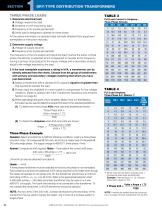
DRY-TYPE DISTRIBUTION TRANSFORMERS THREE PHASE LOADS 1. Determine electrical load A. Voltage required by load. B. mperes or kVA required by load. A C. requency in Hz (cycles per second). F D. erify load is designed to operate on three phase. V All the above information is standard data normally obtained from equipment nameplates or instruction manuals. 2. Determine supply voltage A. Voltage of supply (source). B. requency in Hz (cycles per second). F The frequency of the line supply and electrical load must be the same. A three phase transformer is selected which is designed to operate at this...
Open the catalog to page 12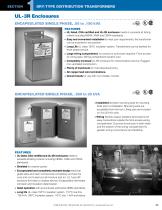
DRY-TYPE DISTRIBUTION TRANSFORMERS UL-3R Enclosures ENCAPSULATED SINGLE PHASE, .05 to .150 kVA FEATURES L listed, CSA certified and UL-3R enclosure meets or exceeds all listing U criteria including NEMA, ANSI and OSHA standards. asy and convenient installation to meet your re uirements, the transformer E q can be mounted in any position. ong Life UL class 130°C insulation system. Transformers can be banked for L three phase service. arge wiring compartment, no conduit or pull boxes required. Front access L for wiring ease. Wiring compartment remains cool. ompletely enclosed UL-3R enclosure for...
Open the catalog to page 13All Acme Electric catalogs and technical brochures
 TPC3533131S
2 Pages
 TPC3533141S
2 Pages
 TPC3533113S
2 Pages
 TPC3533123S
2 Pages
 TPC3533133S
2 Pages
 TPC3533143S
2 Pages
 TPC3533151S
2 Pages
 TPC3533161S
2 Pages
 TPC3533171S
2 Pages
 TPC3533181S
2 Pages
 TPC3533153S
2 Pages
 TPC3533163S
2 Pages
 TPC3533173S
2 Pages
 TPC3533183S
2 Pages