


Designing Slides into Electronic Enclosures

Designing Slides into Electronic Enclosures
Catalog excerpts
Electronic Enclosures An overview of electronic enclosure construction and components
Open the catalog to page 1
Cabinet Rail Construction 3 Slide Selection Criteria 6 Calculating Overall Slide and Bracket Thickness 9 Slide Position on the Chassis 1 1 Locating/Transferring the Slide Hole Pattern to the Chassis 13
Open the catalog to page 2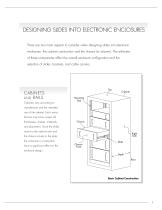
Designing Slides into Electronic Enclosures There are two main aspects to consider when designing slides into electronic enclosures: the cabinet construction and the chassis (or drawer). The attributes of these components affect the overall enclosure configuration and the selection of slides, brackets, and cable carriers. Cabinets and Rails Cabinets vary according to Mounting Rail manufacturer and the intended use of the cabinet. Each manufacturer may have unique rail thicknesses, shapes, materials, and placement. Since the slides mount to the cabinet rails and Right Side the chassis mounts to...
Open the catalog to page 3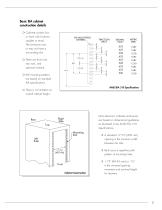
Basic EIA cabinet construction details ❍ Cabinets contain four or more rails (columns, uprights or struts). The enclosure may or may not have a surrounding skin ❍ There are front rails, rear rails, and optional mid-rails ❍ Rail mounting patterns are based on standard EIA specifications ❍ There is no limitation on overall cabinet height. Most electronic cabinets/enclosures are based on dimensional guidelines as illustrated in the ANSI/EIA 310 Specifications. Right Side FRACTION INCH T op Mounting Rail Left Side ❍ standard 17.72" [450 mm] A opening is the minimum width between the rails. ❍ Rails...
Open the catalog to page 4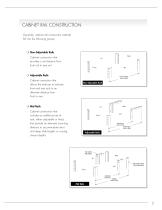
Cabinet Rail Construction Generally, cabinet rail construction methods fall into the following groups: Cabinet construction that provides a set distance from front rail to rear rail. Cabinet contruction that allows the end-user to relocate front and rear rails to an alternate distance from front to rear. Fixed Depth Rail to Rail Non-Adjustable Rails Cabinet construction that includes an additional set of rails, either adjustable or fixed, that provide an alternate mounting distance to accommodate short and deep slide lengths or varying chassis depths. Minimum Rail to Rail Maximum Rail to Rail...
Open the catalog to page 5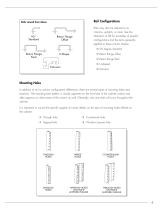
Rail Configurations Rails viewed from above Rails may also be referred to as columns, uprights, or struts. See the illustration at left for examples of popular configurations and the terms generally applied to these column shapes. Return Flange Offset Return Flange Flush ❍ Return flange offset ❍ Return flange flush ❍ U-shaped Mounting Holes In addition to rail or column configuration differences, there are several types of mounting holes and locations. The mounting hole pattern is visually apparent on the front face of the cabinet column and often appears on other areas of the column as well....
Open the catalog to page 6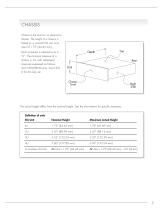
Chassis is the term for an electronics drawer. The height of a chassis is based on a nominal EIA unit incre- Each increment is referred to as a chassis is 1 U, with subsequent measures expressed as follows: The actual height differs from the nominal height. See the chart below for specific measures. EIA Unit Nominal Height Maximum Actual Height N (number of) Units N Units x 1.75" [44.45 mm]
Open the catalog to page 7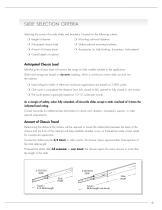
Slide Selection Criteria Selecting the correct Accuride slides and bracketry is based on the following criteria: ❍ Height of drawer ❍ Mounting rail-to-rail distance ❍ Anticipated chassis load ❍ Slide-to-cabinet mounting bracketry ❍ Amount of chassis travel ❍ Accessories on slide (locking, disconnect, hole pattern) ❍ Overall depth of cabinet Anticipated Chassis Load Identifying the chassis load will narrow the range of slide models suitable to the application. Slide load ratings are based on dynamic loading, which is continuous motion both out and into the cabinet. ❍ Load ratings for slides in...
Open the catalog to page 8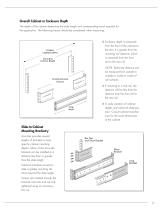
Overall Cabinet or Enclosure Depth The depth of the cabinet determines the slide length and corresponding travel required for the application. The following factors should be considered when measuring: ❍ Enclosure depth is measured from the front of the cabinet to the rear. It is greater than the mounting rail distance, which is measured from the front rail to the rear rail. OVERALL CABINET DEPTH Rail-to-Rail Distance (Depth) Bracket-to-Bracket Distance NOTE: Rail-to-rail distance can be measured from outside to outside or inside to inside of rail surfaces. ❍ If mounting to a mid rail, the distance...
Open the catalog to page 9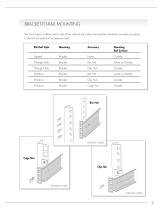
BRACKET-TO-RAIL MOUNTING The chart below outlines which side of the cabinet rail surface the bracket should be mounted according to the EIA rail style and accessories used. EIA Rail Style Mounting Accessory Mounting Rail Surface Tapped Bracket None Outside Through Hole Bracket Bar Nut Inside or Outside Through Hole Bracket Clip Nut Outside Window Bracket Bar Nut Inside or Outside Window Bracket Clip Nut Outside Window Bracket Cage Nut Outside
Open the catalog to page 10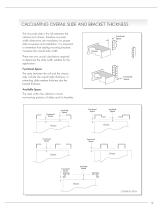
Calculating Overall Slide and Bracket Thickness The Accuride slide is the link between the cabinet and chassis; therefore accurate width dimensions are mandatory for proper slide movement and installation. It is important to remember that adding mounting brackets increases the overall slide width. Functional Space There are two crucial calculations required to determine the slide width suitable for the application: Functional Space: The area between the rail and the chassis side. Include the overall slide thickness, or extending slide member thickness plus the bracket thickness. Functional Space...
Open the catalog to page 11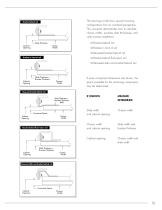
The drawings at left show several mounting configurations from an overhead perspective. This viewpoint demonstrates how to calculate chassis widths, evaluate slide thicknesses, and verify bracket installation. Bracket behind rail Slide Thickness Cabinet Opening Chassis Width ❍ Bracket behind rail ❍ Bracket in front of rail Cabinet Opening Slide Thickness + Bracket Thickness Chassis Width ❍ Bracket behind flush-return rail Bracket in front of rail ❍ Recessed bracket behind rail ❍ Recessed slide and bracket behind rail If some component dimensions are known, the space available for the remaining...
Open the catalog to page 12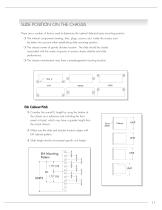
Slide Position on the Chassis There are a number of factors used to determine the optimal slide-to-chassis mounting position: ❍ The internal components (venting, fans, plugs, screws, etc.) inside the chassis must be taken into account when establishing slide mounting position. ❍ The chassis center of gravity dictates location. The slide should be closely associated with the center of gravity to ensure chassis stability and slide performance. ❍ The chassis manufacturer may have a pre-designated mounting location. EIA Cabinet Pitch ❍ Consider the overall U height by using the bottom of the chassis...
Open the catalog to page 13All ACCURIDE catalogs and technical brochures
 1432
14328 Pages
 1332
13328 Pages
 1234
12344 Pages
 1155
11552 Pages
 1145
11452 Pages
 340
3402 Pages
 322
3222 Pages
 301
3012 Pages
 201
2012 Pages
 123
1234 Pages
 117
1174 Pages
 2632
26322 Pages
 2601
26012 Pages
 2132
21322 Pages
 2037
20372 Pages
 1029
10292 Pages
 3300 Series
2 Pages
 Heavy Duty 3/4"
4 Pages
 3641
36412 Pages
 3732
37322 Pages
 3832HDTR
2 Pages
 9308
93082 Pages
 7950 Heavy Duty
4 Pages
 AL4140
2 Pages
 3832
38322 Pages
 CBLift-0019
2 Pages
 Model 115RC
2 Pages
 MODEL 115
2 Pages
 MODEL 0363
2 Pages
 MODEL 38EL
4 Pages
 MODEL 10EL
4 Pages
 3507 Product Sheet
3 Pages
 2907WB Product Sheet
3 Pages
 2807 Product Sheet
3 Pages
 Aero Models 6221/6231
2 Pages
 Mechanical lift DBLIFT-0019
3 Pages
 DA4160 efg catalog
2 Pages
 5321EC
1 Page
 635xx-efg catalog
4 Pages
 Home Hobbyist Catalog
40 Pages


- Lifting system
- Linear motion system
- Ball bearing slide
- Telescopic slide
- Ball bearing linear guide
- Column type lift system
- Full-extension slide
- Drawer slide
- Aluminum linear guide
- Roller slide
- Roller linear guide
- Track linear guide
- Heavy-duty slide
- Aluminium slide
- Partial-extension slide
- Stainless steel slide
- Adjustable carriage block
- Crossed roller slide
- Over-extension slide
- Furniture slide