
- Catalogs
- Abbey Electronic Controls
- APS003KS DIFFERENTIAL AIR PRESSURE SWITCH

APS003KS DIFFERENTIAL AIR PRESSURE SWITCH

APS003KS DIFFERENTIAL AIR PRESSURE SWITCH
- Adjustment Range: 0.2 – 3.5 mbar or 20 – 350 Pa with a vertical diaphragm.
- Accuracy: ±15%.
- Contact Type: Change over (SPDT) with normally closed, normally open, and common contacts.
- Contacts Rating: 230V AC, 0.05 – 5A resistive (cosφ = 1.0), 0.05 – 1A inductive (cosφ = 0.6).
- Temperature Range: -10°C to 70°C, with no condensation.
Catalog excerpts
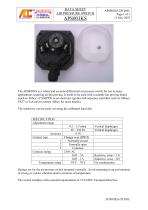
Abbey Electronics DATA SHEET AIR PRESSURE SWITCH APS003KS The APS003KS is a robust and accurate differential air pressure switch for use in many applications requiring air/fan proving. It needs to be used with a suitable fan proving board (such as Abbey’s FX30PPT) or an electronic ignition full sequence controller such as Abbeys FX37 or Fx4 series (contact Abbey for more details). The sensitivity can be easily set using the calibrated hand dial. Ratings are for the air pressure switch mounted vertically. Avoid mounting in an environment of strong or violent vibration and/or extremes of temperature. The switch complies with essential requirements of 73/23/EEC European Directive.
Open the catalog to page 1All Abbey Electronic Controls catalogs and technical brochures
 AEC
AEC1 Page
 WSX53
WSX534 Pages
 WSX53G06 PRECIPITATION
4 Pages
 WSX53B WEATHER SENSOR
4 Pages
 FX37FSA
1 Page
 WSX53A48 PRECIPITATION
4 Pages
 FX37-P16
1 Page
 WSX53A24 PRECIPITATION
4 Pages
 WSX53A12 PRECIPITATION
4 Pages
 WSX53A06 PRECIPITATION
4 Pages
 MPC34A DUAL MODE
2 Pages
 M021P MODULATING PUMP CONTROLLER
16 Pages
 WSX53
WSX534 Pages


- Circuit breaker
- Electronic filter
- Waterproof pressure switch
- Gas pressure switch
- Flow switch
- Differential pressure switch
- Current circuit breaker
- Pump controller
- AC circuit breaker
- Manual reset circuit breaker
- Thermal circuit breaker
- Current amplifier
- IP66 pressure switch
- Industrial flow switch
- Active electronic filter
- EMC filter
- High-pass electronic filter
- Thermal flow switch