
- Catalogs
- AB TRASMISSIONI SRL
- Flexible Elements


Flexible Elements
1 / 1 PageView full catalog
Flexible Elements
Product catalog summary
Transmission Rubber Elements Specifications
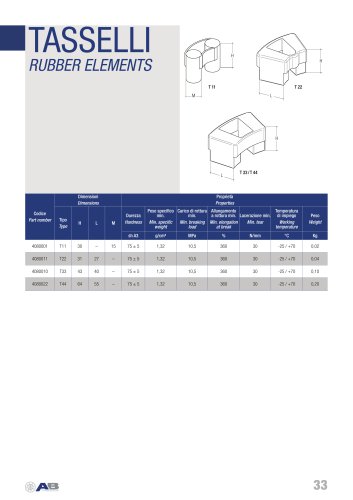
Overview: This document provides detailed specifications for various types of rubber elements used in transmission systems, identified by part numbers and type codes (T11, T22, T33, T44).
Key Sections and Parameters:
1. Identification and Dimensions:
- Each rubber element is assigned a unique part number and type code.
- Dimensions are given primarily as height (H), length (L), and width (M) in millimeters.
2. Material Properties:
- Hardness: All types have a Shore A hardness of 75 ± 5.
- Specific Weight: Consistently 1.32 g/cm³ across all types.
3. Mechanical Performance:
- Minimum Breaking Load: 10.5 MPa for all types.
- Minimum Elongation at Break: 360% for all types.
- Minimum Tear Strength: 30 N/mm for all types.
4. Operating Conditions:
- Working Temperature Range: From -25°C to +70°C.
5. Weight:
- Weight varies by type, increasing with size:
- T11: 0.02 Kg
- T22: 0.04 Kg
- T33: 0.10 Kg
- T44: 0.20 Kg
Summary Table Highlights:
- The smallest element (T11) has dimensions 30 mm (H) by 15 mm (L), while the largest (T44) measures 64 mm (H) by 55 mm (L).
- Despite size differences, all elements share identical hardness, specific weight, breaking load, elongation, and tear resistance values.
Critical Information:
- Consistency in mechanical properties ensures interchangeability and predictable performance.
- The temperature range indicates suitability for typical industrial environments.
- Weight data is essential for design considerations involving mass and balance.
Recommendations and Usage Notes:
- Select the rubber element type based on dimensional requirements and weight constraints.
- Ensure operating temperatures remain within specified limits to maintain material integrity.
- Consider mechanical property uniformity when integrating these elements into transmission assemblies.
This structured summary captures the essential technical data and usage guidelines for the transmission rubber elements detailed in the document.
Overview: This document provides detailed specifications for various types of rubber elements used in transmission systems, identified by part numbers and type codes (T11, T22, T33, T44).
Key Sections and Parameters:
1. Identification and Dimensions:
- Each rubber element is assigned a unique part number and type code.
- Dimensions are given primarily as height (H), length (L), and width (M) in millimeters.
2. Material Properties:
- Hardness: All types have a Shore A hardness of 75 ± 5.
- Specific Weight: Consistently 1.32 g/cm³ across all types.
3. Mechanical Performance:
- Minimum Breaking Load: 10.5 MPa for all types.
- Minimum Elongation at Break: 360% for all types.
- Minimum Tear Strength: 30 N/mm for all types.
4. Operating Conditions:
- Working Temperature Range: From -25°C to +70°C.
5. Weight:
- Weight varies by type, increasing with size:
- T11: 0.02 Kg
- T22: 0.04 Kg
- T33: 0.10 Kg
- T44: 0.20 Kg
Summary Table Highlights:
- The smallest element (T11) has dimensions 30 mm (H) by 15 mm (L), while the largest (T44) measures 64 mm (H) by 55 mm (L).
- Despite size differences, all elements share identical hardness, specific weight, breaking load, elongation, and tear resistance values.
Critical Information:
- Consistency in mechanical properties ensures interchangeability and predictable performance.
- The temperature range indicates suitability for typical industrial environments.
- Weight data is essential for design considerations involving mass and balance.
Recommendations and Usage Notes:
- Select the rubber element type based on dimensional requirements and weight constraints.
- Ensure operating temperatures remain within specified limits to maintain material integrity.
- Consider mechanical property uniformity when integrating these elements into transmission assemblies.
This structured summary captures the essential technical data and usage guidelines for the transmission rubber elements detailed in the document.
See more
Catalog excerpts
RUBBER ELEMENTS Dimensioni Dimensions Codice Part number Tipo Type Proprietà Properties Durezza Hardness Peso specifico Carico di rottura Allungamento Temperatura min. min. a rottura min. Lacerazione min. di impiego Min. specific Min. breaking Min. elongation Min. tear Working weight load at break temperature Peso Weight
Open the catalog to page 1All AB TRASMISSIONI SRL catalogs and technical brochures
 Solenoids
24 Pages
 Mufflers
36 Pages
 Flexible coupling ATEX
24 Pages
 SOLENOIDS MS series
2 Pages
 SOLENOIDS MM series
2 Pages
 PULSE COUNTERS PC129
1 Page
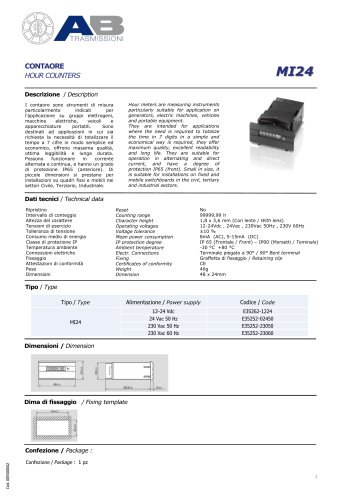 HOUR COUNTERS MI24
1 Page
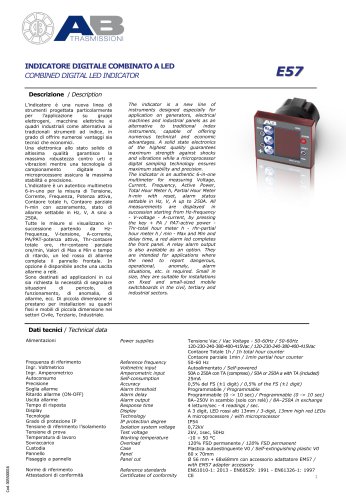 E57
E573 Pages
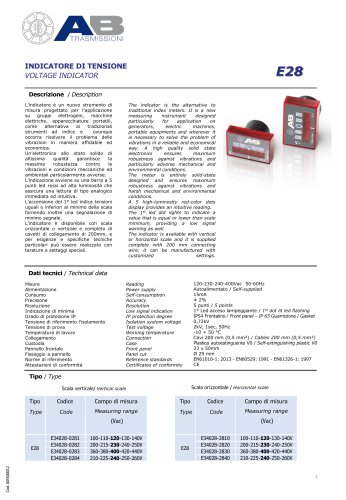 E28
E283 Pages
 Adaptors / Spacers
4 Pages
 Heaters for diesel engine
20 Pages
 Flexible Coupling
40 Pages

Archived catalogs
 Flexible Elements
7 Pages
Related Searches
- Transformer
- Dry transformer
- Push-button switch
- Digital indicator
- Circuit breaker
- Flexible coupling
- Shaft shaft coupling
- Panel panel meter
- Current transformer
- IEC transformer
- Encapsulated transformer
- Single-phase transformer
- Flange coupling
- Industrial transformer
- Solenoid
- Torque coupling
- Hose clamp
- Heater
- Three-phase transformer
- Transmission coupling
*Prices are pre-tax. They exclude delivery charges and customs duties and do not include additional charges for installation or activation options. Prices are indicative only and may vary by country, with changes to the cost of raw materials and exchange rates.
About DirectIndustry
DirectIndustry is a marketplace that offers B2B players a complete experience, from product sourcing to purchase. DirectIndustry is an entity of VirtualExpo Group.
Are you a buyer?
Are you a supplier?