
- Catalogs
- 7Leaders Corp.
- 2021 7Leaders Catalogue-(Eng ver.)


2021 7Leaders Catalogue-(Eng ver.)

2021 7Leaders Catalogue-(Eng ver.)
7-Leaders Corp. specializes in tungsten carbide cutting tools, including end mills, drills, and reamers. Established in 1990, the company distributes globally, serving sectors like Mold & Die, Machine Tools, Automotive, Aerospace, and Medical solutions.
The company offers a comprehensive production process, including tungsten carbide rod manufacturing, CNC grinding, and advanced coating services using Swiss technology, emphasizing automated production and strict quality testing.
Multipurpose End Mills: Designed for high efficiency and stability, featuring unequal flutes and variable helix to reduce vibration. The E140HX model shows 30% lower abrasion rates compared to competitors.
Ball Nose End Mills: Known for excellent heat and wear resistance, with precision and smooth surface finishing. The B272ATX model offers a tool life nearly 50% longer than competitors.
7-Leaders provides coatings like AITiSiN and AlTiXN+ZrN, offering benefits such as high heat resistance and enhanced tool life, suitable for machining materials like steels, aluminum, and titanium.
The document includes a detailed index of end mills and routers categorized by application, with series codes, appearance, and page numbers for easy reference.
Details specifications for multipurpose end mills with 4 flutes, designed to reduce vibration through varied helix geometry and unequal flute designs. These tools feature a Nano multilayer coating (AlTiCrN) to enhance tool life and are suitable for cutting various materials.
- Multipurpose end mills with 4 flutes.
- Designed to decrease vibration.
- Big chip breaker for high removal rates.
- Nano multilayer coating for improved tool life.
- Suitable for a wide range of materials.
Provides recommended milling conditions for different grades of materials, including specific parameters such as cutting speed (Vc), RPM, and feed rate for both side milling and slotting operations.
- Use high precision facilities and collet chuck.
- Select appropriate cutting fluid.
- Adjust cutting data based on actual working conditions.
- If RPM is lower than the reference value, reduce feed rate and RPM proportionally.
- Reduce cutting parameters if vibration occurs during cutting.
Includes extensive tables listing various end mill codes, dimensions, and recommended RPM and feed rates for different materials and operations.
Provides detailed specifications and recommended milling conditions for various types of multipurpose end mills, focusing on models B252-2.5HX and B274HX, including information on work materials, cutting parameters, and product features.
- End Mills: B252-2.5HX and B274HX models are highlighted, with specifications for diameter (Dc), length (L), and corner radius (R).
- Materials: Made from UMG carbide with AlTiCrN nano multilayer coating for enhanced lubrication and wear resistance.
- Design Features: Include corner radius for increased tool life, various helix geometry, and unequal flutes to reduce vibration.
- Work Materials: Carbon Steel, Low-alloyed Steel, Hi-alloyed Steel, Hardened Steel, Stainless Steel, Cast Iron, and Titanium.
- Cutting Speeds (Vc): Vary based on material and tool diameter, with specific ranges provided for each material type.
- Feed Rates and RPM: Detailed tables provide recommended RPM and feed rates for different tool diameters and materials.
- Ensure high rigidity and precision in facilities and use of collet chuck.
- Select appropriate cutting fluid based on material and conditions.
- Adjust cutting data according to actual working conditions, as provided values are reference only.
- If RPM is lower than reference, reduce feed rate and RPM proportionally.
- Reduce cutting parameters if vibration occurs during operation.
- Multipurpose end mills with corner radius and 4 flutes, suitable for a range of materials from roughing to finishing.
- Big chip breaker design for high material removal rates.
- Step design to increase effective length and cutting edge with corner radius for extended tool life.
Provides technical specifications and recommended milling conditions for various types of multipurpose end mills, focusing on the UMG carbide material with AlTiCrN coating, including detailed tables of operational parameters for different materials and end mill types.
- End mills are made from UMG carbide material with a Nano multilayer coating of AlTiCrN, enhancing lubrication and wear resistance.
- Design features include 4 flutes, short and long neck options, and a slim shank for different applications.
- Various helix geometries and unequal flute designs are used to reduce vibration.
- Big chip breakers are incorporated to achieve high material removal rates.
- Side Milling and Slotting operations are detailed for different grades of work materials, including carbon steel, low-alloyed steel, high-alloyed steel, hardened steel, stainless steel, cast iron, titanium, nickel, and high-temperature alloys.
- Specific parameters such as cutting speed (Vc), RPM, and feed rates are provided for each material and end mill size.
- Adjustments are recommended based on real working conditions, with guidelines for reducing RPM and feed rates proportionally if necessary.
- Multipurpose end mills are suitable for a wide range of materials and applications, including finishing operations.
- Design enhancements aim to improve tool life and performance, particularly through the use of advanced coatings and structural design.
- Use high precision facilities and collet chucks for optimal performance.
- Select appropriate cutting fluids to enhance operation.
- Adjust cutting data based on specific working conditions to prevent vibration and ensure efficiency.
Provides technical specifications and recommendations for various types of end mills used in machining different materials such as steel, stainless steel, titanium, nickel, and aluminum, including details on product features, recommended milling conditions, and operational guidelines.
- End Mills with Corner Radius: Designed for multipurpose use with features like slim shank, long type, and corner radius to increase tool life. Coated with Nano multilayer AlTiSiN for improved wear and heat resistance.
- End Mills for Stainless Steel: Available in 4 and 5 flutes, suitable for roughing and finishing difficult-to-cut materials. Coated with AlTiXN+ZrN for enhanced performance.
- End Mills for Titanium: Designed for high precision and high-speed cutting, suitable for materials like titanium and high-temperature alloys.
- End Mills for Aluminium: Features sharp cutting edges and larger chip removal space, suitable for both roughing and finishing in aluminum and copper.
- Specific RPM and feed rates are provided for different materials and end mill sizes.
- Parameters vary based on the material being machined, such as carbon steel, low-alloyed steel, hardened steel, stainless steel, titanium, nickel, and aluminum.
- Use high precision facilities and collet chuck for optimal performance.
- Select appropriate cutting fluid based on the material and operation.
- Adjust cutting data according to real working conditions as the provided data are reference values.
- If RPM is lower than the reference value, reduce both feed rate and RPM proportionally.
- Reduce cutting parameters if vibration occurs during machining.
- End mills are designed to decrease vibration and increase tool life through various helix geometries and unequal flute designs.
- Big chip breakers are included to achieve high removal rates.
- Coatings like AlTiSiN and AlTiXN+ZrN enhance wear and heat resistance.
Provides detailed specifications and recommended milling conditions for various types of end mills designed for machining aluminum and other materials, including information on different product codes, dimensions, and operational guidelines.
- End Mills for Aluminium (E142, E143, E145, E194, E195): Designed with sharp cutting edges and high removal cutting geometry to prevent sticking and improve surface roughness. Available in various diameters and lengths, with specific codes indicating their dimensions and features.
- Materials: Primarily designed for aluminum, with some models also suitable for copper and graphite.
- Coatings: Options include uncoated, bright, and diamond-like carbon (DLC) coatings to enhance wear resistance and surface lubrication.
- General Guidelines: Use high precision facilities and collet chucks, select appropriate cutting fluids, and adjust cutting data based on actual working conditions. Reduce RPM and feed rate proportionally if necessary, and adjust parameters to minimize vibration.
- Specific Conditions: Each product code has specific recommended RPM and feed rates for side milling and slotting operations, with variations based on the diameter of the tool.
- End Mills for Aluminium: Designed for both roughing and finishing operations, featuring a larger helix angle for better finishing and multiple flutes for enhanced efficiency.
- Corner Radius End Mills (E145): Include a corner radius to extend tool life and improve surface finish.
- Finishing End Mills (E194): Feature multiple flutes to enhance working efficiency and are specifically designed for finishing operations.
- Single Point End Mills (E195R/L): Available in right-hand and left-hand versions, designed for efficient chip removal and improved surface finish.
Provides comprehensive data on the specifications and operational guidelines for various end mills, emphasizing the importance of selecting the right tool and conditions for optimal performance in machining aluminum and other materials.
Provides detailed specifications and recommendations for various types of routers and end mills designed for composite materials and plastics, including information on product features, recommended milling conditions, and operational guidelines.
- Routers for Composite Materials (E190/E191, E197/E198/E199, E298/E299, E291/E294): Designed with staggered blades to prevent fiber pull-out, suitable for roughing and finishing in composite materials like phenolic-epoxy parts and polyester glass reinforced products.
- End Mills for Plastics (E189R/E189L): Feature sharp cutting edges and high removal cutting geometry, designed for finishing in various plastic materials.
- Short End Mills for Lathe (E113X/E114X, E115HX/E116HX): Designed for use in CNC lathes with excellent wear resistance due to AlTiN and AlTiCrN coatings, suitable for various steel materials up to HRC48.
- Composite Materials: For routers like E190/E191 and E197/E198/E199, recommended cutting speeds (Vc) are around 188 m/min with specific RPM and feed rates depending on the tool diameter.
- Plastics: For end mills like E189R/E189L, the recommended cutting speed is 188 m/min with varying RPM and feed rates based on tool diameter.
- Steel and Other Metals: For short end mills like E113X/E114X and E115HX/E116HX, cutting speeds range from 30 to 120 m/min depending on the material hardness and type.
- Ensure the use of high precision facilities and collet chucks for optimal performance.
- Select appropriate cutting fluids to enhance tool life and performance.
- Adjust cutting data based on actual working conditions, as provided values are reference only.
- If RPM is lower than the reference value, reduce both feed rate and RPM proportionally.
- Reduce cutting parameters if vibration occurs during the cutting process.
Provides detailed specifications and recommended conditions for various end mills used for chamfering at angles of 60°, 90°, and 120°, including information on materials, coatings, helix angles, and operational parameters for different work materials.
- Materials: Made from carbide materials, including MG and UMG carbide, with coatings such as AlTiN, X-NaNo, and AlTiCrN.
- Helix Angles: Varying helix angles are specified, including 0°, 15°, 30°, and 45°.
- Flutes: The number of flutes ranges from 3 to 6, depending on the specific end mill model.
- End mills are suitable for operations such as drilling, tapering, countersinking, NC spot drilling, and frame milling.
- Specially designed for uncoated aluminum alloys and other materials like steel, hardened steel, stainless steel, cast iron, and copper.
- Work Materials: Categorizes work materials into groups such as carbon steel, low-alloyed steel, high-alloyed steel, hardened steel, stainless steel, cast iron, and aluminum.
- Cutting Speeds (Vc): Recommended cutting speeds vary based on the material, ranging from 20 to 200 m/min.
- RPM and Feed Rates: Detailed RPM and feed rate tables are provided for different end mill diameters and work materials.
- Use high precision facilities and collet chucks for optimal performance.
- Select appropriate cutting fluids based on the material and operation.
- Adjust cutting data according to actual working conditions, especially if vibration occurs.
- For V-groove processing, set feed speed to 50% of the recommended conditions.
- The standard cutting depth (Ap) is 0.3 times the diameter (d).
Provides detailed specifications and recommended milling conditions for various types of end mills, specifically designed for high-performance processing of difficult-to-cut materials such as hardened steel, stainless steel, carbon steel, and non-ferrous metals. The end mills are characterized by their heat resistance and are suitable for both back and front chamfering.
Provides detailed specifications and recommended milling conditions for various end mill products, including E165TX, E158TX, E159TX, E168TX, E169TX, E166TX, and E167TX, with information on dimensions, materials, and operational guidelines for different types of steel and other materials.
- End Mills: Lists several end mill models, each with specific dimensions (diameter, length, etc.) and material coatings such as AITiSiN.
- Materials: Suitable for various materials, including carbon steel, low-alloyed steel, high-alloyed steel, hardened steel, stainless steel, cast iron, aluminum, copper, titanium, and high-temperature alloys.
- Speed and Feed Rates: Detailed tables provide recommended RPM and feed rates for different end mill diameters and materials, categorized by material hardness and type.
- Cutting Parameters: Guidelines for axial depth of cut (ap) and radial depth of cut (ae) are provided, with specific values for different operations.
- Use high precision facilities and collet chucks for optimal performance.
- Select appropriate cutting fluids based on the material and operation.
- Adjust cutting data according to actual working conditions, as the provided values are reference points.
- If RPM is lower than the reference value, reduce both feed rate and RPM proportionally.
- Reduce cutting parameters if vibration occurs during operation.
- End mills are designed with features such as negative rake angles for strength and chipping resistance, high helix angles for reduced cutting resistance, and multi-flute designs for even pressure distribution and increased tool life.
Provides detailed specifications and recommended milling conditions for various types of Ball Nose End Mills, focusing on their material composition, coating, geometry, and operational parameters, structured to guide users in selecting the appropriate end mill for different materials and machining conditions.
- Material and Coating: Made from carbide and feature coatings such as AlTiN, X-NaNo, and AlTiSiN, which enhance wear resistance and lubrication.
- Geometry: Tools have a ball nose geometry with varying helix angles (15° to 45°) and flute numbers, designed to maintain cutting stability and extend tool life.
- Size Range: Lists end mills with diameters ranging from 0.1 mm to 20 mm, with specific dimensions for cutting length (Lc), overall length (L), and shank diameter (d).
- Work Materials: Suitable for a variety of materials, including carbon steel, low and high-alloyed steel, hardened steel (up to 68 HRC), stainless steel, cast iron, and copper.
- Cutting Speeds (Vc): Recommended cutting speeds vary based on material hardness and tool diameter, with specific values provided for different material groups.
- RPM and Feed Rates: Detailed tables provide recommended RPM and feed rates for each tool size and material type, emphasizing adjustments based on real working conditions.
- Ensure the use of high-precision facilities and collet chucks for optimal performance.
- Select appropriate cutting fluids to enhance tool life and machining quality.
- Adjust cutting parameters if vibration occurs or if the RPM is lower than the reference value.
Provides technical specifications and guidelines for using high-performance end mills with corner radius, specifically models B286TX, B275TX, B277TX, and B259TX/B269TX, designed for various milling operations on different materials, including steel, hardened steel, stainless steel, cast iron, titanium, nickel, and high-temperature alloys.
- Select appropriate cutting fluid based on the material and operation.
- Adjust cutting data according to actual working conditions, as the provided data are reference values.
- If the RPM is lower than the reference value, reduce both the feed rate and RPM proportionally.
- Reduce cutting parameters if vibration occurs during operation.
- Suitable for 3D curved profile machining.
- High precision corner radius for mold processing with high hardness and precision.
- RPM and feed rates are specified for each end mill size and material grade, ensuring optimal performance and tool life.
Provides technical specifications and guidelines for the use of F690TX, F693TX, and F695TX series end mills, designed for rib processing with corner radius and ball nose configurations, used in high precision mold making and machining of various materials, including steel and copper.
Provides detailed specifications and recommended milling conditions for various types of end mills and drills designed for graphite and other materials, including information on product features, material compatibility, and operational guidelines.
- End Mills for Graphite: Various models such as G696DC, G234DC, G244DC, G697DC, and G298DC are detailed, made from carbide with diamond coatings, featuring a 30° helix angle and designed for high-speed machining of graphite.
- Ball Nose End Mills: Suitable for corner angle cleaning and curved surface processing of graphite electrodes, coated with high hardness diamond for wear resistance.
- NC Spot Drills: Models like D921X, D922X, and D932X are designed with double drill tip angles for enhanced strength and are coated with AlTiN for increased wear resistance.
- For high-speed machining of graphite, specific RPM and feed rates are recommended for each tool model, with adjustments suggested based on real working conditions.
- For NC Spot Drills, borehole parameters are provided for different materials, including carbon steel, low-alloyed steel, and cast iron, with specific RPM and feed rates.
- Ensure the use of high precision facilities and collet chucks for optimal performance.
- Choose appropriate cutting fluids to enhance tool life and performance.
- Adjust cutting data according to actual working conditions, especially if RPM is lower than reference values.
- Reduce cutting parameters if vibration occurs during operation.
Provides detailed specifications and recommended milling conditions for various drill models, specifically the IAD422TX, D423TX-3, D423TX-5, and D423TX-8, designed for specific work materials, including carbon steel, low-alloyed steel, high-alloyed steel, hardened steel, stainless steel, cast iron, titanium, nickel, and high-temperature alloys.
Outlines the borehole parameters and cutting conditions for each drill model, including diameter (Dc), rotational speed (RPM), and feed rate (mm/rev) for different grades of work materials, with cutting speed (Vc) specified in meters per minute, varying depending on the material hardness and type.
1. Ensure the use of high precision facilities and collet chucks for optimal performance.
2. Select appropriate cutting fluids to enhance the cutting process.
3. The provided cutting data are reference values and should be adjusted based on actual working conditions.
4. If the RPM is lower than the reference value, both the feed rate and RPM should be reduced proportionally.
5. In case of vibration during cutting, reduce the cutting parameters to stabilize the process.
Highlights the features of the drills, such as the 140° S-shape drill tip design, which reduces axial force, and the groove shape design that enhances chip removal rates. The drills are coated with a Nano multilayer AlTiSiN for improved wear resistance and lubrication. The oil-feed design helps in reducing temperature and increasing chip removal rates during the cutting process.
The drills are suitable for drilling steels below HRC48, cast iron, and other materials, with specific models designed for different drilling depths (3XD, 5XD, 8XD).
Provides technical specifications and recommendations for various high-performance drills, specifically the D423TX and D425TX series, designed for efficient chip removal, reduced axial force, and enhanced wear resistance, suitable for drilling in materials like steel and cast iron.
Provides detailed specifications and recommendations for various cutting tools, including end mills and drills, designed for different materials and applications, including technical data, recommended milling conditions, and product features.
Provides detailed specifications and guidelines for various types of end mills, including multipurpose, premium cut, and roughing end mills, covering their applications, material compatibility, and cutting conditions.
Provides detailed cutting conditions for various materials including stainless steel, cast iron, nickel, heat-resistant steel, and aluminium, specifying cutting speeds (Vc) and feed per tooth (fz) for different grades of materials, emphasizing that these values are reference points and should be adjusted based on actual working conditions, with key recommendations including using high precision facilities, selecting appropriate cutting fluids, and adjusting parameters to reduce vibrations.
Designed with variable helix geometry and unequal flutes to enhance cutting performance, featuring sharp cutting edges suitable for tough materials, high removal cutting geometry, and improved edge strength with corner radii, with Nano multilayer coatings applied for better wear resistance and lubrication, optimized for materials like stainless steel, titanium, nickel, and aluminium.
Lists specifications for end mills with corner radii, designed for difficult-to-cut materials, including dimensions such as diameter (Dc), length (L), and corner radius (R), along with coating types like AlTiXN+ZrN and ZrN, suitable for both roughing and finishing applications.
For aluminium, provides cutting conditions for wrought and cast alloys, highlighting high cutting speeds and specific feed rates, detailing design features of tools like the F631ZX and F642ZX, optimized for high chip removal rates and smooth surface finishes.
Briefly mentions thread mills, specifying their appearance, coating types, helix angles, and number of flutes, designed for efficient chip removal and cooling, with features like internal oil-feed and chamfering functions.
Provides detailed specifications and guidelines for cutting tools, specifically focusing on end mills and their applications in machining various materials such as carbon steel, hardened steel, and cast iron, including cutting conditions, tool geometries, and recommended practices for optimal performance.
Provides technical specifications and guidelines for various cutting tools, including toric end mills, high feed end mills, and drills, including detailed cutting conditions, material compatibility, and recommended practices for optimal tool performance.
Provides detailed specifications for various reamers, including their appearance, code numbers, materials (such as carbide and VHM), coatings (uncoated and bright), helix angles, and the number of flutes, outlining the dimensions and tolerances for different reamer models, specifying parameters like diameter (Dc), length (L), and number of teeth (Z).
Designed for use with different materials, including steel, cast iron, aluminum, and copper, suitable for reaming steels below 48HRC and 56HRC, depending on the model, categorizing materials into groups such as carbon steel, hardened steel, stainless steel, cast iron, and aluminum alloys, each with specific cutting conditions.
Provided for various materials, detailing cutting speeds (Vc) and feed per tooth (fz) for different grades of materials, for example, carbon steel materials have a cutting speed of 15 m/min with a feed per tooth of 0.008xDc, while hardened steel materials have a lower cutting speed of 5 m/min with a feed per tooth of 0.003xDc.
Designed with left helix and right cutting flutes for downward chip evacuation, while some models have right helix and right cutting flutes for upward chip evacuation, specifying accuracy tolerances for different diameter ranges.
Adjustments to RPM and feed rate are recommended if the RPM is lower than the reference value, advising reducing the cutting parameters in case of vibration during cutting.
Provides detailed specifications and features of various cutting tools, including NC Machine Reamers and End Mills, designed for different materials such as steel, cast iron, aluminum, and more, including information on tool dimensions, materials, coatings, and applications.
- Material: MG Carbide, Uncoated, Bright finish.
- Applications: Suitable for materials like steel, hardened steel, cast iron, aluminum, copper, and plastics.
- Tolerances: Vary based on diameter, ensuring precision in machining.
- Features: Superior wear resistance and ability to withstand high cutting temperatures.
- Types: Includes Easy Cut, Multipurpose, and End Mills for difficult-to-cut materials.
- Materials: MG Carbide and UMG Carbide with various coatings like AlTiCrN, AlTiXN+ZrN, and AITiSiN.
- Applications: Designed for roughing and finishing operations in materials such as steel, stainless steel, titanium, nickel, and high-temperature alloys.
- Features: Unique tool designs minimize chatter, allowing smoother machining and fewer setups.
- Dimensions: Detailed measurements for diameter (Dc), length (L), and number of flutes (Z) for each tool type.
- Helix Angles: Varying angles to optimize cutting efficiency and reduce forces.
- Tolerances: All sizes have a tolerance of +0/-0.001" ensuring high precision.
- High-performance coatings enhance tool life and cutting efficiency.
- Tools are designed for both roughing and finishing, reducing the need for multiple setups.
- Specific tools are optimized for materials like aluminum, offering high metal removal rates and superior surface finishes.
Catalog excerpts

SOLID CARBIDE — End Mills Drills Reamer
Open the catalog to page 1
COMPANY PROFILE 7-Leaders Corp. specializes in production and marketing of tungsten carbide cutting tools such as End mills, Drills, Reamers, and etc. Established in 1990 by Mr. Jack Lee, the company manufactures high quality products and provides best services along with the trade mark “ ” all over the world. 7Leaders manufactures solid carbide cutting tools for Mold& Die, Machine Tools, Automotive, Aerospace, 3C, Watches, Optical and Medical solutions.
Open the catalog to page 2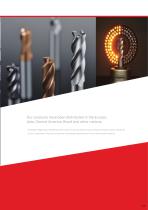
Our products have been distributed in the Europe, Asia, Central America, Brazil and other nations. We keep integrating marketing inall kinds of cutting tools and providing the best quality products to our customers. We aim to become a leading brand name in the cutting tools industry.
Open the catalog to page 3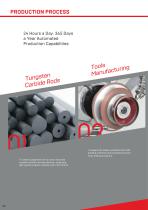
PRODUCTION PROCESS 24 Hours a Day. 365 Days a Year Automated Production Capabilities 01 7-Leaders cooperates with a world-renowned tungsten carbide rod manufacturer, producing high quality tungsten carbide rods in ETM brand. Tools cturing Manufa 02 7-Leaders has Walter and Rollomatic CNC grinding machines and manufactures end mills, drills and reamers.
Open the catalog to page 4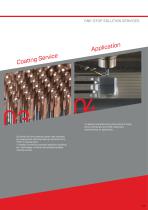
ONE-STOP SOLUTION SERVICES 7-Leaders manufactures cutting tools through strict cutting test and fulfill customers' requirements on application. Our Nano thin film coating center uses cathodic arc evaporation splitting coating machines from "PVD" in Switzerland. 7-Leaders is the first company applying "splitting arc" technology in Taiwan. We provide variable coating service.
Open the catalog to page 5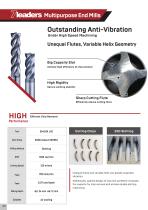
Outstanding Anti-Vibration Under High Speed Machining Unequal Flutes, Variable Helix Geometry Big Capacity Slot Achieve high efficiency of chip removal High Rigidity Secure working stability Sharp Cutting Flute Efficiently reduce cutting force Efficient Chip Removal Performance Tool Work Piece Cutting Speed Milling Depth Cutting Chips Milling Method Unequal flutes and variable helix can greatly suppress vibration. Additionally, special design of chip slot perfectly increases the capacity for chip removal and achieve stable slotting mach
Open the catalog to page 6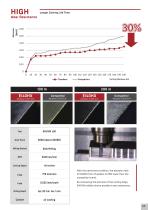
Longer Cutting Life Time Tool Work Piece Milling Method Cutting Speed Milling Depth Coolant E140HX 010 S50C (about 20HRC) Side Milling 3650 rev/min 114 m/min 770 mm/min 0.052 mm/tooth Ap: 20 mm Ae: 1 mm air cooling With the same test condition, the abrasion rate of E140HX from 7Leaders is 30% lower than the competitor brand. By comparing the pictures of the cutting edge, E140HX reliably shows excellent wear resistance.
Open the catalog to page 7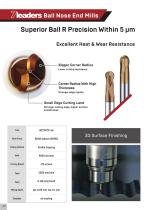
Ball Nose End Mills Superior Ball R Precision Within 5 µm Excellent Heat & Wear Resistance Bigger Corner Radius Lower cutting resistance Corner Radius With High Thickness Stronger edge rigidity Small Edge Cutting Land Stronger cutting edge, higher surface smoothness Tool Work Piece Milling Method Profile Copying Cutting Speed Milling Depth
Open the catalog to page 8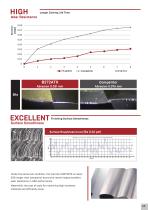
Longer Cutting Life Time B272ATX Competitor Abrasion 0.031 mm Abrasion 0.076 mm 8hrEXCELLENT Finishing Surface Smoothness Surface Roughness Curve (Ra 0.36 pm) Under the same test condition, the tool life of B272ATX is nearly 50% longer than competitor brand and remain keeps excellent wear resistance in HSC performance. Meanwhile, the cost of tools for machining high hardness materials are efficiently lower.
Open the catalog to page 9
High heat resistance, high oxidation resistance, nanocom- TiAlN posite coating with lubrication property. Suitable for any F-NaNo material and steels < 48HRC. Very high heat resistance and oxidation resistance. AlTiN Suitable for steels < 52HRC. X-NaNo Multilayer, higher hardness, high oxidation resistance. AlTiCrN Suitable for steels < 48 HRC. HX Z Multilayer, higher nanohardness, extremely high heat AITiXN resistance, very good thermal insulation. Suitable for high performance machining condition and also for midhardX1 ness alloy steels to 62HRC. Multilayer, higher nanohardness, extremely high...
Open the catalog to page 10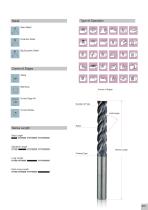
Series Length Stub Length Extra Long Length
Open the catalog to page 11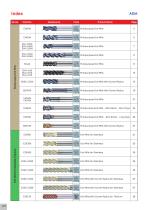
Index Series Product Name Multipurpose End Mills With Corner Radius Multipurpose End Mills With Corner Radius Multipurpose End Mills.Slim Shank.Short Type Multipurpose End Mills.Slim Shank.Long Type Multipurpose End Mills With Corner Radius End Mills With Corner Radius for Stainless End Mills For Stainless, Titanium End Mills With Corner Radius for Stainless End Mills With Corner Radius for Titanium
Open the catalog to page 12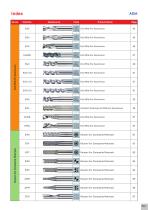
Product Name Utmost Finishing End Mills For Aluminium Routers For Composite Materials Routers For Composite Materials Routers For Composite Materials Routers For Composite Materials Routers For Composite Materials Routers For Composite Materials Routers For Composite Materials Routers For Composite Materials
Open the catalog to page 13
Index ASIA Product Name Routers For Composite Materials Short End Mills For Lathe Short End Mills For Lathe Short End Mills For Lathe Short End Mills For Lathe End Mills For Back and Front Chamfering 30° / 60° / 90° / 120° End Mills For Back and Front Chamfering 30° / 60° / 90° / 120°
Open the catalog to page 14
Product Name High Performance End Mills High Performance End Mills Ball Nose End Mills Ball Nose End Mills Ball Nose End Mills Ball Nose End Mills Ball Nose End Mills Ball Nose End Mills Ball Nose End Mills Ball Nose End Mills - 3 Flutes Ball Nose End Mills - 4 Flutes Ball Nose End Mills End Mills With Corner Radius End Mills With Corner Radius End Mills With Corner Radius End Mills With Corner Radius End Mills With Corner Radius
Open the catalog to page 15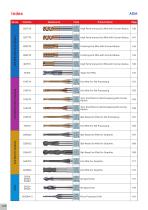
High Performance End Mills With Corner Radius Finishing End Mills With Corner Radius Finishing End Mills With Corner Radius High Performance End Mills With Corner Radius Toric End Mills For Rib Processing With Corner Radius Toric End Mills For Rib Processing With Corner Radius Ball Nose End Mills For Rib Processing Ball Nose End Mills For Graphite Ball Nose End Mills For Graphite Ball Nose End Mills For Graphite High Performance End Mills With Corner Radius Product Name B275TX End Mills With Corner Radius Micro Precision Drills
Open the catalog to page 16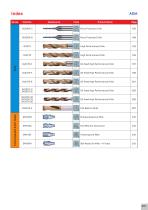
Index Series ASIA Appearance Product Name Micro Precision Drills Micro Precision Drills High Performance Drills High Performance Drills Oil-Feed High Performance Drills Oil-Feed High Performance Drills Oil-Feed High Performance Drills Oil-Feed High Performance Drills Oil-Feed High Performance Drills Flat Bottom Drills Ball Nose End Mills - 4 Flutes Interchangeable Cutter Heads
Open the catalog to page 17All 7Leaders Corp. catalogs and technical brochures
 2021 OSL Catalog
52 Pages
- Milling tool
- Solid milling cutter
- Drilling tool
- Steel milling cutter
- Solid drill bit
- Metal milling cutter
- Clamping milling cutter
- Milling cutter with cylindrical shank
- Cast iron milling cutter
- Solid carbide milling cutter
- Ball nose milling cutter
- Cutting milling cutter
- Corner radius milling cutter
- Coated milling cutter
- High-performance milling cutter
- Helix angle milling cutter
- Roughing milling cutter
- Shoulder milling cutter
- Tungsten carbide drill bit