
- Catalogs
- SUCO Robert Scheuffele GmbH & Co. KG
- TRANSMISSION TECHNOLOGY


TRANSMISSION TECHNOLOGY
1 /40Pages

TRANSMISSION TECHNOLOGY
1 /40Pages
Catalog excerpts

www.suco.de TRANSMISSION TECHNOLOGY CENTRIFUGAL CLUTCHES CENTRIFUGAL BRAKES ELECTROMAGNETIC CLUTCHES ELECTROMAGNETIC BRAKES STANDARD VERSIONS CUSTOMIZED SOLUTIONS >
Open the catalog to page 1
1938 Robert Scheuffele opens a mechanical workshop. 1945 Partnership formed by Robert Scheuffele and Georg Fuhrmann. 1950 ... Registration of the name SUCO ( S cheuffele u nd Co ) as a trademark. Development Design and development of new products To simulate realistic environmental and production of centrifugal using the latest CAD tools. conditions and loads, our products are clutches and brakes. Market subjected to extensive trials and tests. leader in Germany and abroad. Company moves into a new production and administration building. 1960 ... Electromagnetic clutches and brakes introduced...
Open the catalog to page 2
1985 SUCO Inc. formed in the USA to serve the American market. A new building extends the production and administrati - on facilities. 1997 ... Dealer structure built up in Asia. Company certified to ISO 9001. 1999 Founding of a subsidiary company, SUCO VSE, in France. Thorough training at SUCO Capacity and schedule Ultra-modern produc- is an important guarantee planning of production or - tion plant with inte - 2001 for the continuing deve - ders to make optimum use grated, fully-automatic Certification to lopment of the company of the available human, component handling for ISO 9001:2000. in...
Open the catalog to page 3
Օ Compact design, self-increasing torque Wear parts easy to replace Օ Performance factor for torque transmission: ca. 2.5 > Robust construction Օ Bonded linings Very smooth running Օ Performance factor for torque transmission: ca. 1.5 > Wearing parts easy to replace Օ Very smooth running Performance factor for torque transmission: ca. 1.0 > Օ Narrow design Torque capacity depends on direction of rotation Օ Performance factor for torque: ca. 1.75 or 1.25 depending on direction Only available in large sizes Օ Extremely smooth running > Construction and mode of operation, temperature characteristics...
Open the catalog to page 4
Electromagnetic clutch without bearings Օ Input side mounted on fl ange or shaft Output side available with hub > Օ Electromagnetic clutch with bearings Input side mounted on fl ange or shaft Օ Output through hub or belt pulley > Flange-mounted electromagnetic brake Օ On request with internal or external hub > When our standard models cannot be used, we design and manufacture individual, customer-specifi c solutions. Our engineers check enquiries to make sure they are practicable, and, as far as possible, the design of the product complies with the customerґs wishes. >
Open the catalog to page 5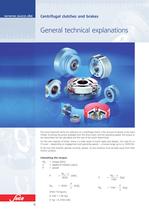
The most important factor for selection of a centrifugal clutch is the amount of power to be trans- mitted. Knowing the power available from the drive motor and the operating speed, the torque to be transmitted can be calculated and the size of the clutch determined. For the vast majority of drives, there is a wide range of clutch types and designs. Our sizes 01 to 13 cover depending on engagement and operating speeds ֖ a torque range up to ca. 2000 Nm. To be sure that clutches operate correctly, grease, oil and moisture must be kept away from their friction surfaces. Calculating the torque:...
Open the catalog to page 6
Performance factor for torque transmission: The performance factor for torque transmission is a measure of the capacity of a clutch to provide suffi cient friction to transmit the power applied to it when the fl yweights are in contact with the drum. Whereas a W-Type clutch has a performance factor of 1.0, an F-Type clutch of the same size with self-increasing effect is capable of transmitting a torque approximately 2.5 times greater at the same speed and with the same fl yweight mass. The asymmetric pivot clutch achieves a power factor of ca. 1.75 or ca. 1.25 depending on the direction of rotation....
Open the catalog to page 7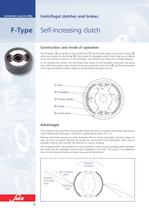
The fl yweights 2 are seated on the profi led hub 1 and are held against it by tension springs 3 , which are hooked into the linings 4 . Discs locate the fl yweights axially. Each lining has a crimping on its inner surface to locate it on the fl yweight. This prevents the linings from moving sideways. As the profi led hub rotates, the centrifugal force acting on the fl yweights overcomes the spring force. When the speed is high enough, the linings contact the clutch drum 5 , and friction between the linings and the drum allows torque to be transmitted between the two. 1 Hub 2 Flyweights 3 Tension...
Open the catalog to page 8
The cylindrical hub 1 carries three fl yweights 2 which are located by and can slide on cylindrical pins 3 . Inside the fl yweights, there are tension springs 4 which restrain neighbouring fl yweights until centrifugal force overcomes the spring force. Then the fl yweights lift from their seats and the linings 5 on the fl yweights contact the inside diameter of the clutch drum 6 . Friction between the linings and the clutch drum allows torque to be transmitted. 3 Cylindrical pin 2 Flyweights 1 Hub 4 Tension spring 5 Lining 6 Clutch drum > In contrast to F-Type clutches, the linings of pin-guided...
Open the catalog to page 10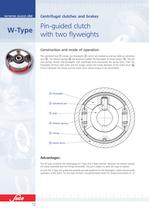
The cylindrical hub 1 carries two fl yweights 2 , which are located by and can slide on cylindrical pins 3 . The tension springs 4 are attached outside the fl yweights to lining carriers 5 . The ten- sion springs restrain the fl yweights until centrifugal force overcomes the spring force. Then the fl yweights lift from their seats and the linings contact the inside diameter of the clutch drum 6 . Friction between the linings and the clutch drum allows torque to be transmitted. 2 Flyweight 3 Cylindrical pin 1 Hub 4 Tension spring 5 Lining 6 Clutch drum > The W-Type combines the advantages of F-Type...
Open the catalog to page 12
Flyweights 1 are normally mounted so that they can pivot on pins 5 , which are fi tted to a fl ange. There are tension springs 2 which restrain neighbouring fl yweights until centrifugal force over- comes the spring force. Then the fl yweights lift from their seats and the bonded linings 3 contact the inside diameter of the clutch drum 4 . Due to the asymmetric arrangement of the fl yweights, the torque that can be transmitted by this type of clutch depends on the direction of rotation. 1 Flyweight 2 Tension spring 3 Lining 4 Clutch drum 5 Shoe pivot > P-Type clutches are extremely narrow. In...
Open the catalog to page 14All SUCO Robert Scheuffele GmbH & Co. KG catalogs and technical brochures
 M.10 Accessories
6 Pages
 E.7 Accessories
4 Pages
 SUCO Transmission Technology
38 Pages
 SUCO Medical Applications
6 Pages
 M.4 Pressure switches hex 27
10 Pages
 M.3 Pressure switches hex 24
12 Pages
 M.7 Pressure switches 30 A/F
5 Pages
 M.9 Vacuum switches
4 Pages
 SUCO Pressure Monitoring
178 Pages
 T.6 Accessories
4 Pages
 SUCO Plasma cleaning
5 Pages
 ESI Oil, Gas & Subsea
8 Pages
 ESI General Product range
8 Pages
 Product Overview 2020
6 Pages
 ESI Pressure Sensors
88 Pages


Archived catalogs
 Pressure transmitter
6 Pages
 SUCO Thread adapter
2 Pages
 Pressure switches PLUS
6 Pages
 SUCO Small wind turbines
4 Pages
 SUCO Agriculture
6 Pages
 SUCO Construction Machines
6 Pages
 SUCO Water Applications
6 Pages
 Vakuum Switch
4 Pages
 Pressure Switch hex 24
10 Pages
 Pressure Switch hex 27
12 Pages
 Pressure Switch 30 A/F
4 Pages
 Centrifugal cluches and brakes
16 Pages
 PRESSURE MONITORING
64 Pages


- Pressure transmitter
- Analog pressure transmitter
- Pressure switch
- Membrane pressure transmitter
- Waterproof pressure transmitter
- Stainless steel pressure transmitter
- Relative pressure transmitter
- Mechanical pressure switch
- Waterproof pressure switch
- Gas pressure transmitter
- Liquid pressure transmitter
- Threaded pressure transmitter
- Process pressure transmitter
- Sensitive element pressure transmitter
- DC pressure transmitter
- Diaphragm pressure switch
- IP65 pressure transmitter
- IP67 pressure transmitter
- Compact pressure transmitter
- Piezoresistive pressure transmitter