

END MEASURING RODS AND INSIDE MICROMETERS
1 /5Pages

END MEASURING RODS AND INSIDE MICROMETERS
1 /5Pages
Catalog excerpts

83 The following pages show our varied line of precision end measuring rods and inside micrometers. The variations are fixed-range or adjustable-range micrometers and solid or tubular measuring rods. Unless otherwise noted under the individual tools, all have these features: Ÿ Balanced design for better feel and accurate measurement Ÿ All contact points are hardened and ground for better accuracy and long life Ÿ Satin chrome finish on all micrometer heads and reading surfaces that resist rust and also make for easy reading by providing a no-glare background for the sharp lines and figures Ÿ Hardened and stabilized spindle for accuracy and long life Ÿ Advanced sleeve design with staggered lines and distinct figures for precise and easy readability Ÿ Quick and easy adjustment Ÿ Starrett workmanship Ÿ Inside Micrometers Nos. 121, 124, 823 and 824 by design have a firmer rotation than regular micrometers. This is to limit the tendency of the micrometer head to rotate when withdrawn from the workpiece. Measuring Tips for Inside Measurements Whether to use a two-point or threepoint contact measuring tool is usually a matter of preference, but there are some differences. A two-point contact rod-type inside micrometer shown in this section is usually lighter, easier to handle, and more versatile over long ranges from approximately 6-107 (150-2700mm). Any two-point contact micrometer, regardless of range, can probe a hole better to find the geometry of that hole than a three-point contact. Most three-point contact tools have setting rings to insure accuracy. If you desire very close tolerance work with two-point contact inside micrometers, it is recommended that they be set to a ring gage or to an outside micrometer. A three-point contact micrometer shown in the Bore Gages section has an advantage in that it can be seated in position more quickly than a two-point contact tool. Usually these tools can also be read to a finer accuracy. The three-point tool will tell the maximum true diameter that can enter the hole a little faster than a two-point contact tool. Micrometer heads used in these tools are accurate to ±.0001 or 0.002mm, but overall accuracy on tools that add rods is dependent on good practice and technique. To insure accuracy, these practices should be followed: Ÿ Always make sure that there are no specks of dirt between the clamping surfaces of the rods and micrometer heads Ÿ Tighten all rods uniformly, not too tight, not too loose, but a fairly firm assembly Ÿ Assemble long sections vertically or, with support, horizontally Ÿ Because temperature can affect long rods used in these tools, they should be assembled in the same environment in which they will be used (For additional information, refer to the Bore Gage Section) END MEASURING RODS AND INSIDE MICROMETERS
Open the catalog to page 1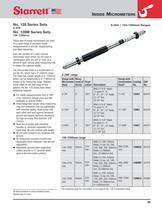
85 6-294 range Range with Move- Range with Micrometer ment of Grad- Combination Catalog EDP Head Screw uation Description Head* No. No. 6-78 2 .001 With (1) 4-6 Head, 11-83 128AZ 64375 (1) each 2, 4, 6, 8, 10, 12 Rods, (1) 12 Ext., (2) 24 Ext. 6-150 2 .001 With (1) 4-6 Head, 11-155 128BZ 64376 (1) each 2, 4, 6, 8, 10, 12 Rods, (1) 12 Ext., (5) 24 Ext. 6-294 2 .001 With (1) 4-6 Head, 11-299 128CZ 64377 (1) each 2, 4, 6, 8, 10, 12 Rods, (1) 12 Ext., (11) 24 Ext. 150-7350mm range 50mm 0.01 With (1) 100-150mm 150-1950 300-2100 128MAZ 64378 mm Head, (1) ea. 50, 100, mm 150, 200, 250, 300mm mm Rods,...
Open the catalog to page 3
86 Combination Head with Inside Micrometer No. 128 No. 128M The Starrett combination head for inside micrometers combines the precision of a dial indicator sensor and the linear accuracy of a micrometer. This combination of indicator and micrometer reduces the need for operator “feel” and provides faster readings with increased reliability. This head is interchangeable with the Starrett No. 128 Series end rods and extension combinations. For direct measurements, the dial indicator hand and the telltale hand must both register zero before reading the micrometer. As a comparator, the micrometer...
Open the catalog to page 4
87 Solid-Rod Inside Micrometers No. 124 Series Sets 2-32 No. 124M Series Sets 50-800mm These are the most popular inside micrometers because of their lightness, ease of use, and range. They are very useful for measuring inside diameters of cylinders and rings, measuring parallel surfaces, etc. The desired range is obtained by assembling rods and spacing collars to the micrometer head. Measuring rods are provided with a shoulder that is set accurately in the micrometer head and locked in position. When assembling rods to the A and B heads, the reading line on the micrometer head should be lined...
Open the catalog to page 5All STARRETT catalogs and technical brochures
 Hardness Testers and Accessories
32 Pages
 Material Testing Systems
194 Pages
 Catalog 82 - Metrology Systems
60 Pages
 HF750
HF7503 Pages
 HF600
HF6003 Pages
 VF600
VF6003 Pages
 VB300 VB400
3 Pages
 Metrology systems THE HD400
4 Pages
 METROLOGY SYSTEMS THE HB400
3 Pages
 HE400
HE4003 Pages
 AV350
AV3504 Pages
 AVR-FOV Brochure
2 Pages
 KMR Series
4 Pages
 AVX 550
2 Pages
 PTA AND HAND TOOLS
124 Pages
 FORCE AND MATERIAL TESTING
194 Pages
 CALIBRATION SERVICES
4 Pages
 HB400 W-M2
2 Pages
 MARKING PRODUCTS
4 Pages
 PRIMALLOY
1 Page
 BAND SAW CUTTING RATE CHART
2 Pages
 ADVANZ TS
1 Page
 TM SERIES X-Y STAGES
1 Page
 OV2 VIDEO ADAPTOR
1 Page
 ADVANZ FS
1 Page
 TRU-STONE
16 Pages
 HDV300
2 Pages
 VERSATIX MP
1 Page
 BAND SAW BLADES
72 Pages
 PRECISION, QUALITY, INNOVATION
612 Pages
 Surface360™
2 Pages
 MTH MANUAL TESTER
2 Pages
 L1 FORCE MEASUREMENT
24 Pages
 DIGITAL FORCE GAGE
2 Pages
 AVR series
4 Pages
 MVRSerieS
4 Pages
 FORCE MEASUREMENT
16 Pages
 SMART CABLE
1 Page
 200W WOODEN TOOL BOX
1 Page
 3089 DIAL BORE GAGES
1 Page


Archived catalogs
 Galileo EZ
2 Pages
 Starrett Optical Comparators
6 Pages
 VB400
VB4004 Pages
 AV150, AV300, AV350
6 Pages
 HD400
HD4006 Pages
 HB400
HB4006 Pages
 METROLOGY SYSTEMS
68 Pages
 KINEMIC KMR
4 Pages
 SHIP AUGER DRILL BITS
2 Pages
 ROOFING TAPE
1 Page
 CHALK
CHALK2 Pages
 TOUGH TAPES
1 Page
 BORE GAGES No. 78XT Series
3 Pages
 TEST INDICATORS AND HOLDERS
4 Pages
 SLIDE CALIPERS
5 Pages
 DEPTH MICROMETERS
6 Pages
 OUTSIDE MICROMETERS
6 Pages


- Measuring machine
- Indentation hardness tester
- Saw blade
- Benchtop hardness tester
- Inspection system
- Digital display hardness tester
- Thickness gauge
- Portable thickness gauge
- Automatic measurement system
- Rockwell hardness tester
- Optical measurement system
- Brinell hardness tester
- Metal saw blade
- Automatic inspection system
- Caliper
- Vickers hardness tester
- Automatic hardness tester
- Portable hardness tester
- Data acquisition unit