
- Catalogs
- Stanford Research Systems
- Rubidium Frequency Standard

Rubidium Frequency Standard
1 /4Pages

Rubidium Frequency Standard
1 /4Pages
Catalog excerpts

Frequency Standards PRS10 — Rubidium frequency standard with low phase noise PRS10 Rubidium Frequency Standard · Low phase noise (< −130 dBc/Hz at 10 Hz) · Time-tags or phase-locks to a 1 pps input · 72 hour Stratum 1 level holdover · RS-232 for diagnostics, control and calibration · 20 year lamp life The PRS10 is an ultra-low phase noise, 10 MHz rubidiumdisciplined crystal oscillator. The device fulfills a variety of communication, synchronization and instrumentation requirements. The phase noise of the 10 MHz output is low enough to be used as the reference source for synthesizers. The unit’s short-term stability and low environmental coefficients make it an ideal component for network synchronization. Its low aging rate makes it an excellent timebase for precision frequency measurements. The PRS10 can time-tag an external 1 pps input with 1 ns resolution. These values may be reported back via RS-232, or used to phase-lock the unit to an external reference (such as GPS) with time constants of several hours. This feature can provide Stratum 1 performance at a very low cost. The PRS10 establishes a new level of features and performance in atomic frequency standards. Its design provides the lowest phase noise, greatest versatility, and easiest path to system integration of any rubidium frequency standard available. PRS10 Operation and Design All commercial rubidium frequency standards operate by disciplining a crystal oscillator to the hyperfine transition at 6.834,682,612 GHz in rubidium. The amount of light from a rubidium discharge lamp that reaches a photodetector through a resonance cell will drop by about 0.1 % when the rubidium vapor in the resonance cell is exposed to microwave Stanford Research Systems
Open the catalog to page 1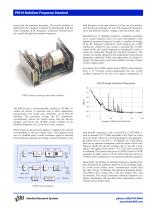
PRS10 Rubidium Frequency Standard power near the transition frequency. The crystal oscillator is stabilized to the rubidium transition by detecting the light dip while sweeping an RF frequency synthesizer (referenced to the crystal) through the transition frequency. final frequency as the unit warms up. In the case of a problem with the physics package, the unit will suspend the frequency servo and hold the varactor voltage at the last locked value. Manufacturers of rubidium frequency standards sometimes use a crystal frequency that is an exact sub-multiple of the hyperfine transition frequency...
Open the catalog to page 2
PRS10 Rubidium Frequency Standard GPS Tracking Frequency offsets and long-term aging of the PRS10 can be eliminated by phase-locking to a source with better long-term stability, such as the 1 pps from a GPS timing receiver. As Standard Interface Connector GPS 1pps Root Allan Variance (Parts in 1012 ) When an external 1 pps signal is applied, the PRS10 will verify the integrity of that input and will then align its 1 pps output with the external input. The processor will continue to track the 1 pps output to the 1 pps input by controlling the frequency of the rubidium transition with a small magnetic...
Open the catalog to page 3
Output Output frequency 10 MHz sine wave Amplitude 0.5 Vrms, ±10 % Phase noise (SSB) < –130 dBc/Hz (10 Hz) < –140 dBc/Hz (100 Hz) Spurious < –130 dBc (100 kHz BW) Harmonic distortion < –25 dBc Return loss >25 dB (at 10 MHz) Accuracy at shipment ±5 × 10–11 Aging (after 30 days) Monthly <5 × 10–11 (<2.5 × 10⁻¹¹ with opt. C) Yearly <5 × 10⁻¹⁰ Short-term stability <2 × 10–11 (1 s) (Allan variance) <1 × 10–11 (10 s) <2 × 10–12 (100 s) Holdover 72 hour Stratum 1 level Frequency retrace ±5 × 10–11 (72 hrs. off, then 72 hrs. on) Settability <5 × 10–12 Trim range ±2 × 10⁻⁹ (0 to 5 VDC) ±1 ppm (via RS-232)...
Open the catalog to page 4All Stanford Research Systems catalogs and technical brochures
 SR556
SR5561 Page
 QMSc
QMSc3 Pages
 FS730/1
4 Pages
 SC10
SC102 Pages
 PRS10
PRS104 Pages
 SR715/720
3 Pages
 CG635
CG6355 Pages
 PERF10
2 Pages
 SR865 DSP Lock-In Amplifier
5 Pages
 SR620
SR6204 Pages
 SIM900Mainframe
2 Pages
 SIM964Analog Limiter
1 Page
 SIM970Quad Digital Voltmeter
2 Pages
 SIM983Scaling Amplifier
1 Page
 SIM965Analog Filter
2 Pages
 SIM921AC Resistance Bridge
3 Pages
 SR250Gated Integrator
3 Pages
 SR540 Optical Chopper
1 Page
 SR640 Programmable Filters
3 Pages
 LCR Meters
3 Pages
 Synthesized Clock Generator
5 Pages
 UGAUniversal Gas Analyzer
3 Pages
 RGAResidual Gas Analyzers
5 Pages
 SR850DSP Lock-In Amplifier
4 Pages
 SR10/11/12Audio Switchers
2 Pages
 SR1Audio Analyzer
6 Pages
 6 GHz Vector Signal Generator
10 Pages
 SR255Fast Sampler
3 Pages
 SR245 Computer Interface
2 Pages
 SR200 Gate Scanner
1 Page
 SR630 Thermocouple Reader
3 Pages
 SR510/530 Lock-In Amplifiers
4 Pages
 IGC100 Ion Gauge Controller
4 Pages
 NL100 Nitrogen Laser
2 Pages
 SIM980 Summing Amplifier
1 Page
 SR235 Analog Processor
1 Page
 Laser Diode Controller
4 Pages
 DS335 Function Generator
2 Pages
 Audio Switchers
2 Pages


Archived catalogs
 Partial Pressure Monitor
2 Pages
 Analog PID Controller
2 Pages
 Optical Chopper
2 Pages
 Programmable Filters
3 Pages
 Distribution Amplifier
1 Page
 Audio Analyzer
6 Pages
 Residual Gas Analyzers
5 Pages
 Photon Counters
6 Pages
 Waveform Generator
2 Pages
 Lock in Amplifiers
3 Pages
 DSP Lock-in Amplifier
3 Pages


- Power supply unit
- DC power supply
- AC/DC power supply
- Measuring device
- Gas analyzer
- Concentration analyzer
- Monitoring analyzer
- Automatic analyser
- Benchtop analyser
- Digital temperature control
- Digital indicator
- Signal amplifying integrated circuit
- Temperature controller
- Compact power supply
- Tabletop power supply
- Generator
- Integration analyzer
- Real-time analyzer
- Electronic filter
- Digital gauge