- Catalogs
- SPM Instrument
- Product Catalogue

Product Catalogue

Product Catalogue
- BearingChecker: A portable device for assessing bearing condition using shock pulse and temperature measurements. It includes a graphic display, LED indicators, and can function as an electronic stethoscope. Specifications include a measurement range of -9 to 90 dBsv, operating temperature of 0°C to +50°C, and a battery life exceeding 20 hours.
- VibChecker: Designed for machine condition monitoring, compliant with ISO 2372 and ISO 10816 standards. It measures vibration velocity, acceleration, and displacement, with a frequency range of 10 to 1000 Hz, and includes a built-in probe transducer for real-time FFT spectrum analysis.
- A handheld machine condition analyzer with a color touchscreen, operating under Windows CE. It features data logging, vibration monitoring, speed and temperature measurement, and supports advanced vibration analysis techniques.
- Technical specifications include a 400 MHz processor, 64 MB RAM, and a 16-bit A/D converter. It supports various transducer types and offers extensive measurement capabilities.
- Accessories include external transducers, headphones, carrying cases, and protective covers. Leonova Infinity offers options for extended memory, recording functions, and additional diagnostic capabilities such as order tracking and orbit analysis.
- SPM Instrument AB is ISO 9001 certified, with technical data subject to change without notice. The company focuses on reliability and ease of use in its range of condition monitoring instruments and accessories.
The Shock Pulse Method (SPM) has been used for over 30 years to diagnose rolling element bearings. It detects shocks generated by bearings using an SPM transducer, which outputs electric pulses proportional to the shock magnitude. The transducer operates at a resonance frequency of about 32 kHz, allowing for calibrated shock pulse amplitude measurements.
The shock pulse meter measures the rate of incoming shock pulses per second and adjusts the measuring threshold to determine two amplitude levels: the shock carpet level (dBc) and the maximum level (dBm). The shock pulse amplitude is influenced by rolling velocity, oil film thickness, and the mechanical state of the bearing surfaces. Input data such as rpm and shaft diameter help neutralize the effect of rolling velocity.
Initial values and condition zones (green, yellow, red) are established empirically. The height of the carpet value and delta (dBm minus dBc) indicate lubrication quality or installation issues. Technical specifications include a measuring range of –9 to 99 dBsv, resolution of 1 dBsv, and accuracy of ± 1 dBsv. The output includes maximum value dBm, carpet value dBc, and audible shock pulse signals.
The LR/HR method, derived from the original SPM, provides precision analysis of oil film condition and calculates optimal lubricant. It requires precise data on bearing geometry, size, and speed. The method outputs include LR and HR raw shock values, a general bearing condition (CODE), oil film condition (LUB), and surface damage (COND).
The SPM Spectrum verifies the source of high shock pulse readings through pattern recognition. It uses a Fast Fourier Transform (FFT) to produce a spectrum for pattern recognition. The evaluation is based on dBm or HR values, with alarm levels set manually for symptoms.
Leonova offers vibration measurement according to ISO 2372 and ISO 10816 standards. ISO 2372 is a platform function for broad band vibration measurement, while ISO 10816 offers more flexibility in frequency range and recognizes various vibration parameters. Both standards categorize machine condition into green, yellow, and red zones based on vibration severity.
This function provides vibration analysis by generating machine condition data, highlighting significant line patterns in vibration spectra, and trending symptom values. Users can select data types suited for individual machine surveillance.
EVAM is a method for analyzing machine conditions through vibration analysis. It generates condition parameters, vibration spectra, and machine-specific condition codes. Key parameters include RMS values for velocity, acceleration, displacement, crest, kurtosis, skewness, and noise levels. Spectrum analysis uses 'fault symptoms' for pattern recognition, with automatic configuration based on RPM.
Frequency limits range from 0.5 Hz to 40,000 Hz, with various measurement windows and averaging methods. Spectrum lines can be extended up to 12,800, and different spectrum types (linear, power, PSD) are supported. Transducer types include SLD144 or IEPE (ICP®) with voltage output.
This function allows for the observation of machine movement in two dimensions using two transducers. It requires identical parameter setups for both channels and uses a special measuring cable (CAB51). The system displays RMS values for displacement, velocity, and acceleration, with spectrum, phase spectrum, and time signal graphs available.
These functions analyze vibration during machine start-up or shutdown and assess vibration response at standstill. The run-up/coast-down test records RPM and RMS values, while the bump test uses a rubber mallet to measure vibration response. Technical data include frequency limits and spectrum lines.
Orbit analysis detects failures like rubs, unbalance, and misalignment in machinery with journal bearings. It requires two-channel simultaneous measurement and displays an orbit graph showing shaft movement. Settings include transducer type, signal unit, and filter type, with measurements made via buffered outputs or accelerometers.
Leonova offers single and dual-plane balancing functions. Single-plane balancing involves measurements with and without trial weights to calculate correction mass. Dual-plane balancing uses a similar method but in two planes. The system guides users through the balancing process and saves a log file for future reference.
Various ordering numbers are provided for different functions and options, including unlimited and limited use versions of the software and hardware components.
- Features: Includes a 3G router for remote connectivity, power supply unit, external antenna, and DIN rail for earth connections.
- Monitoring Capabilities: Measures bearing condition on eight channels, vibration on four channels, and analog signals on three channels.
- Connectivity: Equipped with Ethernet LAN and supports various wireless standards.
- Specifications: Enclosure is IP66 rated, operating temperature range is 0 to +60 °C, and it includes a 2 GB SD card for data buffering.
- Features: Similar to INS12W but with increased monitoring channels (12 for bearings, 6 for vibration).
- Specifications: Enclosure is IP66 rated, with similar temperature and humidity specifications as INS12W.
- Features: Combines features of INS18 with a built-in 3G router for enhanced connectivity.
- Monitoring Capabilities: Similar to INS18 with additional remote connectivity features.
- Features: A slim relay with LED indicator and test button, designed for DIN rail mounting.
- Specifications: Rated for 12 VDC coil voltage, with specific load and switching capabilities.
- Design: Intended for 19-inch rack mounting, includes a Commander Unit INC41.
- Features: Equipped with terminal blocks and internal cabling for power and digital connections, with status LED indicators.
- All units are designed for harsh environments with robust enclosures and are IP66 rated.
- They support a range of monitoring methods and transducer types, with specific channels for digital and analog inputs and outputs.
- Accessories include connectors, mounting braces, and cables for various configurations.
The document outlines the specifications for various components of the Intellinova system, including operating and storage temperature ranges (-20 to +80 °C), relative humidity (10% to 90% non-condensing), and dimensions and weight for different units. The system includes network connections via RJ45 and screw terminal blocks for power supply and digital inputs/outputs.
Components and Part Numbers:
The document lists part numbers for system units, commander units, subracks, and various monitoring units such as bearing and vibration monitoring units. It also includes part numbers for accessories like power supply units and clamping yokes.
Monitoring Units:
The document describes different types of monitoring units, including bearing monitoring units (INB80, INB82) and vibration monitoring units (INV80A). Each unit has specific input connectors and is designed for specific transducer types.
Portable System Unit (INP20):
The INP20 is a portable system unit housed in a MIL standard plastic carrying case, featuring a Commander Unit (INC40), connectors, internal measuring cables, and a power supply unit. It is suitable for rapid installation and temporary monitoring.
Commander Unit (INC40/INC41):
The Commander Unit is a modular platform for continuous machine condition monitoring. It supports up to four monitoring units and includes features like multiplexing measuring logic, alarm, storing, and analysis logic. It connects via Ethernet and supports digital outputs for PLC connections.
Cabinets (INO18, INO22):
The document details industrial enclosures for the Commander Unit, designed for harsh environments. They include internal cabling, terminal blocks, and cable inlets for power supply and network connections.
Technical Data Sheets:
The document references technical data sheets (TD-271 to TD-275) for detailed specifications of the Commander Unit and various monitoring units.
Additional Features:
The system supports various measuring methods, including dBm/dBc, LR/HR, SPM Spectrum, and SPM HD. It includes features like pattern recognition and automatic configuration of bearing symptoms.
- Supports protocols like Transparent, DNP3, Modbus, and modem emulation.
- Transmission range is up to 3 meters with 9-pin D-sub connections.
- Includes a built-in two-port 10/100 Ethernet switch and RS-232 port for connectivity.
- Operates within a temperature range of -20 to +60°C and supports humidity up to 90%.
- Frequency bands range from 850 MHz to 2100 MHz with SMA connection.
- Supports UICC/SIM with 3V and 1.8V specifications.
- Measures AC current up to 2500 A with a 4-20 mA output.
- Features true RMS measurement and is easy to install with a flexible sensor.
- Complies with EN 61010 and EMC EN 61326 standards.
- MG4-1A: Monitors machine vibration on one channel with programmable alarms and status display.
- MG4-2A: Monitors vibration on two channels with similar features as MG4-1A.
- MG4-12A: Monitors vibration and bearing condition with additional SPM channels.
- MG4-22A: Monitors both vibration and bearing condition on two channels each.
- All units support Modbus network connectivity and have options for RS-485 ports.
- All devices are designed for wall mounting with IP65 casing for protection.
- Operating temperature range is generally 0° to 50°C.
- Power supply options include 230 Vac, 115 Vac, or 15 to 30 Vac/Vdc.
- Casing: Polycarbonate/PVC, IP65 rated for wall mounting.
- Display: LCD with 4x16 characters, backlit, and status LEDs (green, yellow, red).
- Dimensions and Weight: 200 x 144 x 77 mm, 1140 grams.
- Power Supply: 230 Vac or 115 Vac.
- Measuring Range: 0.5 to 49.9 mm/s RMS.
- Frequency Range: 10 to 1000 Hz.
- Alarm Limits: Two programmable limits with delays.
- Transducer Type: IEPE (ICP®) with specific bias and sensitivity.
- Method: dBm/dBc.
- Measuring Range: 0 to 99 dBsv.
- Transducer Type: SPM 42000.
- Continuous updates of measured values with analog output (4-20 mA).
- Relay actions at programmable alarm levels.
- System fault indication via yellow LED.
- Bearing Monitoring Modules (BMM): Convert shock pulse measurements to 4-20 mA signals.
- Display Modules (DMM): Display and control modules with relay outputs.
- Vibration Monitoring Modules (VMM): Convert vibration velocity to 4-20 mA signals.
- Vibration Display Modules (VDM): Display vibration measurements and provide relay outputs.
- Various transducers for vibration and shock pulse measurements.
- Coaxial and twisted pair cables for connectivity.
- Temperature transmitters and mounting accessories.
- Modules are wall-mounted and require specific power supplies.
- Transducer line faults are indicated by specific output signals.
- Modules are programmable for different measuring ranges and alarm settings.
- Modules: VDM, DMM, BMR, and VMR series, each with specific frequency ranges and channel configurations.
- Measuring Method: Vibration severity similar to ISO 10816 and shock pulse method for bearing condition.
- Input/Output: 4-20 mA analog signals, with relay outputs (24V/100mA).
- Power Supply: 12 to 24V DC, with specific current requirements.
- Housing and Mounting: Polycarbonate or anodized aluminum, IP65 protection, suitable for rack or wall mounting.
- Alarm Levels: Two alarm levels (ALERT and ALARM) can be set per channel, with programmable alarm delays.
- Display: Three-digit LED displays for measured values, with condition indicators using green, yellow, and red LEDs.
- Programming: Parameters are set using push-buttons, and settings are retained during power failures.
- ISO 9001 certified.
- Tested according to EN 50082-2 for power supply stability.
- Ensure proper mounting and connection of transducers and cables to maintain signal accuracy.
- Regularly check and calibrate alarm levels and delays to ensure accurate monitoring.
- Frequency Range: Varies from 3-1000 Hz to 10-1000 Hz depending on the module.
- Measuring Ranges: Multiple ranges from 0-5 mm/s to 0-40 mm/s with corresponding resolutions.
- Dimensions and Weight: Vary across modules, with specific mounting requirements.
- Modules are designed for continuous condition monitoring, converting transducer signals into manageable analog outputs.
- Relay outputs provide control based on measured conditions, with flexibility in channel configuration.
- Time Signal HD: Used for monitoring lubrication quality and bearing installation issues.
- FFT with Symptoms: Offers vibration analysis with fault symptoms, allowing for pattern recognition and trending of symptom values.
- EVAM (Evaluated Vibration Analysis Method): Provides condition parameters, vibration spectra, and machine-specific condition codes based on statistical evaluations.
- Two-channel Simultaneous Vibration: Allows for the study of machine movement in two dimensions by comparing phase angles from two channels.
- Run up/Coast down and Bump Test: Analyzes changes in vibration during machine speed variations and checks vibration response at standstill.
- Orbit Analysis: Detects failures in machinery with journal bearings by analyzing the movement of the shaft’s centerline.
Condmaster®Nova is a comprehensive software suite designed for condition monitoring and maintenance management. It offers various modules tailored for specific monitoring needs, each with unique functionalities and ordering numbers.
This module enhances the system's resolution and frequency range, ideal for monitoring high-speed gearboxes in turbines. It extends the spectrum lines to a maximum of 12,800 and supports frequencies from 0.5 Hz to 40,000 Hz. Ordering number: MOD139
Order tracking is used with Leonova Infinity for vibration analysis in variable speed applications. It uses multiples of running speed (orders) instead of absolute frequency to maintain line resolution across varying speeds. This method simplifies the comparison of spectra from the same machine. Ordering number: MOD188
This feature helps identify patterns and trends in spectrums that indicate damage. It distinguishes between constant machine signals and those caused by developing damages, offering zoom capabilities and logarithmic or power spectrum views. Ordering number: MOD189
The Intellinova module allows communication with Commander Units for bearing and vibration monitoring. It provides advanced measurement, filtering, and alarm options, using a color-coded system to highlight potential issues. Ordering number: MOD187
This module enables communication with all measuring units within the online condition monitoring system CMS, including BMS, AMS, VMS, VCM, and BMC units. It uses empirical data and international standards for evaluation. Ordering number: MOD182
CondmasterWEB allows remote access to Condmaster data via a web interface, while the e-mail alarm feature sends selected alarms to specified addresses. This module requires a web address and can be accessed via LAN or Internet. Ordering number: MOD183
This module provides a direct link to SAP software, facilitating the creation and management of work orders based on Condmaster alarms. It requires specific functions in SAP for proper communication. Ordering number: MOD184
Similar to the SAP link, this module connects Condmaster with AMOS software for alarm management and work order creation. It requires a CBM module in AMOS and equivalent planned actions in both systems. Ordering number: MOD185
RBE provides guidance on actions to take when certain alarm conditions are met, using standard comments and user-defined texts. It is useful for Product Integrated Maintenance (PIM). Ordering number: MOD181
This statistics module enables strategic analysis of maintenance's economic and technical impact. It supports user-defined statistical assignments and presents data in pie, bar chart, or 3D diagrams. It also facilitates the calculation of technical KPIs.
- Material: Transducers are made from stainless, acid-proof steel (Sandvik Grade:1802, EN:1.4523), suitable for aggressive environments.
- Connector Type: TNC jack with IP65 or IP67 tightness when sealed.
- Temperature Range: -30°C to +150°C.
- External Overpressure: Max. 1 MPa (10 bar).
- Measuring Range: Max. 100 dBsv.
- Cable Length: Max. 100 m for standard transducers, 4 m for bolt design.
- Standard Transducers: Mounted using M8 or UNC 5/16" threads. Torque should be 15 Nm, max. 20 Nm.
- Glue-on Transducers: Used for thin-walled bearing housings. Mounted with adhesives like 3M DP810, Loctite 638 or 480. Torque should not exceed 1 Nm.
- Isolation Foot: Provides electrical isolation to prevent measuring faults due to earth potential differences. Max. torque is 15 Nm.
- Special Bolts: Used in permanent installations, especially in turbochargers. Made of high-tensile steel, mounted without washers.
- Use sealed TNC connectors in moist environments to prevent corrosion.
- Ensure proper alignment and pressure when using hand-held probes to maintain measurement accuracy.
- Mark measuring points clearly to ensure consistent data collection.
- Various part numbers are provided for different transducer types and configurations, including standard, extended, glue-on, and bolt design transducers.
- Includes counterbores, holders, sockets, and other tools necessary for installation and maintenance.
- TRA-73: Shock pulse transducer with a coaxial cable, Lemo connector, and dimensions of 260 x 25 mm. It weighs 275 g.
- TRA-30, TRA-70, TRA-74, TRA-75: These models are shock pulse transducers with quick connectors, designed for use with permanently installed adapters. They have a measuring range of up to 100 dBsv, are sealed, and operate within a temperature range of -30° to +70° C. They differ in connector types and specific design features for various applications.
- TRA-76, TRA-77: Sealed shock pulse transducers with quick connectors, designed for longer cable lengths up to 100 m. They are suitable for moist environments and have a temperature range of -30° to +100° C.
- TRA-31, TRA-32: Designed for narrow spaces, these transducers have a quick connector and a built-in transducer matching unit (TMU) for cable lengths up to 100 m.
- TAD-18/TAD-18TA: Tachometer probes used for optical and contact measurement of rotation rates and peripheral speeds. They include various contact adapters for different measurement units.
- TEM-11: A temperature probe for measuring temperatures from -50 to +440°C, with interchangeable tips for solids and liquids.
- For attaching transducers, push them firmly onto the adapter and twist clockwise to secure, and counterclockwise to remove.
- For tachometer probes, use a light beam for optical measurements and contact adapters for direct measurements.
- Temperature probes should be connected to the instrument's EXT connector, and the appropriate probe tip should be used based on the measurement type.
- Various tools such as center drills and rotary files are available for preparing measuring points and mounting holes.
- Specific part numbers are provided for ordering transducers, cables, and other accessories.
- Ensure proper sealing of cables and connectors in moist environments to prevent damage.
- Handle and store probe tips with care to maintain accuracy and longevity.
- These devices provide a 4-20 mA output signal proportional to the RMS value of vibration velocity, suitable for integration with PLC and DCS systems.
- Standard cable length is 3 meters, with optional lengths up to 30 meters.
- Specifications include a power requirement of 12 to 24 V DC, operating temperature range of -40 to 85 °C, and IP67 sealing.
- Mounting requires a smooth, flat surface with standard thread sizes of M8 or UNF 1/4"-28.
- These transmitters measure temperatures from -16° to +120° C with a 4-20 mA output.
- They are compatible with various monitoring systems and PLCs, using a power supply of 12 to 24 V DC.
- Technical data includes an inaccuracy of 1° C, IP67 sealing, and stainless steel housing.
- Includes magnetic mounting bases, glue-on measuring pads, and isolation feet for various mounting needs.
- Isolation feet provide electrical and thermal isolation, affecting transducer sensitivity at higher frequencies.
- Used to extend coaxial cable length between transducers and measuring devices up to 100 meters.
- Suitable for chemically basic and acid environments, with IP65/IP67 sealing options.
- The terminal cabinet can accommodate up to 16 coaxial cables, with BNC terminal connectors for secure connections.
- Technical data includes IP66 protection, stainless steel casing, and compatibility with various connector types.
Specifications for terminal connectors include a thread type of TNC, a nut width of 17 mm, and a mounting hole diameter of 14 mm. The maximum wall thickness is 4.5 mm. The connector body is made of stainless acid-proof steel, specifically Sandvik Grade 1802, EN 1.4523, while the nuts are made of nickel-plated brass. Ordering numbers are provided for different configurations, such as TNC-TNC and TNC-BNC connectors.
These switches feature integrated amplifiers and LED indicators for ease of operation. They are available with either an integrated 2m cable or a connector. The housing is made of nickel-plated brass, and the active face is PBT. Switching distances vary by model, with frequencies ranging from 250 Hz to 500 Hz. They operate within a temperature range of -25°C to +70°C and have an IP67 protection rating. The switches operate on 10 to 30 V DC with a ripple of less than 10%.
Various accessories are available, including sensor cables, connectors, and angle brackets. The sensor cables are rated for 250 V and have a degree of protection of IP68. The connectors are designed for use with specific switch models and have a rated current of 4 A at 40°C.
Coaxial cables are available for different temperature ranges and applications, including vibration and shock pulse transducers. The cables come with various connector types, such as TNC, BNC, SMA, and SMB. Accessories include sealing covers, PVC sleeves, and protection tubes made of stainless steel.
Twisted pair cables are available in TEFZEL and PUR materials, with temperature ranges from -65°C to +200°C. They come with 2-pin connectors and are suitable for various industrial applications.
The multicore cable 90466-L features 10 twisted pairs, is halogen-free, and resistant to UV radiation and water absorption. It is suitable for use with SPM Junction Boxes and has a temperature range of -40°C to +125°C.
Sealed connectors are designed for use in moist environments to prevent moisture ingress. They are available in various types, including TNC and SMB, and are made of stainless steel or composite materials. They provide IP67 protection and are suitable for use with SPM measuring equipment.
- Designed for use with cable protection tube SPM 81385.
- Prevents moisture entry, suitable for environments with water, steam, or high humidity.
- Fits standard shock pulse transducers with TNC jacks (ø 14 mm connector base).
- Includes two cable seals (green for 4-4.5 mm, black for 4.5-5.2 mm diameters).
- Material: Stainless acid-proof steel AISI 316L, Seals: Viton, IP67.
- Torque: 7-9 Nm.
- Used for joining or repairing coaxial cables.
- Ensures moisture prevention with sealing rings.
- Material: Stainless acid-proof steel, Sandvik Grade 1802.
- Connector tightness: IP65 with TNC, IP67 with SPM13008.
- Composite material with gold contact plating.
- Temperature range: -40°C to +150°C.
- Mounting: Crimp/solder termination.
- Includes two cable seals (green and black).
- Fits SPM vibration transducers with SMB connector.
- Material: Stainless acid-proof steel AISI 316L.
- Torque: 7-9 Nm.
- Designed for extreme conditions and explosive atmospheres.
- Material: Composite with gold contact plating.
- Ex certification: I M1/II 1G Ex ia I/IIC T4 Ma/Ga.
- Includes three contact pins and two cable seals.
- For twisted pair cables, used with SLD transducers.
- Material: Stainless acid-proof steel.
- Includes accessories like short end piece and PVC sleeve.
- Tools for mounting include cutting and crimping tools (81052, 81026, 81300).
- Instructions for cable stripping and crimping are provided in the package.
Certification and Specifications:
The document provides technical specifications for various SPM Instrument products, including certifications such as Nemko 05ATEX1179X and IECEx NEM 10.0007X. The products are designed for use in potentially explosive atmospheres, with certifications like I M1/II 1G Ex ia I/IIC T4 Ma/Ga and II 1D Ex ia IIIC T 112°C Da IP 66/67.
Product Descriptions:
- SPM 46105-L and 46106-L: These are 2-pin MIL style cable jacks with integrated twisted pair cables for vibration transducers, designed for extreme conditions.
- Service Box 15758: A protective cover for cable joints made of stainless acid-proof steel, suitable for harsh environments.
- Junction Box: Designed for joining multiple measuring cables into a single multicore cable, available in stainless or powder-coated steel, accommodating up to 16 coaxial or 8 twisted pair cables.
Tools and Accessories:
The document lists various tools and accessories for fitting cables and connectors, including crimping tools, cutting tools, and fitting tools for SPM installations.
Shimming Materials:
Details on precut shims in stainless steel and brass, available in various sizes and thicknesses, are provided. The shims are used for machine foot adjustments.
Instruments for Explosive Atmospheres:
- BearingChecker Ex: A device for measuring bearing condition, approved for explosive atmospheres, featuring a built-in probe and infrared sensor for temperature measurement.
- VibChecker Ex: Used for measuring machine condition, based on ISO standards for vibration measurement, with a built-in probe transducer.
Shock Pulse Transducer with Probe TRA-37:
This hand-held probe transducer is used with the BearingChecker Ex for applications in explosive atmospheres, designed to measure shock pulses directly from bearing housings.
Conclusion:
The document provides comprehensive technical data and specifications for SPM Instrument products, emphasizing their suitability for extreme and potentially explosive environments. It includes detailed descriptions of product features, certifications, and accessories, ensuring users have the necessary information for installation and maintenance.
This document provides technical specifications and usage instructions for various shock pulse transducers, tachometer probes, temperature probes, and vibration transducers designed for use in potentially explosive atmospheres. These devices are manufactured by SPM Instrument AB and are ISO 9001 certified.
Shock Pulse Transducers
- TRA-38: Designed for use with the Bearing Checker Ex, it features a quick connector and is suitable for explosive environments. It includes a transducer matching unit (TMU) and connects via a 1.5 m coaxial cable. Key specifications include a measuring range of up to 80 dBsv and a temperature range of 0 to +50°C.
- TRA-35: Compatible with SPM Tester T30 and Analyzer A30, it also features a quick connector and TMU. It has similar specifications to the TRA-38, with a weight of 140 g and a TNC connector.
Coupling Transformers
- SPM 14196 and SPM 15127 are used to connect ex-proof transducers to measuring equipment. They should be mounted in non-explosive environments and support a maximum cable length of 100 m.
Tachometer Probe 13882
- Used for optical and contact measurement of rotational speed, it is compatible with Analyzer A30Ex and Tester T30Ex. It supports a maximum optical measuring range of 19,999 rpm and a contact measurement range with various adapters for different units.
Temperature Probe TEM-11Ex
- Designed for temperature measurement in explosive environments, it connects to handheld instruments via a spiral cable. It includes probe tips for surface and liquid temperature measurement, with a range of 0 to +300°C.
Vibration Transducers
- TRM100Ex: A MEMS-based accelerometer for use with SPM VibChecker Ex, featuring a magnetic attachment and a linear frequency range of 1 to 1000 Hz.
- SLD 200 Series: Piezo-electric accelerometers with built-in electronics for vibration monitoring. They require connection to a Transducer Interface or Ex-proof zener barrier and are suitable for use in explosive atmospheres.
General Recommendations
- Ensure all instruments connected to transducers have applicable certification.
- Mount transducers carefully to avoid damage and ensure accurate measurements.
- Store and handle probe tips with care to maintain accuracy and longevity.
1. The SPM 46105-L/46106-L is recommended for Group I environments and is certified by Nemko (05ATEX1179X) for Group II category 1G, as per CENELEC EN 50284 4.4.1. The casing is made of stainless acid-proof steel with IP67 sealing when used with an appropriate connector. The case is isolated with a resistance greater than 1 Mohm, and the torque limit is 10 Nm (7.4 lbf.ft). The weight is 200 grams (7 oz).
2. The transducer interface 15226 is an 8-channel interface for non-hazardous areas, connecting to certified intrinsically safe vibration transducers SLD243B/F or SLD244B/F. It requires mounting in a box or cabinet with at least IP20 protection. The interface separates intrinsically safe transducers from SPM vibration measuring devices like Leonova, VCM, VMM/VMR, and MG4.
3. The TRV-26 and TRV-27 transducers are piezo-electric accelerometers designed for vibration monitoring in potentially explosive atmospheres. They are mounted on a smooth, flat surface and come with washers for adjusting the connector angle. The transducers have a nominal sensitivity of 10 pC/m/s² and a linear frequency range of 0 to 5000 Hz.
4. The TRV-28 and TRV-29 transducers are similar to TRV-26/27 but include a built-in pre-amplifier. They are used with transducer interfaces SPM 14423, 14424, or 14540 and have a cable length limit of 50 m.
Procedures:
1. For installation in moist environments, use sealing TNC cable plugs (SPM 13008) to prevent cable corrosion.
2. To drill the mounting hole, use a 6.9 mm (M8) or 5.5 mm (UNF 1/4"-28) drill bit. Use a torque wrench and a 17 mm socket for installation.
Standards and Certifications:
1. The equipment is ISO 9001 certified.
2. Various components have Nemko ATEX certifications, ensuring compliance with safety standards for explosive environments.
Recommendations:
1. Ensure all interfaces and measuring devices are installed in non-explosive environments.
2. Use appropriate barriers and connectors to maintain safety and functionality in hazardous areas.
Technical Data Summary:
1. Cable capacitance varies by group: IIA max 2.09 µF, IIB max 596 nF, IIC max 29 nF.
2. Output parameters for transducer interfaces include Uo = 27.15 V, Io = 90.5 mA, Po = 0.615 W.
3. The 4-20 mA vibration transmitters provide output proportional to vibration velocity and are suitable for connection to process control systems.
Catalog excerpts

Product Catalogue condition monitoring solutions
Open the catalog to page 1
Contents 1 Portable Instruments for Condition Monitoring 2 Continuous Monitoring Systems 3 Software 4 Shock Pulse Transducers, Adapters and Tools 5 Vibration Transducers and Transmitters 6 Accessories for Remote Monitoring 7 Cables, Connectors and Tools 8 Precut Shims 9 Instruments Approved for Potential Explosive Atmosphere SPM Instrument AB • Box 504 • SE-645 25 Strängnäs • Sweden Tel +46 152 22500 • Fax +46 152 15075 • [email protected] • www.spminstrument.com Technical data are subject to change without notice. ISO 9001 certified. © SPM Instrument AB. 71700 B
Open the catalog to page 2
condition monitoring solutions Condition Monitoring SPM Instrument AB • Box 504 • SE-645 25 Strangnas • Sweden Technical data are subject to change without notice. Tel +46 152 22500 • Fax +46 152 15075 • [email protected] • www.spminstrument.com ISO 9001 certified. © SPM Instrument AB. 71700 B
Open the catalog to page 3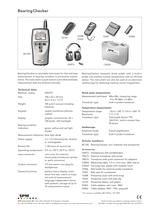
Bearing Checker 15288 15455 16124 15287 15286 BC100 EAR12 Bearing Checker is a portable instrument for fast and easy measurement of bearing condition in preventive maintenance. The instrument is push button controlled and basic measurement data are entered manually. CAS24 Bearing Checker measures shock pulses with a built-in probe and machine surface temperature with an infrared sensor. The instrument can also be used as an electronic stethoscope for detecting machine sound irregularities. Technical data Material, casing: ABS/PC Shock pulse measurement Size: 158 x 62 x 30 mm (6.2 x 2.4 x 1.2...
Open the catalog to page 4
VibChecker 15962 15288 15455 15287 TRM100 VC100 VibChecker is an instrument for fast and easy measurement of machine condition in preventive maintenance. The instrument and the monitoring technique are based on the recommendations of ISO 2372 and ISO 10816 standards for broad band measurements of vibration. These standards make the assumption that limited information, obtained easily and at a low cost, is often as use- CAS24 ful as a detailed analysis using expensive equipment and elaborate techniques. VibChecker has a built in probe transducer. It is push button controlled and basic measurement...
Open the catalog to page 5
Leonova™Infinity - Platform Leonova™ Infinity is a hand-held machine condition analys- er with colour touch screen, operating under Windows CE. Following functions are always included for unlimited use: • Data logging with Condmaster®Nova • Speed measurement • Temperature measurement • Analog signals, current and voltage • Reading from and writing to CondID® memory tags • Manual recording, free quantity • Check points, free text The main Leonova functions are user selected, see TD-212. With synchronous measurement, enveloping, true zoom and up to a 1 2 800 line spectrum over 0.5 Hz up to 40 kHz,...
Open the catalog to page 6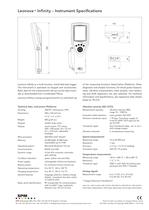
Leonova™ Infinity – Instrument Specifications 32 285 63 102 63 Leonova Infinity is a multi-function, hand-held data logger. The instrument is operated via keypad and touchscreen. Basic data for the measurement set-up can be input manually or downloaded from Condmaster®Nova. Leonova Infinity is always programmed for an unlimited use of the measuring functions listed below (Platform). Other diagnostic and analytic functions, for shock pulse measurement, vibration measurement, orbit analysis, rotor balancing and shaft alignment, are user selected. For technical information and specifications, see...
Open the catalog to page 7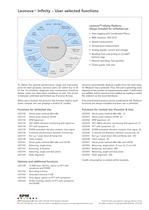
Leonova™ Infinity – User selected functions LR/HR dBm/dBc Leonova™ Infinity Platform, always included for unlimited use Balancing single plain SPM Spectrum ISO 10816 Balancing dual plain • Data logging with Condmaster®Nova • RMS vibration, ISO 2372 Shaft alignment FFT with symptoms • Speed measurement • Temperature measurement PLATFORM 12800 lines 40 kHz EVAM Run up/ coast down Bump test Recording • Analog signals, current and voltage • Reading from and writing to CondID® memory tags • Manual recording, free quantity 2 channel vibration Extended memory Orbit analysis Order tracking • Check points,...
Open the catalog to page 8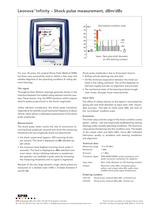
Leonova™ Infinity – Shock pulse measurement, dBm/dBc Normalized condition scale delta Input: Rpm plus shaft diameter (or ISO bearing number) For over 30 years, the original Shock Pulse Method (SPM) has been very successfully used to obtain a fast, easy and reliable diagnosis of the operating condition of rolling element bearings. Shock pulse amplitude is due to three basic factors: • Rolling velocity (bearing size and rpm) The signal • The mechanical state of the bearing surfaces (roughness, stress, damage, loose metal particle). Throughout their lifetime, bearings generate shocks in the interface...
Open the catalog to page 9
Leonova™ Infinity – Shock pulse measurement, LR/HR Evaluation boxes determined by bearing geometry and speed Calibration The LR/HR method was developed from the original Shock Pulse Method for condition diagnosis of rolling element bearings. It allows a precision analysis of oil film condition in the rolling interface and contains calculation models for finding the optimal lubricant. Poor lubrication is the root cause of most bearing failures. Signal and measurement Transducer and measuring procedure are the same as for the dBm/dBc method (TD-213). The shock pulse meter counts the rate of occurrence...
Open the catalog to page 10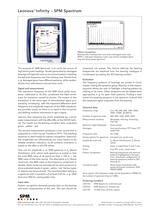
Leonova™ Infinity – SPM Spectrum Damage severity Trend Pattern recognition: Bearing with rotating inner race and a damaged outer race. BPFO = ball pass frequency outer race and its multiples dominate the shock pulse spectrum. The purpose of 'SPM Spectrum' is to verify the source of high shock pulse readings. Shocks generated by damaged bearings will typically have an occurrence pattern matching the ball pass frequency over the rotating race. Shocks from e. g. damaged gears have different patterns, while random shocks from disturbance sources have none. Signal and measurement The resonance frequency...
Open the catalog to page 11All SPM Instrument catalogs and technical brochures
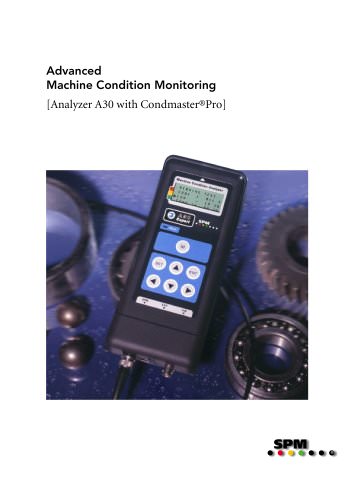 Analyser A30 with Condmaster®
8 Pages