


Rapid Application Development Framework (RADF)
1 /2Pages

Rapid Application Development Framework (RADF)
1 /2Pages
Catalog excerpts
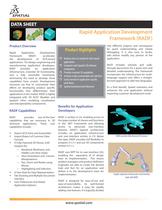
Product Highlights .. Reduces time-to-market for ACIS-based applications .. Integrates with Spatial’s 3D software components .. Provides essential 3D capabilities .. Includes a fully customizable user interface .. Easily extends for application-specifi c work-fl ows .. Spatial maintained and enhanced RADF provides fully featured 3D viewer Graphic depiction of kinematics functionality built with RADF DATA SHEET www.spatial.com Product Overview Rapid Application Development Framework (RADF) accelerates the development of ACIS-based applications. For design, engineering and manufacturing application developers, RADF provides an application infrastructure, essential 3D functionality, and a fully extensible framework, eliminating the need to develop these capabilities from scratch. Development resources are free to concentrate their eff orts on developing product specifi c functionality that diff erentiates their applications in the market. RADF is tightly integrated with 3D ACIS® Modeler and Spatial’s other modeling, visualization and interoperability components. RADF Capabilities RADF provides ‘out-of-the-box’ capabilities that are necessary in 3D technical applications. These core capabilities include: .. Import ACIS Parts and Assemblies .. Import/Export of Common Data Formats .. A Fully-Featured 3D Viewer, with Support for: — Rendered, Wireframe, and Hidden Line View States — View Orientation and Camera Manipulations — Pan, Zoom and Rotate using Mouse — Highlighting and Selection .. A Tree-View for Data Representation .. Tab-Docking and Multiple Document Interface .. User Preferences and Global Application Options Benefi ts for Application Developers RADF is written in C#, enabling access to the large number of classes and functions in the .NET Framework and allowing access to advanced user-interface features. RADF’s layered architecture includes an application infrastructure and user-interface written in C#. Below this layer, RADF provides full fl exibility to program in C++ and use 3D components written in C++. RADF uses WPF for its user-interface (UI), enabling the separation of UI design from its implementation. This means product managers and product defi nition engineers are able to create the desired look and feel for an application and deliver it to the development team for implementation. RADF is designed for ease-of-use and ease-of-extensibility. Its well-formed architecture makes it easy for rapidly adding new features. It is logically divided into diff erent projects and namespaces for quick understanding and simple debugging. It is also easy to locate, add and/or modify any portion of the application. RADF includes tutorials and walkthrough documents for a quick start and detailed understanding. The framework incorporates the infrastructure for multilanguage support and off ers a straightforward approach to add new languages. As a fi nal benefi t, Spatial maintains and enhances the core application without impacting customer development work. Rapid Application Development Framework (RADF)
Open the catalog to page 1
Ribbon menu Multi-document interface RADF projects and solution in visual studio www.spatial.com Plug-in Architecture RADF supports the creation of plug-ins which interact with the core application through a set of interfaces. Multiple plug-ins can be created to add specifi c functionality and groups of features. Because RADF utilizes a plugin architecture it is possible to update the core application without the need to also update plugins. DATA SHEET - RADF U.S. Corporate Headquarters 310 Interlocken Parkway, Ste. 200 Broomfi eld, CO 80021 Tel: 1+303-544-2900 Fax: 1+303-544-3000 Spatial Asia...
Open the catalog to page 2All SPATIAL catalogs and technical brochures
 3D Springback
1 Page
 HOOPS Visualize
2 Pages
 3D InterOp Suite
2 Pages
 3D ACIS® Modeler
2 Pages
 CGM
CGM2 Pages
 EDA 3D Analysis Suite
2 Pages
 3D Mesh Datasheet
2 Pages
 3D Constraint Manager
2 Pages

- Automation software solution
- Management software solution
- Analysis software solution
- Windows software
- Real-time software
- Computer-aided design software
- Design software solution
- Measurement software
- Interface software
- Quality software
- Visualization software solution
- Simulation software solution
- Automated software
- Programming software
- Development software
- Engineering software
- Creation software
- Optimization software
- 2D software