


SITEMA Locking Units KFH
1 /6Pages

SITEMA Locking Units KFH
1 /6Pages
Catalog excerpts

Technical Data Sheet TI-F50 Locking Units series KFH For a detailed functional description refer to“Technical Information TI-F10". Further important practical advice is given in “Operating Manual BA-F50". © Pressure port L “release” see 0 © Pressure port LL, alternative to L see @ © Ports T “pressure compensation” see 0 © Holder for proximity switch 1, signal “rod clamped” see 0 © Holder for proximity switch 2, signal “clamping released” see 0 Fig. 1: Dimensions Locking Unit KFH (CAD-files download at www.sitema.com) O The nominal holding force F is the minimum holding force for dry or hydraulic-oil wetted rods. 0 The pressure p is required to release the clamping. The admissible operating pressure is 160 bar. 3 As supplied, pressure port LL is plugged by a plug screw. It may be used alternatively to pressure port L and is useful for filling / airbleeding. We recommend connecting auto-bleeders to the ports which are not in use (not supplied in scope of delivery; available as option - see “Technical Information TI-Z10”). o Hydraulic operating volume 0 Proximity switch holders are provided for standard inductive proximity switches (M12 x 1 nominal switching distance 2 mm, flush mountable), except KFH 18 and KFH 25: M8 x 1 with a nominal switching distance of 1.5 mm. For easier service, the proximity switch holders have a depth stop and are pre-adjusted when delivered from the factory. The switches only need to be inserted to the stop and then clamped. The proximity switches are not supplied in the standard scope of delivery, but are available as accessories. o Internal volume changes during switching are compensated at ports T. An air filter is fitted to one of the ports T for “breathing”. The other port T is closed by a plug screw. In a dry and clean factory environment, this offers sufficient protection against dust etc. If, however, moisture or aggressive media are present, a pressureless hose instead of the filter must be installed to connect the Locking Unit KFH with clean atmosphere (e.g. a clean pressureless container). The other port T must be sealed with a plug screw. 7 Spacers keep the Locking Unit released and need to be removed after installation. Subject to modification without prior notice SITEMA GmbH & Co. KG . G.-Braun-StraUe 13 . D-76187 Karlsruhe . Phone: +49(0)721/98661-0 . Fax: -11 . www.sit
Open the catalog to page 1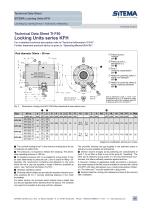
Technical Data Sheet TI-F50 Locking Units series KFH For a detailed functional description refer to“Technical Information TI-F10". Further important practical advice is given in “Operating Manual BA-F50". © Pressure port L “release” see © © Pressure port LL, alternative to L see @ © Ports T “pressure compensation” see 6 © Holder for proximity switch 1, signal “rod clamped” see 0 © Holder for proximity switch 2, signal “clamping released” see 0 Due to tolerances, ports 1, 2 and T can be displaced up to +/-5° relative to drawn position as well as the threaded holes G2 to pressure ports L/LL and...
Open the catalog to page 2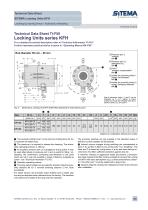
Technical Data Sheet TI-F50 Locking Units series KFH For a detailed functional description refer to“Technical Information TI-F10". Further important practical advice is given in “Operating Manual BA-F50". ©Pressure port L “release” see © ©Pressure port LL alternative to L see @ © Ports T “pressure compensation” see 6 ©Holder for proximity switch 1, signal “rod clamped” see 0 ©Holder for proximity switch 2, signal “clamping released” see 0 Fig. 3: Dimensions Locking Unit KFH (CAD-files download at www.sitema.com) o The nominal holding force F is the minimum holding force for dry or hydraulic-oil...
Open the catalog to page 3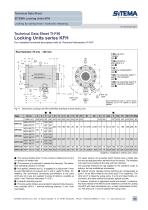
Subject to modification without prior notice o The nominal holding force F is the minimum holding force for dry or hydraulic-oil wetted rods. 0 The pressure p is required to release the clamping. The admissible operating pressure is 160 bar. 0 As supplied, pressure port LL is plugged by a plug screw. It may be used alternatively to pressure port L and is useful for filling / airbleeding. We recommend connecting auto-bleeders to the ports which are not in use (not supplied in scope of delivery; available as option - see “Technical Information TI-Z10”). o Hydraulic operating volume 0 Proximity...
Open the catalog to page 4
Purpose The Locking Unit KFH is used as an infinitely variable lock on piston rods for cylinders or other clamping rods. The Locking Unit KFH absorbs axial forces in both load directions. Axial play The load is held free from axial play in load direction 1. In standard designs, the load is also free from axial play in load direction 2 as long as the load does not exceed 80 % of the nominal holding force (F). In the case of exceeding, the axial play in load direction 2 is about 0.1 - 0.3 mm. Operating conditions The Locking Unit KFH is designed to operate in normal clean and dry workshop atmosphere. Operation...
Open the catalog to page 5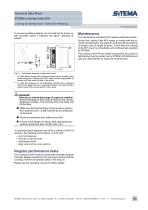
J WARNING! Risk due to slowed discharge of pressure medium! Slowed discharge of the pressure medium may cause a dangerous situation. The clamping then only locks with a time delay. K Make sure that the discharge of the pressure medium from pressure port L is not impaired by any additional components. K Route all connection lines without any kinks. K If there is any danger of kinking, take appropriate precautions (protective tube, thicker hose, etc.). If a particular quick response time of the Locking Unit KFH is required, the following preconditions must be met: • short line distances • fast...
Open the catalog to page 6All SITEMA catalogs and technical brochures
 electric Safety Brake linear
2 Pages
 PowerStroke SITEMA
9 Pages
 SITEMA_Flyer_2020
2 Pages
 TI-S10 Safety Locks
4 Pages
 TI-A10
7 Pages
 TI-P30
1 Page
 SITEMA Applications
2 Pages
 Dimensions, type KRG
1 Page
 Dimensions, type KRP/T
1 Page
 Dimensions, type KRP
1 Page
 Dimensions, type KR, K
2 Pages
 SITEMA Safety Catchers
2 Pages
 STB10 Rod Attachment STB
3 Pages
 F60 Dimensions, type KFHA
6 Pages
 Z10 - Auto Bleeder
3 Pages
 SITEMA Safety Locks KRG
1 Page
 SITEMA company
15 Pages
 Locking Units KFPC
3 Pages
 Locking units series KFPA
4 Pages


- Lifting table
- Double-acting cylinder
- Scissor lift table
- Hydraulic cylinder
- Pneumatic cylinder
- Stationary lift table
- Friction brake
- Hydraulic lift table
- Industrial cylinder
- Standard cylinder
- ISO cylinder
- Electromagnetic brake
- Industrial control system
- Heavy load lift table
- Hydraulic clamping
- Cylinder with piston rod
- Monitoring control system
- Safety brake