
- Catalogs
- Telemecanique Sensors
- MICROSONIC® Thru-beam Sensors Model SM100 Series


MICROSONIC® Thru-beam Sensors Model SM100 Series
1 /10Pages
MICROSONIC® Thru-beam Sensors Model SM100 Series
1 /10Pages
Catalog excerpts
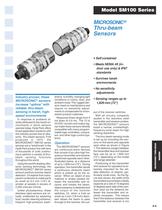
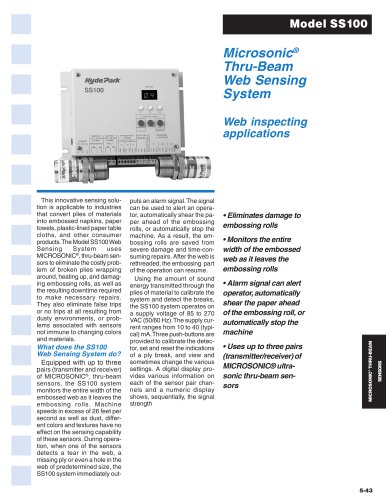
Industry proven, these MICROSONIC® sensors increase "uptime" with reliable, thru-beam sensing in harsh, high- speed environments rectly attributed to the harsh en- vironments in which sensors operate today, Hyde Park offers broad application solutions with this industry-proven line of ultra- sonic thru-beam sensors. First Hyde Park product line with tens of thousands of units continu- ing to perform a variety of thru- beam sensing functions Using the world's leading ultra- sonic sensing technology, the sensors perform precise object detection. Of objects from trans- parent containers to metal parts ameter at speeds in excess of Unlike photoelectrics, these stainless steel sensors are vir- tually unaffected by splashing food, caustic cleaning solutions, frequent high-pressure wash- downs, humidity, changing light conditions or colors, dust, and ambient noise. The rugged sen- sors need no maintenance and require no sensitivity adjust- ments to compensate for incon- sistent product materials. Response times range from 4 nal make these sensors directly compatible with many program- mable logic controllers, comput- ers, and other logic control sys- that consist of an ultra-high-fre- quency transmitter and receiver positioned opposite each other, illustrated below, at a distance operation, the transmitter sends a continuous ultrasonic beam ceiver. When an object of any material or shape passes be- ceiver and breaks the beam, object presence is detected and switches. Or, when a hole as small as 3 mm (1/8 inch) diam- eter allows the beam to pass • Self contained • Survives harsh With all circuitry compactly sealed in the stainless steel transmitter and receiver probes, boast a narrow, constanthigh- frequency sonic beam for high sensing resolution. The thru-beam sensing mode sors on the same axis opposite each other as shown in Figure 1 .The distance (range) between the transmitter face and receiver tremely important for the reli- able detection of objects, par- ticularly small ones. As the fig- ure also shows, the width of the transmitted sound beam initially expands at a rate of 10 degrees (5 degrees each side of the com- ceiver increases. This means that if the distance between the
Open the catalog to page 1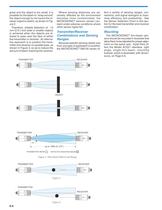
great and the object is too small, it is possible for the beam to "wrap around" the object enough to not cause the re- ceiver output to switch, as shown in Fig- Therefore, reliable detection of 13 mm (0.5") inch wide or smaller objects is achieved when the objects are al- lowed to pass near the face of either the transmitter or receiver. An alterna- tive approach is to position the trans- mitter and receiver on parallel axes, as shown in Figure 3, so as to reduce the amount of beam reaching the receiver. Where sensing distances are ad- versely affected as the environment becomes more contaminated,...
Open the catalog to page 2
Electrical Wiring Cable Style** Transmitter Models, Standard Cable Models, Standard Cable Length 3 m (10') Quick-disconnect (Amphenol) Style** Transmitter Models with Model AC100 Amphenol, 2-conductor, 3 m Receiver Models with Model AC150 Amphenol, 3-conductor, 3 m (10) Mating Connector Cable: SM170,175,182,186,188,190,193C, * Operates only on 15 VDC power ** Use Belden Cable No. 8423 and No. 9154 to extend receiver and transmitter cable length, respectively. Maximum recommended cable length is 152 m (500). (watertight) Style Transmitter Models with Model AC107 Mating Connector Cable SM138WTC,...
Open the catalog to page 3
Dimensions Cable Style Transmitter Models: SM121, 126, 139, 141, 145, 147 2.875 7.30 cm 1/2' PTS CABLE END 10' LONG OR CONNECTOR 1.375 3.50 HEX 1.125 2.86 cm 1 1/4-18 THREADS 2.875 7.30 cm 1.125 2.86 cm SENSING FACE LED INDICATOR ON RECEIVER 1/2 NPT 1 1/4-18 THREADS NUT, XA438 (ONE FURNISHED) NUT, XA438 (ONE FURNISHED) CABLE END 10' LONG OR CONNECTOR Receiver Models: SM171, 176, 187, 189, 191, 193, 195, 198, 199, 251, CS101 Quick-disconnect (Amphenol) Style Transmitter Models: SM120, 125, 128, 138, 140, 146 Variable-power potentiometer on Model SM128 only 3.575 9.08 cm 2.880 7.30 cm 3.575 9.08...
Open the catalog to page 4
General Specifications Minimum-size Detection: Power Requirements Supply Voltage: 12 to 24 VDC ± 10%, regulated Maximum on state voltage 100 mA @ 0.2 V Receiver red LED "on" when beam is received Response Time Transmitter: None Red LED: Illuminated when sonic energy is received, regardless of output state. Cable Style Models: Transmitter: 305 cm (10'), 20 AWG, foil shield, Receiver: 305 cm (10'), 22 AWG, foil shield, Connector Style Models: Amphenol (nonwatertight) quick-disconnect style 305 cm (10'), 20 AWG, foil shield, lead-free, 305 cm (10'), 22 AWG, foil shield, lead-free, Watertight (WTC)...
Open the catalog to page 5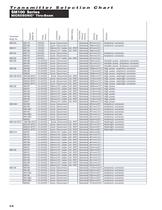
Transmitter Selection Chart MICROSONIC Thru-Beam
Open the catalog to page 6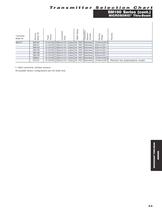
Transmitter Selection Chart MICROSONIC Thru-Beam • = Most commonly stocked sensors All possible sensor configurations are not listed here.
Open the catalog to page 7
Receiver Selection Chart MICROSONIC Thru-Beam
Open the catalog to page 8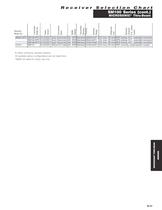
Receiver Selection Chart SM100 Series (cont.) SM252-WTC SM138-WTC SM140-WTC SM146-WTC CS101 SM147 12-24VDC 12-24VDC 12-24VDC 12-24VDC Quick Disconnect Quick Disconnect Quick Disconnect 305cm(10') Cable 4X, 4X, 4X, 4X, IP67 Stainless IP67 Stainless IP67 Stainless IP67 Stainless 1829mm(72" ) 635mm(25") 1016mm(40") 1016mm(40") On 4ms, Off 4ms On 4ms, Off 4ms On 4ms, Off 4ms On 4ms, Off 4ms Remarks (Outputs N.O. unless noted) Response time Sensing Range Transmitter/ Receiver Housing NEMA Rating* Connection Style Power Version Reveiver Model No. Transmitter Model No. MICROSONIC® Thru-Beam NPN sinking,...
Open the catalog to page 9All Telemecanique Sensors catalogs and technical brochures
 Photo-electric sensors OsiSense XU
186 Pages
 Safety light curtains XUSL range
38 Pages
 Ultrasonic sensors XX range
79 Pages
 Limit switches XC Standard range
161 Pages
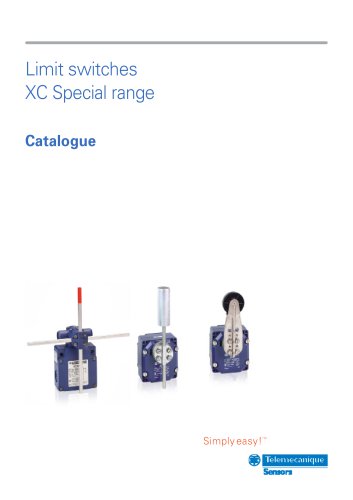 Limit switches XC Special range
67 Pages
 limit switch XCMN
6 Pages
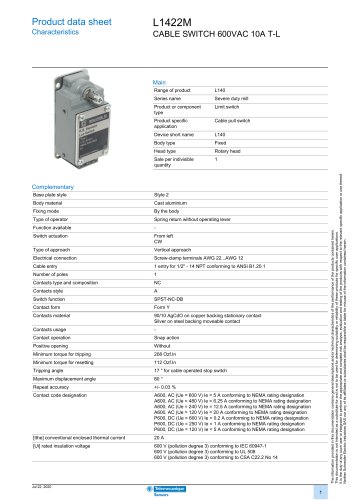 L1422M
2 Pages
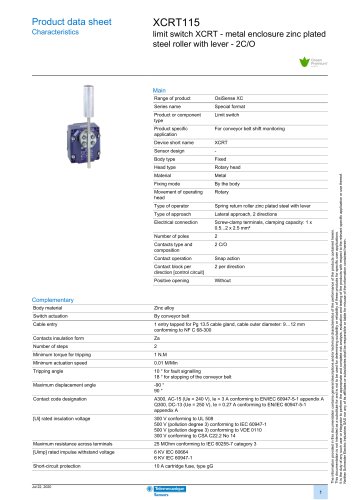 limit switch XCRT
5 Pages
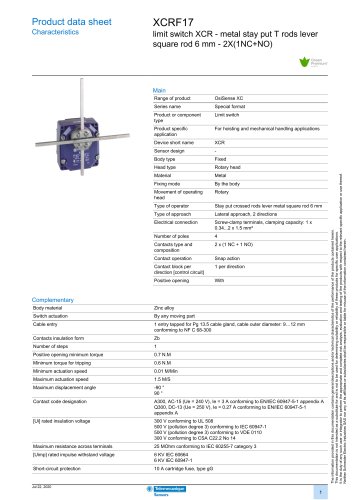 limit switch XCR
5 Pages
 limit switch XCKL
6 Pages
 Ultrasonic sensors OsiSense XX
36 Pages
 Limit switches OsiSense XC Standard
146 Pages
 New 2011 sensors catalog
24 Pages
 Model VM18 Proximity
6 Pages
 Osiconcept Photoelectric Sensor
2 Pages
 PhotoVirtu™ Photoelectric Sensor
4 Pages
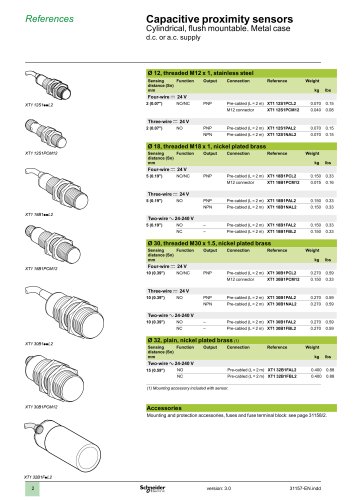 Osicap Capacitive Sensors
8 Pages






Archived catalogs
 Osiris XUA Photoelectric Sensor
2 Pages
 Virtu™ 30A Catalog
4 Pages
 Virtu™ Product Brochure
8 Pages
- Pressure transmitter
- Proximity switch
- Pressure switch
- Cylindrical proximity sensor
- Stainless steel pressure transmitter
- Relative pressure transmitter
- Inductive proximity sensor
- Mechanical pressure switch
- Photoelectric sensor
- IP67 proximity sensor
- Limit switch
- Sensitive element pressure transmitter
- DC proximity sensor
- DC pressure transmitter
- Diaphragm pressure switch
- Rectangular photoelectric sensor
- Adjustable pressure switch
- Light barrier
- Multibeam light curtain
- M12 proximity sensor