
- Catalogs
- Schaeffler Technologies AG & Co. KG
- Sealing rings


Sealing rings

Sealing rings
The document emphasizes the critical role of sealing rings in bearing arrangements, focusing on their ability to prevent contamination and lubricant loss. It highlights the development and effectiveness of INA sealing rings across various industries over the past fifty years.
Criteria for Selection of Sealing Rings
Optimal sealing is achieved by matching criteria such as resistance to media, temperature ranges, and compatibility with housing materials. The document compares different types of sealing rings (GR, G, SD) based on these factors.
Product Overview
Sealing rings are designed for small radial dimensions, effectively protecting against contamination and grease loss. They are easy to install and support high circumferential speeds.
Types of Sealing Rings
Sealing Rings G: Made from synthetic NBR elastomer with a single lip, suitable for shaft diameters from 8 mm to 80 mm, featuring a rubber-encased reinforcing ring.
Sealing Rings GR: Similar to G but with external steel reinforcement, suitable for shaft diameters from 4 mm upwards.
Sealing Rings SD: Double-lipped, suitable for shaft diameters from 8 mm to 50 mm, made from reinforced polyamide and thermoplastic PU elastomer, also suitable as wipers on shafts with axial motion.
Design and Safety Guidelines
Includes tolerances for housing bore, shaft surface roughness, and guidelines for coaxiality and runout to ensure proper sealing function and minimize wear.
Fitting Instructions
Proper handling and fitting of sealing rings are crucial for long-term functionality. Detailed instructions on fitting, including the use of pressing tools and fitting sleeves, are provided.
Materials and Characteristics
Discusses the hardness, compression set, and materials used for sealing rings, emphasizing the importance of selecting appropriate materials for specific applications.
Operating Behavior
Details static and dynamic sealing capabilities, changes in radial forces, and the impact of temperature and speed on sealing performance.
Sealing Ring Temperature and Material Interaction
The interaction between medium and temperature affects sealing ring material. Increased circumferential speed raises contact surface temperature, risking wear and heat cracks. Suitability should be tested as temperature limits are approached.
Circumferential Speed
Standard materials like NBR and TPE-U are suitable for speeds up to 10 m/s, while special materials like FPM and HNBR can handle up to 16 m/s and 12 m/s respectively, assuming no excess pressure and adequate lubrication.
Lubrication
Continuous lubrication is essential for reliable sealing ring function. Heat generated at the seal edge is dissipated by the lubricant.
Friction and Wear
Friction is influenced by material pair, shaft surface, radial force, and lubrication. Wear types include adhesive and abrasive wear, mitigated by using hardened or coated shafts.
Leakage and Operating Life
Leakage can occur as gas, vapor, or droplets. Operating life is influenced by ageing, medium, temperature, wear, and contamination, with seals lasting up to 10,000 hours or 3-5 years under normal conditions.
Axial Motion of the Shaft
Sealing rings act as wipers in pure axial motion, retaining lubricant and preventing contamination. For rotary motion with axial overlay, INA sealing rings adapt well with appropriate lubrication.
Application Examples
Examples include trucks, hand drills, circular saws, and forklifts, demonstrating the use of sealing rings in protecting bearings from contamination and ensuring smooth operation.
Catalog excerpts
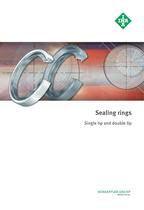
Sealing rings SCHAEFFLER GROUP
Open the catalog to page 1
Sealing rings The quality of a bearing arrangement is decisively influenced by the components – shaft, housing, seal – that are directly adjacent to the bearing. Seals play a decisive role in protecting bearings against contamination. If inadequate seals are used, contaminants can penetrate the bearing or an unacceptably large quantity of lubricant may escape from the bearing. Solid contaminants lead to wear and/or fatigue of the raceways and rolling elements. Bearings that are contaminated or running dry will fail long before they reach their fatigue rating life. When designing the bearing arrangement,...
Open the catalog to page 2
Sealing rings Criteria for selection of sealing rings Product overview Design and safety guidelines Special designs Dimension tables Structure of sealing rings Schaeffler Group Industrial
Open the catalog to page 3
Operating behaviour Application examples Schaeffler Group Industrial
Open the catalog to page 4
Schaeffler Group Industrial
Open the catalog to page 5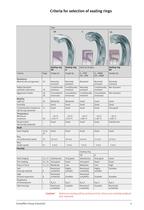
Criteria for selection of sealing rings Special designs G..-FPM GR..-FPM G..-HNBR GR..-HNBR Resistance Mineral oils and greases Normally resistant Normally resistant Normally resistant Normally resistant Highly blended/ synthetic lubricants Conditionally resistant Conditionally resistant Normally resistant Conditionally resistant Consultation necessary Consultation necessary Conditionally resistant Consultation necessary Weather Light/air Contamination resistance (lip facing outwards) Very good Aggressive media Temperature Minimum/ maximum Relubrication (lip facing outwards) Shaft Seal integrity...
Open the catalog to page 6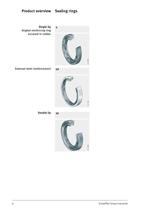
Product overview Single lip Angled reinforcing ring encased in rubber Sealing rings External steel reinforcement Schaeffler Group Industrial
Open the catalog to page 7
Sealing rings Sealing rings of series G, GR and SD are matched to the small radial dimensions of INA drawn cup needle roller bearings with open ends and with closed end and of needle roller bearings without an inner ring. These contact seals protect the sealed area against contamination, spray water and the excessive loss of grease. In comparison with spring-preloaded rotary shaft seals, they have significantly smaller cross-sectional dimensions, lower friction values and allow space-saving, economical sealing of shafts undergoing rotary and axial motion. The sealing rings are easy to fit, since...
Open the catalog to page 8
Sealing rings Sealing rings SD have a double lip and are suitable for shaft diameters from 8 mm to 50 mm: ■ a contact seal lip essentially prevents the escape of lubricant and unpressurised oil from the bearing arrangement ■ a protective lip not in contact with the shaft (marked side) also acts as a gap seal against the ingress of contamination The space between the seal lip and protective lip must be filled with grease. The sealing rings comprise two plastic components. The seal carrier is made from reinforced polyamide (coloured black), while the seal lip area is made from thermoplastic PU...
Open the catalog to page 9
Tolerances and roughness of the shaft surface For shafts, the tolerances should be in accordance with the table Shaft and housing design. The ISO tolerance class h8 to DIN ISO 286 is also permissible. The surface roughness must be in accordance with the table Shaft and housing design. The sliding surface for the seal lips must be free from score marks and damage such as impact points, scratches, cracks, rust, raised areas. The end of the shaft must have a lead chamfer so that the seal lips are not damaged during fitting – chamfer dimensions according to Figure 2 and the table Chamfer dimensions...
Open the catalog to page 10
Sealing rings Coaxiality and runout Caution! The coaxiality and runout influence the sealing function and wear at the seal edge. If the coaxiality between the shaft and housing bore is too large, Figure 3, the radial force will be distributed unevenly. This will lead to wear of the seal edge on one side and will reduce the sealing action. Runout deviations can, especially at high circumferential speeds, increase the seal gap and lead to leakage, Figure 4 . Do not exceed the limit values for coaxiality and runout, Figure 5 . Tm 1 ᕃ Locating bore ᕄ Centre of bore ᕅ Shaft ᕆ Centre of shaft Tm =...
Open the catalog to page 11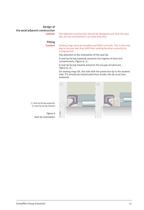
Design of the axial adjacent construction Caution! The adjacent construction should be designed such that the seal lips are not constrained in an axial direction. Fitting Caution! Sealing rings must be handled and fitted correctly. This is the only way to ensure that they fulfil their sealing function correctly for a long period. Pay attention to the orientation of the seal lip. A seal lip facing outwards prevents the ingress of dust and contaminants, Figure 6, ᕃ. A seal lip facing inwards prevents the escape of lubricant, Figure 6, ᕄ. On sealing rings SD, the side with the protective lip is...
Open the catalog to page 12
Sealing rings Oil or grease the running surface of the shaft and seal lip. This reduces the frictional energy during initial movement. In the case of sealing rings with an encased reinforcing ring – sealing ring G – the outer surface should be oiled before the seal is pressed in. This makes it easier to fit the seal in the housing. Press sealing rings carefully into the housing bore using a pressing device and a suitable pressing tool, Figure 7. Ensure that the seal lip is not damaged. Cover any sharp shaft edges, slots, teeth or threads using fitting sleeves, Figure 8. Fit sealing rings in such...
Open the catalog to page 13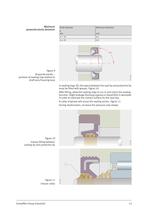
Maximum perpendicularity deviation Shaft diameter Maximum deviation Perpendicularity – position of sealing ring relative to shaft axis/housing bore In sealing rings SD, the space between the seal lip and protective lip must be filled with grease, Figure 10. After fitting, allow the sealing rings to run in and check the sealing function. Slight leakage (forming a grease or liquid film) is desirable in order to lubricate the contact surface for the seal lips. A collar of grease will assist the sealing action, Figure 11. During relubrication, increase the pressure only slowly. Figure 10 Grease filling...
Open the catalog to page 14
Sealing rings Sealing rings should be stored in dry, dust-free rooms – relative humidity max. 65%, moderate ventilation, free from draughts. Observe the storage room requirements in accordance with DIN 7 716. Sealing rings should be stored at an air temperature of +20 °C Ϯ5 °C free from stress, i.e. without tension, compression or deformation. Do not allow the rings to come into contact with chemicals such as acids, solvents or fuels. Protect sealing rings from: ■ direct sunlight ■ UV light ■ ozone (e.g. produced by electrical equipment) ■ intense thermal radiation. If these conditions are not...
Open the catalog to page 15All Schaeffler Technologies AG & Co. KG catalogs and technical brochures
 ProLink CMS
2 Pages
 Split plummer block housings SNV
84 Pages
 Always Following the Sun
12 Pages
 Active Magnetic Bearing
4 Pages
 RDDM Rotary Direct Drive Motors
106 Pages
 FAG RS ? Robust and Fast
6 Pages
 FAG Alignment Tools
36 Pages
 Split Plummer Block Housings SNS
68 Pages
 FAG SmartCheck
2 Pages
 Customized Hubridization
20 Pages
 Crossed roller bearings
67 Pages
 Bearings for screw drives
106 Pages
 Sealed Spherical Roller Bearings
24 Pages
 Spherical Roller Bearings E1
40 Pages
 Tapered Roller Bearings E1
4 Pages
 Single Row Ball Roller Bearings
18 Pages
 Super Precision Bearings
243 Pages
 Slewing rings
108 Pages


Archived catalogs
 Triondur
2 Pages
 FAG E1 Spherical Roller Bearings
28 Pages


