
- Catalogs
- SCANLAB GmbH
- RTC5 control boards


RTC5 control boards

RTC5 control boards
The RTC®5 control board is designed for synchronous, interference-resistant control of scan systems, lasers, and peripheral equipment in real-time. It is available in various formats including a PC interface board, PCI-Express board, or PC/104-Plus module. The board features a high-performance signal processor and a DLL for simplified programming under Windows.
- Available interfaces: PCI bus, PCI-Express (PCIe-x1 version 1.0), PC/104-Plus.
- Supports multiple RTC®5 boards in one PC and master/slave synchronization.
- Compatible with Windows 7, Vista, and XP (SP2 or later) with drivers for 32-bit and 64-bit systems.
- Supports multi-threading and multi-processing.
- Uses SL2-100 transfer protocol for 20-bit positioning resolution.
- Features a virtual processing field with 24-bit resolution and a 10 µs output period.
- Includes galvanically isolated signals and tuning selection.
- Supports vector and jump mode with tuning auto-switching and scan-system diagnosis.
- Equipped with a 15-pin D-Sub connector and laser signals with 15 ns resolution.
- Supports various laser modes and bitmap mode with pixel frequencies up to 300 kHz.
- Includes RS232 interface and speed/position-dependent laser control.
- 16-bit digital output and input, 8-bit digital output, and 12-bit analog output (0...10 V).
- Features McBSP interface and stepper motor signals.
- Configurable list buffers with 1,000,000 list positions and protected memory area.
- Supports lists, subroutines, and enhanced list execution status.
- Includes marking of dates, times, serial numbers, circles, and ellipses.
- Control of 3-axis scan systems and processing-on-the-fly functionality.
- Dual-head capability for simultaneous control of two scan systems.
- Customer-specific extensions are possible.
For more details, contact SCANLAB AG or SCANLAB America, Inc. Contact information is provided in the document.
Catalog excerpts

The RTC16^ control board provides synchronous, interference- resistant control of scan systems, lasers and peripheral equipment in real time. It is available as a PC interface board, as a PCI-Express A high-performance signal processor and the supplied DLL simplify programming under Windows. Software commands are loaded into the RTC®5's freely-configurable list buffer and processed by the DSP. Every 10 us, appropriate signals are output to or read-out from the scan system, laser and peripheral equipment. The RJC% communicates with scan systems via the new SL2-100 data transfer protocol. This protocol supports 20-bit control sig- nals and thereby a 16x higher positioning resolution compared to the RTC®4 predecessor board. The RTC®5's processor automati- cally performs micro-vectorization and image field correction. For laser control, various programmable laser signals are available for vector and bitmap processing. During execution, the board can provide automatic position/speed/vector-dependent readjustment For SCANLAB scan systems with fully digital servo electronics (e.g. intelliSGW®, ¡ntelI¡cube®, intelliD/?//./.®, intellil/1/H.D®, powerSC/W i), the RTC® 5 also supports all possibilities arising from the ¡DRIVE® technology. This includes real-time monitoring and remote diagnosis of key operational parameters, simulation- assisted process optimization and the use of different dynamics tunings. The feedback of the scan-system speed can be used for speed-dependent laser control. Numerous options provide the extensive flexibility system integra- tors need for meeting diverse customer requirements.
Open the catalog to page 1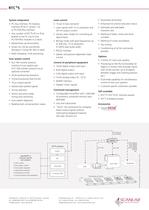
System integration Master/slave synchronization • Multi threading, multi processing Scan system control (control of scan systems per optional converter) • Virtual processing field (24 bit) • Galvanically isolated signals • Tuning selection • Vector and jump mode, tuning auto-switching • Scan-system diagnosis • Reading back actual-position values Laser control • Laser signals with 15 ns resolution and • Various laser modes for controlling all typical lasers Bitmap mode with pixel frequencies up 0-100% laser pulse width • Speed- and position-dependent laser Control of peripheral equipment • 16-bit...
Open the catalog to page 2All SCANLAB GmbH catalogs and technical brochures
 smart scanning
6 Pages
 intelliSCAN IV
4 Pages
 powerSCAN II 50i
2 Pages
 excelliSHIFT
1 Page
 dynAXIS 421
4 Pages
 Polygon Scanner Systems
2 Pages
 palmSCAN
2 Pages
 laserDESK
4 Pages
 intelliWELD II, intelliWELD
4 Pages
 basiCube
2 Pages
 basiCube14
2 Pages
 rtc4
rtc42 Pages
 powerscanpowerscani
4 Pages
 intelliscaniii
2 Pages
 intelliscanse
2 Pages
 intelliSCAN+intelliScande
4 Pages
 hurryscaniiihurryscan
4 Pages
 high-speed z axis
1 Page
 dynaxis
2 Pages
 CollimationModul
2 Pages
 excelliSCAN scan system
4 Pages
 Company Profile SCANLAB AG
24 Pages
 SCANalign Vision System
4 Pages
 basiCube 10 scan head
2 Pages
 hand-held scan-device
2 Pages
 universal and compatible
4 Pages
 intelliSCAN III Scan Heads
2 Pages
 Galvanometer Scanners
2 Pages
 Scancube III Scan Heads
2 Pages
 Camera Adapter
2 Pages
 laserDESK Software
4 Pages
 Scan System "powerSCAN"
4 Pages
 Scan-System "intelliWELD"
4 Pages
 2D Scan Heads "hurrySCAN"
4 Pages




Archived catalogs
 SCANcube® 7, 8.5, 10, 14
2 Pages
 intelliSCAN®
2 Pages
 intelliWELD® 30 FC
2 Pages
 powerSCAN 33
2 Pages
 RTC®3, RTC®4
2 Pages
 RTC®5
RTC®52 Pages
 Camera Adapter
2 Pages


- Welding system
- Automation software solution
- Positioning table
- Automatic welding machine
- Windows software
- Control software
- Translation stage
- Motorized positioning table
- Interface software
- Quality software
- Laser welding machine
- Creation software
- Optimization software
- 3D scanning system
- Measurement scanner
- Laser scanner
- Machining software
- XY scanner
- Vertical positioning stage
- High-precision scanner