
- Catalogs
- Russell Finex
- An in-depth look at vibratory sieves and separators for dry bulk powders


- Company
- Products
- Catalogs
- News & Trends
- Exhibitions
An in-depth look at vibratory sieves and separators for dry bulk powders
1 /2Pages

An in-depth look at vibratory sieves and separators for dry bulk powders
1 /2Pages
Catalog excerpts

Typical Capacities Model Mesh Size (microns) Tungsten Carbide C600 Toner Powder C900 Stainless Steel Powder C900 Salt C900 Powder Paint C900 Pharmaceutical Powders C600 Leaded Glaze C1200 Food Ingredients C600 Flour C1200 Clay Slip C900 Plastic Powder C1500 China Clay C1200 High capacity check screeningwet or dry applications The range of Compact Sieves is ideal for high capacity safety screening of powders and liquid slurries, especially where space is restricted.You can be assured that all oversized contamination is removedfrom your product giving you total peace of mind. Operation and cleaning are quick and easy making these machines perfect for all processing industries. Compact 900 Sieves with Vibrasonic® deblinding system at Colmans - mustard powder producer. The screens are fed from blenders and pass the sieved material through to the packaging area. Full research and testing facilities All our separation equipment is available for extended trials on your premises, while facilities for testing under controlled conditions are provided by state-of-the-art Test and Research Units. These units are located at our sites in the UK, Belgium, USA and India. Among other things, we evaluate the effects of changing variables such as mesh size, motor speed, degree of vibration and rate of material flow. These can all influence the performance of separation equipment. The results of every test are added to a computerized database, which incorporates information gathered by the company since its earliest days. We offer customers confidentiality in regard to specific findings. Improves your product purity Eliminates any oversized contamination from your powders and liquids. Full after market support Increases your production We are committed to giving our customers a fast, responsive and reliable support service that helps to keep production lines running. This means full support from our technical representatives and the availability of a complete range of spares off-the-shelf. Russell standard parts represent excellent value for money and allow units to operate trouble-free at optimum levels of performance. For mesh assemblies, made to order or standard lines, we have our own production facilities, which ensures rapid delivery and extremely competitive pricing. Doubles your throughput with half the size Much higher throughputs per unit mesh area compared to conventional machines. Reduces your down-time Easy to strip down and clean without tools. Eliminates dust and fumes Call us today to find out how the Russell Compact Sieve ® will help solve your processing problems and transform productivity. All our experience is at your disposal. Enclosed screening for total containment. Lowers noise levels Solid rubber suspension gives quieter operation - typically as low as 70 dBA. P in X A use d 2 TE fied for 0, 1 an A Russell Finex Ltd. Feltham, England. Fits into smaller spaces Fits easily into existing installations and areas of limited headroom. Russell Finex N.V. Mechelen, Belgium. Russell Finex Inc. Pineville, N.C. USA. Russell Finex Pvt Ltd. New Delhi, India. Russell Finex Limited. Russell Finex Pvt Ltd. Smartworks, Nehru Place, Russell House, Browells Lane, England. Email: [email protected] Email: [email protected] Russell Finex-COM-04-04/11 © Specification subject to change. 625 Eagleton Downs Drive, North Carolina 28134, U.S.A. Tel: +1 704 588 9808 Email: [email protected] 3rd Floor, Vardhman Trade Centre, New Delhi – 110 019, India Email: [email protected] No clogging, No hold ups Russell Proven Technology made even more effective through working closely with our customers Worldwide Leaders in Fine Mesh Sep
Open the catalog to page 1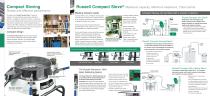
Compact Sieving Simple and effective performance The design of the Russell Compact Sieve is based on ® Russell Compact Sieve ® Meeting industry needs At Russell Finex we are committed to working closely with customers around the world, supplying solutions to your problems and keeping up to date with changes in legislation that affect your industry. simplicity, the material being screened passes through the machine in a straight line, ensuring no hold-ups or dead points. Any oversized material quickly travels across the screen mesh to give maximum separation and can be discharged through an oversize...
Open the catalog to page 2Archived catalogs
 Finex 22
2 Pages
 Compact Airswept Sieve
2 Pages
 Blow Thru Sieve
2 Pages
 Compact Sieve English
2 Pages
 Vibrasonic Deblinding System
2 Pages
 Mini Sifter
1 Page
 Composite Brochure
16 Pages
 Compact Airlock Sieve
4 Pages
 Finex Separator
2 Pages
 Liquid Solid Separator
2 Pages
 Russell Eco Separator
2 Pages


- Vessel
- Liquid filter
- Storage vessel
- Filter with cartridge
- Solids separator
- Russell screener
- Pressure separator filter
- Industrial use filter
- Stainless steel pre-filter
- Russell bulk material screener
- Centrifugal classifier
- Water pre-filter
- Filtration unit
- Liquids separator
- Cascade separator
- Y-strainer filter
- Basket filter
- Separator for the recycling industry
- VOC-free liquid filtration unit
- Russell vibrating screener