
- Catalogs
- ROSS Mixers
- Mixing Moves Osmosis Technology Forward

Mixing Moves Osmosis Technology Forward
1 /4Pages

Mixing Moves Osmosis Technology Forward
1 /4Pages
Catalog excerpts
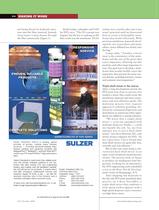
Triple-shaft mixer to the rescue After a long development period, the HTI team was close to success, but needed a mixer that could create the membrane material and meet consis- tency and cost-efficiency goals. The multistep process first requires aggressive cellulose grinding, fol- lowed by continued dispersion and dissolution as numerous other ingre- dients are added to a casting solution.We knew that a single-shaftmixer ӗ even one equipped with multiple disperser blades could not handle the job. So, my first impulse was to test a dual-shaft mixer,ה says Steve Peterson, P.E., and senior project...
Open the catalog to page 2
CP CP ,April, p. 31).With a dual-shaft mixer, the initial phase producedӑgel balls that resisted wetting out and dispersion,Ҕ Peterson says. But with the triple-shaft mixer ӗ thanks to the intense shear that the rotor/stator mixer applies the gel balls dissipate very quickly. At that point in the cycle, we turn off the high-shear mixer and proceed with only the high-speed disperser and the anchor agitator.ה The batch was complete in two hours, compared with the six-hour cycle that a dual-shaft mixer required.Today, HTI operates with a 40-gal. VersaMix in full-scale production, while a 2-gal....
Open the catalog to page 4All ROSS Mixers catalogs and technical brochures
 42B
42B2 Pages
 42N
42N2 Pages
 Ross Motionless Mixers
10 Pages
 HSM-100LCI-T
2 Pages
 Vertical Blender
2 Pages
 DCB
DCB1 Page
 VCB
VCB1 Page
 Three Roll Mill
1 Page
 CDA
CDA1 Page
 PVM
PVM1 Page
 Series700
2 Pages
 Series500
1 Page
 Series100
1 Page
 Series400
1 Page
 Discharge System
1 Page
 High Viscosity Disperser
2 Pages
 Ross High Speed Disperser
2 Pages
 High Shear Mixers
16 Pages
 Blenders
12 Pages
 Mixing/Dispersion Equipment
4 Pages


- Vessel
- Dynamic agitator
- Batch agitator
- Grinding mill
- Drying system
- Metal tank
- Liquid homogenizer
- Stainless steel vessel
- Agitator for the food industry
- Vertical homogenizer
- Homogenizer for the chemical industry
- Vertical tank
- Stainless steel homogenizer
- In-line mixer
- Horizontal lump breaker
- Solid kneader
- Solid/liquid agitator
- Horizontal tank
- Powder kneader
- Horizontal kneader