
- Catalogs
- RKB Europe
- It’s All About the Steel: the Importance of Bearing Steel Cleanliness for Long-Life Applications


It’s All About the Steel: the Importance of Bearing Steel Cleanliness for Long-Life Applications
1 /7Pages

It’s All About the Steel: the Importance of Bearing Steel Cleanliness for Long-Life Applications
1 /7Pages
Catalog excerpts
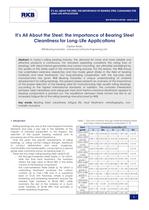
IT’S ALL ABOUT THE STEEL: THE IMPORTANCE OF BEARING STEEL CLEANLINESS FOR LONG-LIFE APPLICATIONS RKB TECHNICAL REVIEW - MARCH 2011 1 It’s All About the Steel: the Importance of Bearing Steel Cleanliness for Long-Life Applications Ciprian Radu RKB Bearing Industries - Advanced Software Engineering Unit Abstract: In today’s rolling bearing industry, the demand for more and more reliable and effective products is continuous. For standard operating conditions the rating lives of bearings, with ideal internal geometries and correct mounting, are ultimately established by the quality of the steels used in the manufacturing process. For this reason, the RKB Group has undertaken extensive researches and has made great strides in the field of bearing materials and heat treatments. Our long-standing cooperation with the top-class steel manufacturers has given RKB Bearing Industries a unique understanding of material development for rolling bearings. The present paper presents an overview of the importance of the proper selection of the bearing steel for manufacturing high quality rolling bearings, according to the highest international standards. In addition, the complex interrelation between steel cleanliness and adequate heat and thermo-chemical treatments applied to bearing components is pointed out. The equilibrium between these factors has led to an increased fatigue life of the rolling bearings manufactured by RKB. Key words: Bearing steel, cleanliness, fatigue life, heat treatment, metallography, nonmetallic inclusions 1. Introduction Rolling bearings are one of the most frequent machine elements and play a key role in the reliability of the majority of industrial equipment. In this respect, the selection of the proper bearing material and its processing are of the utmost importance. Over the years, the specific requirements of rolling bearings, i.e. rolling contact fatigue strength, resistance to contact deformation and wear, toughness, machinability and hardenability, conducted to a special grade steel commonly known as bearing steel [1]. There are two major rolling bearing steel variants [2]: - the through-hardened steels (table 1), for which, after the final heat treatment, the hardness attains the high value of 58-64 HRC in the entire volume of the bearing component; - the case-hardened steels (table 2), for which a carburizing treatment increases the carbon content up to 0.65-1.10% only in a superficial layer of 15-25 mm thickness, where a proper hardening and tempering treatment ensures the needed high hardness of 58-64 HRC, while maintains the rest of the material at a much lower hardness of 25-48 HRC that provides a better operating toughness. Table 1 - The most common through-hardened bearing steels and major chemical elements composition [1; 3] Steel grade Chemical composition (%) C Mn Si Cr Mo ASTM-A295 (52100) 0.98-1.10 0.25-0.45 0.15-0.35 1.30-1.60 0.10 ASTM-A295 (50100) 0.98-1.10 0.25-0.45 0.15-0.35 0.40-0.60 0.10 ASTM-A295 (5195) 0.90-1.03 0.75-1.00 0.15-0.35 0.70-0.90 0.10 ASTM-A295 (1570) 0.65-0.75 0.80-1.10 0.15-0.35 - 0.10 ASTM-A295 (1560) 0.56-0.64 0.75-1.00 0.15-0.35 0.70-0.90 0.10 ASTM-A485 grade 1 0.95-1.05 0.95-1.25 0.45-0.75 0.90-1.20 0.10 ASTM-A485 grade 2 0.85-1.00 1.40-1.70 0.50-0.80 1.40-1.80 0.10 ASTM-A485 grade 3 0.95-1.10 0.65-0.90 0.15-0.35 1.10-1.50 0.20-0.30 ASTM-A485 grade 4 0.95-1.10 1.05 – 1.35 0.15-0.35 1.10-1.50 0.45-0.60 DIN 100CrMo6 0.92-1.02 0.25-0.40 0.25-0.40 1.65-1.95 0.30-0.40 JIS G4805 SUJ1 0.95-1.10 0.50 0.15-0.35 0.90-1.20 - JIS G4805 SUJ2 0.95-1.10 0.50 0.15-0.35 1.30-1.60 - Ovako803Q 0.90-1.00 0.20-0.40 0.15-0.40 1.40-1.60 0.10
Open the catalog to page 1
IT’S ALL ABOUT THE STEEL: THE IMPORTANCE OF BEARING STEEL CLEANLINESS FOR LONG-LIFE APPLICATIONS RKB TECHNICAL REVIEW - MARCH 2011 2 Table 2 - The most common carburizing bearing steels and major chemical elements composition [1] Steel grade Chemical composition (%) C Mn Ni Cr Mo SAE 4118 0.18-0.23 0.70-0.90 - 0.40-0.60 0.08-0.15 SAE 8620 0.18-0.23 0.70-0.90 0.40-0.70 0.40-0.60 0.15-0.25 SAE 5120 0.17-0.22 0.70-0.90 - 0.70-0.90 - SAE 4720 0.17-0.22 0.50-0.70 0.90-1.20 0.35-0.55 0.15-0.25 SAE 4620 0.17-0.22 0.45-0.65 1.65-2.00 - 0.20-0.30 SAE 9315 0.13-0.18 0.45-0.65 3.00-3.50 1.00-1.40 0.08-0.15...
Open the catalog to page 2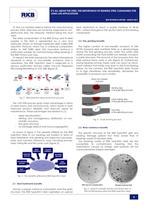
IT’S ALL ABOUT THE STEEL: THE IMPORTANCE OF BEARING STEEL CLEANLINESS FOR LONG-LIFE APPLICATIONS RKB TECHNICAL REVIEW - MARCH 2011 3 To find out material defects before the manufacturing process starts, steel bars are randomly subjected to nondestructive tests, the ultrasonic method being the most used. The latest achievement of the RKB Group and its steel supplier in this field is represented by a new and improved version of through-hardened steel called RKB Type.RAV Protocol, which has a chemical composition similar to SAE A485 steel. This innovative protocol is particularly suitable for manufacturing...
Open the catalog to page 3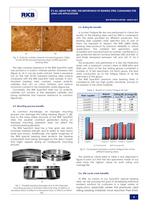
IT’S ALL ABOUT THE STEEL: THE IMPORTANCE OF BEARING STEEL CLEANLINESS FOR LONG-LIFE APPLICATIONS RKB TECHNICAL REVIEW - MARCH 2011 4 a) b) Fig. 6 - Eutectic carbide network microphotography (100x): a) SAE 52100 standard bearing steel; b) RKB Type.RAV bearing steel The high corrosion resistance of the RKB Type.RAV steel was proved in a sodium chloride solution immersion test (figure 5). As it can be easily noticed, there is excessive rust on the SAE 52100 standard bearing steel surface compared with the RKB Type.RAV steel sample. In fact, standard bearing steel contains coarse eutectic carbides...
Open the catalog to page 4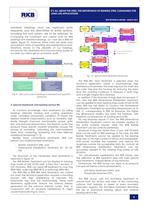
IT’S ALL ABOUT THE STEEL: THE IMPORTANCE OF BEARING STEEL CLEANLINESS FOR LONG-LIFE APPLICATIONS RKB TECHNICAL REVIEW - MARCH 2011 5 standard bearings must be replaced quite frequently and the downtimes of entire systems, including the cost system, are to be reduced. As Comparing the investment and capital costs for RKB bearings and standard bearings, our costs are a little bit higher (figure 9). However, these costs are quite soon recovered in terms of operating and maintenance costs. Therefore, thanks to the reliability of our bearings, ensured by the cleanliness and manufacturing quality of...
Open the catalog to page 5All RKB Europe catalogs and technical brochures
 Cylindrical rolelr bearings
2 Pages
 Technological bearings
2 Pages
 Project S12
2 Pages
 RKB Product Table
2 Pages
 This Is RKB
24 Pages
 RKB Phosphate Treatment
2 Pages
 RKB General Information Form
12 Pages
 Project "241 KPP VL"
2 Pages
 Project "EPB"
2 Pages
 Project "MDU"
2 Pages
 Project "ABI"
2 Pages
 TQOS Maintenance
3 Pages
 AF2D Multiroll Cage Design
2 Pages
 RKB_Europe_SA_ISO_9001
1 Page
 RKB_Europe_SA_ISO_14001
1 Page
 RKB_Europe_SA_ISO_27001
1 Page
 RKB_Europe_SA_ISO_10002
1 Page
 RKB General Quality Program
50 Pages
 RKB Special Projects
68 Pages
 RKB Metals Industry Leaflet
2 Pages
 RKB Company Snapshot
2 Pages
 RKB Brief Company Profile
2 Pages
 RKB_Taper_Roller_Bearings_Assy
39 Pages
 RKB Bearings Production Range
34 Pages
 RKB Bearings Catalogue
168 Pages
 Made in RKB
1 Page
 RKB Taper Roller Bearings Assy
39 Pages
 Why RKB
1 Page
 RKB Basic Load Ratings
14 Pages
 Bearing Industry Matrix
2 Pages
 RKB_Business_Card_T3
1 Page
 RKB_Business_Card_T2
1 Page
 RKB Message of the President
2 Pages
 RKB Brief Introduction
2 Pages
 RKB Digital Presentation
50 Pages
 Company name and motto
6 Pages










- Steel bearing
- Ball bearing
- Radial bearing
- Single-row bearing
- Roller bearing
- Precision bearing
- Axial bearing
- Double-row bearing
- High-speed bearing
- Cylindrical roller bearing
- Deep groove ball bearing
- Bearing with cage
- Tapered roller bearing
- Angular-contact bearing
- Sealed bearing
- Axial deep groove ball bearing
- Bearing for heavy-duty applications
- High-precision bearing
- Combined bearing