
- Catalogs
- RAE Systems
- Correction Factors, Ionization Energies, and Calibration Characteristics


Correction Factors, Ionization Energies, and Calibration Characteristics
1 /11Pages

Correction Factors, Ionization Energies, and Calibration Characteristics
1 /11Pages
Catalog excerpts

Technical Note TN-106 rev 13d wh.01-05 Correction Factors, Ionization Energies*, And Calibration Characteristics Correction Factors and Ionization Energies RAE Systems PIDs (photoionization detectors) can be used to detect a wide variety of gases that exhibit different responses. In general, any compound with ionization energy (IE) lower than that of the lamp photons can be measured.* The best way to calibrate a PID to different compounds is to use a standard of the gas of interest. However, Correction Factors (CFs) have been determined that enable the user to quantify a large number of chemicals using only a single calibration gas, typically isobutylene. In RAE Systems PIDs, Correction Factors can be used in one of three ways: 1. Calibrate the monitor with isobutylene in the usual fashion to read in isobutylene equivalents. Manually multiply the reading by the Correction Factor to obtain the concentration of the gas being measured. 2. Calibrate the unit with isobutylene in the usual fashion to read in isobutylene equivalents. Call up the Correction Factor from the instrument memory or download it from a personal computer and then call it up. The monitor will then read directly in units of the gas of interest. 3. Calibrate the unit with isobutylene, but input an equivalent, "corrected" span gas concentration when prompted for this value. The unit will then read directly in units of the gas of interest. * Some inorganic compounds like H2O2 and NO2 give weak response at photon energies well above those of their ionization energies. The term "ionization energy" replaces the old term "ionization potential." measured is m-xylene (CF = 0.43). After downloading this Correction Factor, the unit should read about 43 ppm when exposed to the same gas, and thus read directly in m-xylene values. Example 3 The desired gas to measure is ethylene dichloride (EDC). The CF is 0.6 with an 11.7 eV lamp. During calibration with 100 ppm isobutylene, insert 0.6 times 100, or 60, at the prompt for the calibration gas concentration. The unit then reads directly in EDC values. Conversion to mg/m3 To convert from ppm to mg/m3, use the following formula: Conc. (mg/m3) = [Conc.(ppmv) x mol. wt. (g/mole)] molar gas volume (L) For air at 25 C (77а F), the molar gas volume is 24.4 L/mole and the formula reduces to: Conc.(mg/m3) = Conc.(ppmv) x mol. wt. (g/mole) x 0.041 For example, if the instrument is calibrated with a gas standard in ppmv, such as 100 ppm isobutylene, and the user wants the display to read in mg/m3 of hexane, whose m.w. is 86 and CF is 4.3, the overall Correction Factor is 4.3 x 86 x 0.041 equals 15.2. Correction Factors for Mixtures The Correction Factor for a mixture is calculated from the sum of the mole fractions Xi of each component divided by their respective Correction Factors CFi: CFmix = 1 / (X1/CF1 + X2/CF2 + X3/CF3 + ... Xi/CFi) Example 1 With the unit calibrated to read isobutylene equivalents, the reading is 10 ppm with a 10.6 eV lamp. The gas being measured is butyl acetate, which has a Correction Factor of 2.6. Multiplying 10 by 2.6 gives an adjusted butyl acetate value of 26 ppm. Similarly, if the gas being measured were trichloroethylene (CF = 0.54), the adjusted value with a 10 ppm reading is 5.4 ppm. Thus, for example, a vapor phase mixture of 5% benzene and 95% n-hexane would have a CFmix of CFmix = 1 / (0.05/0.53 + 0.95/4.3) = 3.2 A reading of 100 would then correspond to 320 ppm of the total mixture, consisting of 16 ppm benzene and 304 ppm hexane. For a spreadsheet to compute the Correction Factor and Threshold Limit Value (TLV) of a mixture, see the appendix at the end of the CF table. Example 2 With the unit calibrated to read isobutylene equivalents, the reading is 100 ppm with a 10.6 eV lamp. The gas 1 RAE Systems Inc. 3775 N. First St., San Jose, CA 95134-1708 USA Phone: +1.888.723.8823 Email: [email protected] Web Site: www.raesystems.com
Open the catalog to page 1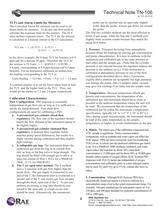
Technical Note TN-106 rev 13d wh.01-05 TLVs and Alarm Limits for Mixtures The Correction Factor for mixtures can be used to set alarm limits for mixtures. To do this one first needs to calculate the exposure limit for the mixture. The TLV often defines exposure limits. The TLV for the mixture is calculated in a manner similar to the CF calculation: TLV mix = 1 / (X1/TLV1 + X2/TLV2 + X3/TLV3 + ... Xi/TLVi) probe can be inserted into an open tube slightly wider than the probe. Excess gas flows out around the probe. The first two cylinder methods are the most efficient in terms of gas usage, while...
Open the catalog to page 2
Technical Note TN-106 rev 13d wh.01-05 6. Filters. Filters affect flow and pressure conditions. Therefore, all filters to be used during sampling should also be in place during calibration. Using a water trap (hydrophobic filter) greatly reduces the chances of drawing water aerosols or dirt particles into the instrument. Regular filter replacements are recommended because dirty filters can adsorb VOCs and cause slower response time and shifts in calibration. Disclaimer Actual readings may vary with age and cleanliness of lamp, relative humidity, and other factors. For accurate work, the instrument...
Open the catalog to page 3
Technical Note TN-106 rev 13d wh.01-05 Compound Name Synonym/Abbreviation CAS No. 624-92-0 598-56-1 68-12-2 57-14-7 756-79-6 77-78-1 67-68-5 123-91-1 646-06-0 Formula C2H6S2 C4H11N C3H7NO C2H8N2 C3H9O3P C2H6O4S C2H6OS C4H8O2 C3H6O2 9.8 C 10.6 C 11.7 C 0.2 1.1 0.7 NR ~23 Dimethyl disulfide DMDS Dimethyl ether see Methyl ether Dimethylethylamine DMEA Dimethylformamide, N,N- DMF Dimethylhydrazine, 1,1UDMH Dimethyl DMMP, methyl phosphonic methylphosphonate acid dimethyl ester Dimethyl sulfate Dimethyl sulfide see Methyl sulfide Dimethyl sulfoxide DMSO, Methyl sulfoxide Dioxane, 1,4Dioxolane, 1,3Ethylene...
Open the catalog to page 6
Technical Note TN-106 rev 13d wh.01-05 Compound Name Synonym/Abbreviation CAS No. Formula 9.8 C 10.6 C 11.7 C IE TWA (eV) HCFC-22 see Chlorodifluoromethane HCFC-123 see 2,2-Dichloro-1,1,1-trifluoroethane HCFC-141B see 1,1-Dichloro-1-fluoroethane HCFC-142B see 1-Chloro-1,1-difluoroethane HCFC-134A see 1,1,1,2-Tetrafluoroethane HCFC-225 see Dichloropentafluoropropane Heptane, n142-82-5 C7H16 Hexamethyldisilazane, HMDS 999-97-3 C6H19NSi2 1,1,1,3,3,3Hexane, n110-54-3 C6H14 Hexanol, 1Hexyl alcohol 111-27-3 C6H14O Hexene, 1592-41-6 C6H12 Histoclear (Histo-Clear) Limonene/corn oil reagent m.w. ~136...
Open the catalog to page 7All RAE Systems catalogs and technical brochures
 HAND & ARM PROTECTION
12 Pages
 Miller TechLine™ Kits
2 Pages
 Miller DuraHoistTM
8 Pages
 Miller ®
4 Pages
 FALL PROTECTION
22 Pages
 Miller H500 Series
8 Pages
 HONEYWELL RIG DOG™ GLOVES
12 Pages
 AreaRAE Pro
8 Pages
 RAELink3 Mesh
2 Pages
 RAEShare
1 Page
 RDK Rugged- Host
2 Pages
 SensorRAE 4R+
2 Pages
 Smoke Generation Tubes
1 Page
 SolarRAE
2 Pages
 ToxiRAE Pro CO2
2 Pages
 ToxiRAE Pro
2 Pages
 ToxiRAE Pro LEL
2 Pages
 ToxiRAE Pro PID
2 Pages
 UltraRAE 3000
2 Pages
 VOC Zeroing Tube
2 Pages
 WeatherPak
2 Pages
 Humidity Filtering II Tube
2 Pages
 MBeacon
2 Pages
 Wireless Alarm Bar
2 Pages
 MicroRAE
5 Pages
 MultiRAE Benzene
2 Pages
 MeshGuard
2 Pages
 AreaRAE Steel Z1
2 Pages
 AreaRAE Gamma Steel
2 Pages
 EchoView Host
2 Pages
 FMC-2 and FMC-4
2 Pages
 FMC-16
2 Pages
 FMC 2000
2 Pages
 EntryRAE
2 Pages
 miniDOSE
2 Pages
 DoseRAE Pro
2 Pages
 QRAE 3
2 Pages
 RAEGuard LEL
2 Pages
 RAEGuard PID
2 Pages
 RAE Systems
35 Pages
 BioHarness
2 Pages
 AutoRAE Lite for ToxiRAE 3
2 Pages
 AutoRAE Lite for QRAE II
2 Pages
 AreaRAE Steel Z2
2 Pages
 MiniRAE Lite Datasheet
2 Pages
 GammaRAE II R
2 Pages
 FMC-60
2 Pages
 FMC-40
2 Pages
 FMC-10
2 Pages
 ChemRAE
2 Pages
 AutoRAE 2
2 Pages
 AreaRAE Inert
2 Pages
 QRAE Plus
2 Pages
 QRAE II Pump
2 Pages
 QRAE II Diffusion
2 Pages
 ProRAE Guardian
2 Pages
 PlumeRAE
2 Pages
 NeutronRAE II
2 Pages
 MultiRAE Pro
2 Pages
 MultiRAE Lite
2 Pages
 MultiRAE
2 Pages
 MiniRAE Lite
2 Pages
 MiniRAE 3000
2 Pages
 DoseRAE
2 Pages


Archived catalogs
 AreaRAE Gamma Steel
2 Pages
 EchoView Host
2 Pages
 ppbRAE 3000
2 Pages
 2010 RAE Systems Mini Catalogue
23 Pages
 HazRAE
2 Pages
 ToxiRAE 3 Datasheet
2 Pages
 Benzene - The Next Asbestos?
5 Pages


- Shoes
- Fabric clothing
- Mechanical protection protection gloves
- Anti-slip safety shoes
- Electrical protection safety shoes
- Work safety gloves
- Gas detector
- Industrial safety gloves
- Anti-static safety shoes
- 10 protection gloves
- 9 protection gloves
- Chemical protection safety gloves
- 8 protection gloves
- Industrial detector
- Work coveralls
- EN 388 safety gloves
- Plastic glove
- Handling protection gloves
- Chemical protection clothing
- Thermal protection clothing