
- Catalogs
- NETZSCH Analyzing & Testing
- Thermoelectric Materials - application brochure


- Company
- Products
- Catalogs
- News & Trends
- Exhibitions
Thermoelectric Materials - application brochure
1 /20Pages

Thermoelectric Materials - application brochure
1 /20Pages
Catalog excerpts

Analyzing & Testing Thermoelectric Materials Material Characterization, Phase Changes, Thermal Conductivity Leading Thermal Analysis
Open the catalog to page 1
Thermoelectricity - Thermoelectric Materials and Devices Thermoelectricity refers to a class of phenomena in which a temperature difference creates an electric potential or an electric potential creates a temperature difference. In modern technical usage, the term refers collectively to the Seebeck effect, Peltier effect, and the Thomson effect. Various metals and semiconductors are generally employed in these applications. One of the most commonly used materials in such applications is bismuth telluride (Bi2Te3). Over recent decades, efforts have been made to improve the efficiency of thermal...
Open the catalog to page 2
PbTe TAGS ZT is a very convenient figure for comparing the potential efficiency of devices constructed of different materials. Values of ZT = 1 are considered good, but values in at least the 3-4 range would be considered essential in order to be competitive in terms of efficiency with regards to mechanical energy generation and refrigeration. To date, however, such values have not been achieved; the best reported ZT values have been in the 2-3 range. Approximate figure of merit (ZT) for various p-type and n-type thermoelectric materials. Source: G. Jeffrey Snyder, California Institute of Technology...
Open the catalog to page 3
Thermoelectric Materials - The Focal Point for Energy Savings Novel thermoelectric materials have already resulted in a new consumer product: a simple, efficient way of cooling car seats in hot climates. The devices, similar to the more familiar car seat heaters, provide comfort directly to the individual rather than cooling the entire car, saving on air-conditioning and energy costs. To optimize a thermoelectric device, its thermal properties must be known. The thermal conductivity (analyzed with LFA) is directly related to the efficiency of a thermoelectric material. The thermal stability (analyzed...
Open the catalog to page 4
The LFA method is illustrated in the figure on page 4, on the left. The front surface of a plane-parallel sample is heated by a short light or laser pulse. The resulting temperature rise on the rear surface is measured versus time using an IR detector. The thermal diffusivity (a) and in most cases also the specific heat (cp) can be determined from the measured signal. If the density (p) is known, the thermal conductivity (A) can be determined as follows: A(T) = a (T) ■ cp(T) ■ p(T) where: A = thermal conductivity [W/(m-K)] p = bulk density [g/cm3] cp = specific heat [J/(g-K)]. The Laser Flash...
Open the catalog to page 5
The LFA 457 MicroFlash® incorporates the latest state-of-the-art technology for laser flash systems. This bench-top instrument allows for measurements from -125°C to 1100°C using two different interchangeable furnaces. The temperature increase on the back surface of the sample can be measured at very low sub-ambient temperatures thanks to the innovative infrared sensor technology. The instrument accommodates both smaller and larger sample sizes (of up to 25.4 mm in diameter) and with the integrated sample changer, measurements can be run on several samples at the same time. The vacuum-tight design...
Open the catalog to page 6
The Laser Flash systems run under Proteus® software on a Windows® operating system. The combination of easy-to-understand menus and automated routines makes this software very user-friendly while still allowing for sophisticated analysis. The LFA software includes: Calculation models for thermal diffusivity: Adiabatic Cowan Improved Cape-Lehman (via consideration of multidimensional heat loss and non-linear regression) 2-/3-layer models (analysis by means of non-linear regression and consideration of heat loss) In-plane Radiation correction (for transparent and semi-transparent samples) Heat-loss...
Open the catalog to page 7
Thermal Analysis – DSC and STA; Coupling to Evolved Gas Analysis Heat Flow DSC Method Differential Scanning Calorimetry Thermogravimetric Analysis and Simultaneous Thermal Analysis Based on a homogeneous temperature field in the DSC furnace, equal heat flows along the disc-shaped sensor are directed to the sample and reference crucibles. If the heat capacities on the sample and reference sides differ, or if the sample shows a changed heat absorption or resulting difference in heat flow causes temperature gradients at the sensor. Sensitive sensors record these temporary deviations, which are then...
Open the catalog to page 8
STA Analysis Information Combines Analysis Information from DSC and TGA DSC Analysis Information Specific heat capacity (cp) Melting/crystallization behavior Solid-solid transitions Polymorphism Degree of crystallinity Glass transitions Cross-linking reactions Oxidative stability Purity Determination DSC data as base for thermokinetic analysis (NETZSCH Thermokinetics software program) Mass changes Temperature stability Oxidation/reduction behavior Decomposition Corrosion studies Compositional analysis TGA data as base for thermokinetic analysis (NETZSCH Thermokinetics software program) Coupling...
Open the catalog to page 9
Dilatometry and Thermomechanical Dilatometer Method Analysis Dilatometry (DIL) is used to measure the expansion or shrinkage of solids, powders, pastes or liquids under negligible load. It is closely related to thermomechanical analysis (TMA), which determines dimensional changes under a defined mechanical force. We offer dilatometer systems for measurements in the temperature range between approx. -260°C and 2800°C. For the investigation of thermoelectric materials, either our DIL 402 C or our dual/differential DIL 402 CD (-180°C to 2000°C) may be used. The specific needs of this application...
Open the catalog to page 10
Irrespective of the selected type of deformation (expansion, compression, penetration, tension or bending), any length change in the sample is communicated to a highly sensitive inductive displacement transducer (LVDT) via a pushrod and transformed into a digital signal. The pushrod and corresponding sample holders of fused silica or aluminum oxide can be quickly and easily changed out to optimize the system to a given application. Linear thermal expansion Coefficient of thermal expansion (CTE) Volumetric expansion Shrinkage steps Glass transition temperature Phase transitions Sintering temperature/sintering...
Open the catalog to page 11All NETZSCH Analyzing & Testing catalogs and technical brochures
 TG 309 Libra Series
24 Pages
 Kinexus Prime Series
20 Pages
 NTA Fire Testing Systems
20 Pages
 Advanced Materials Testing
32 Pages
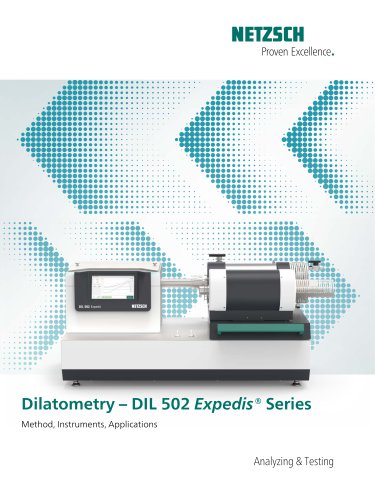 DIL 502 Expedis Series
28 Pages
 NETZSCH Energy Solutions
40 Pages
 Product Overview
12 Pages
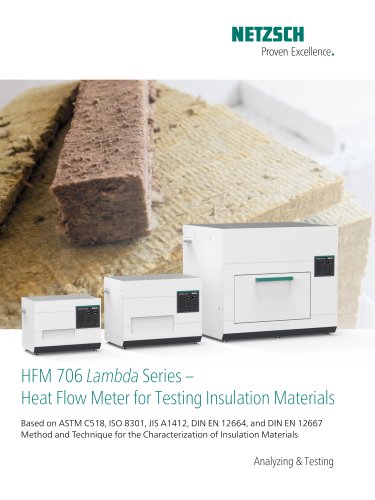 HFM 706 Lambda Series
16 Pages
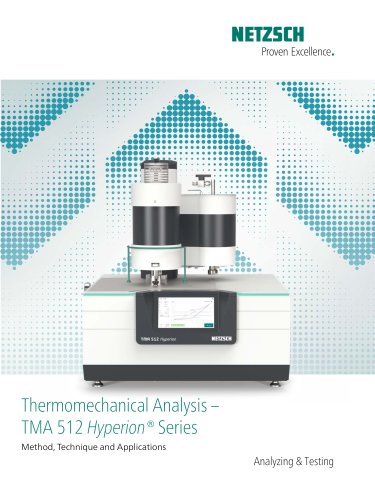 TMA 512 Hyperion® Series
24 Pages
 LFA 427 - product brochure
24 Pages
 Kinexus Prime DSR Series
20 Pages
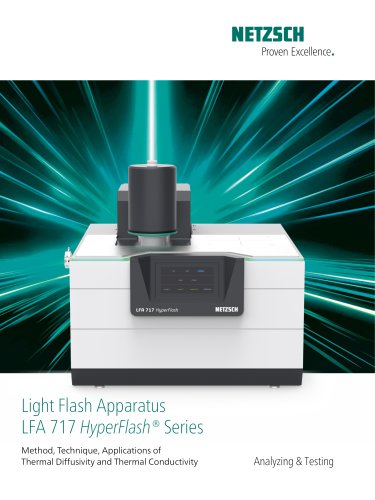 LFA 717 HyperFlash® Series
28 Pages
 DMA 303 Eplexor
24 Pages
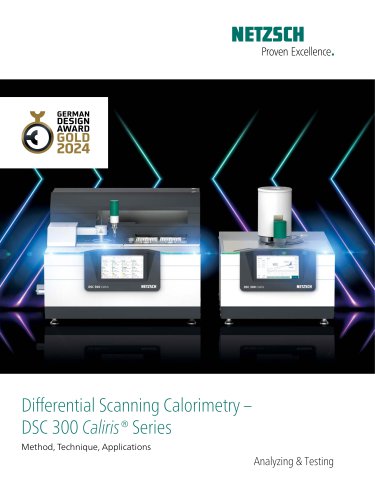 DSC 300 Caliris Series
28 Pages
 STA 509 Jupiter Series
28 Pages
 DEA 288 Ionic
20 Pages
 STA 2500 Regulus
12 Pages
 NTA Guarded Hot Plate Series
16 Pages
 Rosand Series
20 Pages
 Accelerating Rate Calorimetry
20 Pages
 NTA HotBoxes
16 Pages
 DIL 402 Expedis Classic
16 Pages
 Kinetics NEO
20 Pages
 TG-FTIR - product brochure
24 Pages
 TA-QMS Coupling
28 Pages
 HMOR 422
1 Page
 RUL/CIC 421
1 Page
 Cone Calorimeter TCC 918
12 Pages
 SBA 458 Nemesis®
24 Pages
 NETZSCH NEVIO Instrument Series
24 Pages
 Thermal Insulation Materials
24 Pages
 DMA GABO EPLEXOR up to 1500°C
12 Pages
 GABOMETER®
8 Pages





- Test machine
- NETZSCH measuring instrument
- NETZSCH gas analyzer
- NETZSCH test chamber
- Concentration analyzer
- Monitoring analyzer
- Analysis software solution
- Liquids analyzer
- Test stand
- Windows software
- Temperature test chamber
- NETZSCH automatic analyzer
- Material test machine
- Automated testing machine
- NETZSCH benchtop analyzer
- Climatic test cabinet
- NETZSCH solids analyzer
- Spectrometer
- Quality control test cell
- Computer-controlled test machine