
- Catalogs
- NETZSCH Analyzing & Testing
- Characterization of Nuclear Materials -application brochure


- Company
- Products
- Catalogs
- News & Trends
- Exhibitions
Characterization of Nuclear Materials -application brochure
1 /44Pages

Characterization of Nuclear Materials -application brochure
1 /44Pages
Catalog excerpts

Source: Idaho National Laboratory Characterization of Nuclear Materials Methods, Instrumentation, Applications Analyzing & Testing
Open the catalog to page 1
The world demand for electricity is projected to double by mid-century. Because of the ever-increasing price of fossil fuels and the associated environmental concerns such as carbon dioxide emissions, nuclear power generation is regaining popularity. Nuclear fuel is clean and relatively inexpensive compared to fossil fuels. It is in fact the only source of clean, sustainable and affordable energy which can meet current and near-term demands for electricity generation, if sufficient numbers of reactors of current and advanced design can be brought on line in a timely manner. In addition, the nuclear...
Open the catalog to page 2
This renaissance has led to the formation of a multi-national cooperation called the Global Nuclear Energy Partnership (GNEP). Two of the stated aims of GNEP are to: ■ develop a new generation of nuclear power plants - the so-called Generation IV systems (GEN IV) in which six different reactor types are under consideration (both thermal and fast reactors), and ■ educe waste by recycling used nuclear fuel using new technologies. The history of commercial nuclear power generation reaches back to the mid-60s. The Generation III+ reactors now under development and the GEN IV reactors under consideration...
Open the catalog to page 3
Source: Idaho National Laboratory Minor Actinides 0.1% Plutonium 0.9% Stable Fission Products 2.9% U 95.6% (235U 0.5-1.0%) Composition of used fuel Cs and Sr 0.3% Other Long-lived Fission Products 0.1% The major concern with nuclear power generation today is the safe disposal of used fuels. Because of storage-related problems, recycling of used fuel is of paramount importance. Fuel recycling is not a new concept. In fact, used fuel from light-water reactors (LWR) has been reprocessed into (U,Pu)O2 – so-called MOX fuel – for some time by various countries. This is economically feasible because...
Open the catalog to page 4
Fuel Fabrication Reactor/ Power Plant Used Fuel Interim Storage Aged Used Fuel Fuel Recycle/ Target Fabrication/ Separation Geological Repository Uranium Mining & Milling Closed fuel cycle with front end processing of UO2 and back end recycling/target fabrication It has been estimated that the effective capacity of geological repositories can be increased greatly if the long-lived minor actinides such as those mentioned above plus Pu (transuranics) are separated and fabricated into the reprocessed fuel or targets for transmutation/consumption. Several concepts have been proposed to realize this,...
Open the catalog to page 5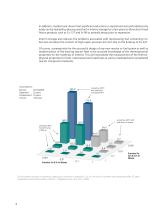
In addition, studies have shown that significant reductions in repository heat and radiotoxicity loads can be realized by placing used fuel in interim storage for a few years to allow short-lived fission products such as Cs-137 and Sr-90 to partially decay prior to separation. Interim storage also reduces the problems associated with reprocessing fuel containing Cm, but also increases the content of high-vapor-pressure Am-241 due to the β-decay of Pu-241. Of course, a prerequisite for the successful design of any new reactor or fuel system as well as modernization of the existing reactor fleet...
Open the catalog to page 6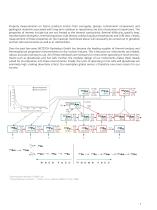
Property measurements on fission products and/or their surrogates, glasses, containment components and geological materials associated with long-term isolation in repositories are also of paramount importance. The properties of interest include but are not limited to the thermal conductivity, thermal diffusivity, specific heat, transformation energetics, thermal expansion, bulk density, solidus/liquidus temperatures and O/M ratio. Clearly, measurement of these properties on the materials mentioned above will necessarily be carried out in glovebox and hot cell environments as well as in cold facilities....
Open the catalog to page 7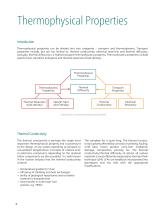
Thermophysical Properties Introduction Thermophysical properties can be divided into two categories – transport and thermodynamic. Transport properties include, but are not limited to, thermal conductivity, electrical resistivity and thermal diffusivity. (Actually, thermal diffusivity is a hybrid transport/thermodynamic property.) Thermodynamic properties include specific heat, transition energetics and thermal expansion (bulk density). Thermophysical Properties Thermal Diffusivity Thermodynamic Properties Thermal Expansion (bulk density) Specific Heat and Enthalpy Transport Properties Thermal...
Open the catalog to page 8
The capacity of a material to store energy is governed, in part, by the specific heat (sensible heat). It is made up of lattice, electronic and defect components, depending on the material. This property is required for design of any transient heat transfer process. It is also used to quantify surface oxidation/reduction and O/M ratio (defects) of fuels during processing. In some cases, the specific heat can be used as an indicator of the extent of damage in post irradiation examination (PIE), e.g. stored energy. It is also required to calculate the thermal conductivity from thermal diffusivity...
Open the catalog to page 9
INSTRUMENTATION Flash Technique The flash method is the fastest and most accurate way of measuring the thermal diffusivity ( thermal conductivity). It has been estimated that 80-85% of all thermal diffusivity/ thermal conductivity measurements are carried out using this technique. This is because of: Air, Mi Poly croporo styre u ne, P s Insula tio U Fo ams ns Fibe rB Buil oards, Fi ding Boa ber Insu rds, Oils lations, Woo d, Po lyme rs, C oal Wat er Con cret e, G lass, Fire Poro Clay us C eram ics, R efra ctor Alum ies inos i Silic on N licates itrid e Alum ina, Carb on B ricks Iron , Ste el,...
Open the catalog to page 10
As shown on the right, the front surface of a sample is heated by a short energy pulse (xenon or laser) and the time-dependent temperature rise on the rear surface is measured by an IR detector. From a plot of T / Tmax (or V / Vmax) vs half-time, the thermal diffusivity of a perfectly insulated sample at one half-time is given by: a = thermal diffusivity (mm2/s) l = sample thickness (mm) t½ = half-time (s) Experimental data There are several sophisticated models to correct for heat loss (non-adiabatic conditions) and the finite pulse width of the energy source. detector Using the measured thermal...
Open the catalog to page 11All NETZSCH Analyzing & Testing catalogs and technical brochures
 TG 309 Libra Series
24 Pages
 Kinexus Prime Series
20 Pages
 NTA Fire Testing Systems
20 Pages
 Advanced Materials Testing
32 Pages
 DIL 502 Expedis Series
28 Pages
 NETZSCH Energy Solutions
40 Pages
 Product Overview
12 Pages
 HFM 706 Lambda Series
16 Pages
 TMA 512 Hyperion® Series
24 Pages
 LFA 427 - product brochure
24 Pages
 Kinexus Prime DSR Series
20 Pages
 LFA 717 HyperFlash® Series
28 Pages
 DMA 303 Eplexor
24 Pages
 DSC 300 Caliris Series
28 Pages
 STA 509 Jupiter Series
28 Pages
 DEA 288 Ionic
20 Pages
 STA 2500 Regulus
12 Pages
 NTA Guarded Hot Plate Series
16 Pages
 Rosand Series
20 Pages
 Accelerating Rate Calorimetry
20 Pages
 NTA HotBoxes
16 Pages
 DIL 402 Expedis Classic
16 Pages
 Kinetics NEO
20 Pages
 TG-FTIR - product brochure
24 Pages
 TA-QMS Coupling
28 Pages
 HMOR 422
1 Page
 RUL/CIC 421
1 Page
 Cone Calorimeter TCC 918
12 Pages
 SBA 458 Nemesis®
24 Pages
 NETZSCH NEVIO Instrument Series
24 Pages
 Thermal Insulation Materials
24 Pages
 DMA GABO EPLEXOR up to 1500°C
12 Pages
 GABOMETER®
8 Pages







- Test machine
- NETZSCH measuring instrument
- NETZSCH gas analyzer
- NETZSCH test chamber
- Concentration analyzer
- Monitoring analyzer
- Analysis software solution
- Liquids analyzer
- Test stand
- Windows software
- Temperature test chamber
- NETZSCH automatic analyzer
- Material test machine
- Automated testing machine
- NETZSCH benchtop analyzer
- Climatic test cabinet
- NETZSCH solids analyzer
- Spectrometer
- Quality control test cell
- Computer-controlled test machine