
- Catalogs
- Master Bond
- Thermally Conductive Adhesives Keep Things Cool


- Company
- Products
- Catalogs
- News & Trends
- Exhibitions
Thermally Conductive Adhesives Keep Things Cool

Thermally Conductive Adhesives Keep Things Cool
Thermally conductive adhesives and potting compounds are essential for heat management in electronic devices, especially as microprocessor power and density increase, necessitating effective thermal management to prevent overheating.
Thermal Management Challenges
Microprocessors today dissipate up to 100 W, with future projections reaching 200 W/cm². Advanced packaging techniques, like system-in-package designs, complicate heat dissipation by stacking components.
Thermal Interface Materials
These materials, including greases, adhesives, and potting compounds, fill air gaps between thermal transfer surfaces, enhancing heat transfer and protecting components from environmental threats.
Adhesive Properties and Considerations
Thermally conductive adhesives must balance thermal conductivity, chemical resistance, and mechanical strength. The particle size of conductive fillers is crucial as it affects bond line thickness and heat transfer efficiency.
Advancements in Fillers
New fillers, such as those by Master Bond, are smaller (3 µm), allowing for thinner bond lines without compromising bond strength, thus improving heat transfer.
Thermally Conductive Films
These epoxy films offer uniform heat transfer, can be die-cut to match component surfaces, and maintain consistent bond lines without flowing under temperature changes.
Conductivity and Mechanical Performance
Adding fillers to polymers enhances thermal conductivity. Master Bond's products range from 1.5 to 3 W/mK, suitable for most applications, with some achieving higher conductivity without sacrificing mechanical performance.
Popular Thermal Adhesive Grades
Master Bond offers various thermal adhesive grades with specific properties like curing time, temperature resistance, and thermal conductivity, catering to different applications.
Applications
These adhesives are used in assembling CSPs, attaching base plates, bonding power supplies, and more, essential for bridging thermal gaps and creating interfaces between components.
Conclusion
Thermally conductive adhesives and potting compounds are crucial for modern electronics, providing thermal management and structural bonding. Engineers must select materials based on application requirements and desired properties.
- Silicone wafers manage heat in aerospace and NASA-approved environments, used for mounting heat sinks and bonding operations.
- Applications include repairing electronic modules, printed circuits, wave guides, flat cables, and high-frequency shields.
- Used for sealing and potting sensors, connectors, and pins, and staking thermal-sensitive components like transistors, diodes, resistors, and integrated circuits to printed circuit boards.
- Offers flexible chemistry and a wide range of physical properties.
- Provides versatility for bonding, potting, and sealing with room temperature cure options.
- Ensures uniform bond line thickness for optimal cooling and convenient handling without mixing.
- Speeds up production and new grades eliminate the need for cryogenic storage.
- Heatsink
- Electronic Component
- Thermal Interface
Catalog excerpts
^MASTER BOND TECH SPOTLIGHT Thermally Conductive Adhesives Keep Things Cool Thermally conductive adhesives and potting compounds are an important weapon in the war against heat raging within today's powerful electronic devices Master Bond Inc. 154 Hobart Street, Hackensack, NJ 07601 USA
Open the catalog to page 1
TECH SPOTLIGHT Thermally Conductive Adhesives Keep Things Cool Thermally conductive adhesives and potting compounds are an important weapon in the war against heat raging within today’s powerful electronic devices. Electronics are hot right now—literally. Chip makers have significantly upped the ante on microprocessor power and density over the past decade. And these powerful microprocessors are shoehorned into tiny mobile and embedded devices that make thermal management all the more difficult. Design engineers charged with keeping these devices cool have a big challenge on their hands. How...
Open the catalog to page 2
Check Out The Latest Films Not all thermally conductive materials come in tubes and cans. Thermally conductive epoxy films are an increasingly popular application option—and for good reason: Films improves the uniformity of heat transfer. Depending on the type of film chosen, uniform bond lines as thin as 0.003 inches are easily achievable. With traditional adhesives in electronic assemblies, the bond lines are hard to control and can vary between 0.003 to 0.006 inches. Right: Master Bond’s line-up of thermal interface materials Films can also be die cut to intricate shapes that closely match...
Open the catalog to page 3
From Insulator To Conductor One obvious barrier to using any adhesives or potting compounds to help dissipate heat is that polymeric materials in their natural state are actually good thermal insulators. Unfilled epoxy, for example, has thermal conductivity of just 0.14 W/mK. Compare that value to a world-class conductor like aluminum, which comes in around 200 W/mK. With the addition of various metallic, ceramic or even nanotech fillers, formulators can improve on an adhesive’s baseline thermal conductivity values by a factor of 10 or more. The resulting products, while never approaching the...
Open the catalog to page 4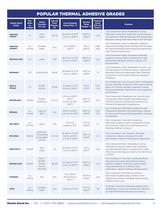
POPULAR THERMAL ADHESIVE GRADES Master Bond base resin: curing agent: Cure Schedule Two Component, Room Temperature Curing, Thermally Conductive, Electrically Isolating Epoxy For Bonding & Sealing Featuring High Temperature Resistance Along With High Shear & Peel Strength One Component, Heat Curing Epoxy Adhesive Featuring both High Shear and High Peel Strength for Optimal Bonding Performance & Exceptionally High Thermal Conductivity Two Component Highly Flexiblized Thermally Conductive Epoxy Resin Compound For High Performance Bonding, Sealing, Coating, And Two Component, Room Temperature Curing,...
Open the catalog to page 5
THERMALLY CONDUCTIVE ADHESIVE FUNDAMENTALS Here's a look at the features to keep in mind when working with thermal adhesives in their liquid and film forms: LIQUID FILM HEATSINK THERMAL INTERFACE ELECTRONIC COMPONENT KEY FEATURES • Flexible chemistry • Wide range of physical properties available • Application versatility for bonding, potting and sealing • Room temperature cure options • Uniform bond line thickness for optimal cooling • Convenient handling, no mixing • Speeds production • New grades eliminate cryogenic storage needs APPLICATIONS • Assemble CSPs • Assemble SECC format devices and...
Open the catalog to page 6All Master Bond catalogs and technical brochures
 Understanding low outgassing
5 Pages


- MasterBond single-component adhesive
- MasterBond metal adhesive
- MasterBond industrial adhesive
- MasterBond plastic adhesive
- MasterBond glass adhesive
- MasterBond dispersion adhesive
- MasterBond bonding adhesive
- MasterBond two-component adhesive
- MasterBond electronic adhesive
- MasterBond ceramic adhesive
- MasterBond sealing adhesive
- MasterBond fast curing adhesive
- MasterBond viscosity adhesive
- MasterBond conductivity adhesive
- MasterBond rubber adhesive
- Curing system
- Automotive adhesive
- MasterBond composite material adhesive