
- Catalogs
- Marsh Bellofram
- Marsh Bellofram Thermo-Couple Products Division Thermowells Overview Sheet

Marsh Bellofram Thermo-Couple Products Division Thermowells Overview Sheet
1 /4Pages

Marsh Bellofram Thermo-Couple Products Division Thermowells Overview Sheet
1 /4Pages
Catalog excerpts

www.tcproducts.com a division of Marsh Bellofram www.marshbellofram.com Thermo-Couple Products Co. 1-800-727-5646 Material - The Longevity Factor In general, the thermowell material chosen for the installation is governed mainly by the corrosion conditions to which the well is exposed. Recommended materials for various services are given in the corrosion table on pages 67 to 69. The high mirror polish given to all stainless and monel wells provides maximum corrosion resistance. Sometimes the major consideration is strength rather than corrosionresistance. For example, a high pressure water service may require a stainless steel well, while from a corrosion standpoint, a brass well would be satisfactory. Connection - The Installation Factor In these pages you will find standardized wells of threaded, flanged (A.N.S.I. and Van Stone), and socket welded types with standard bore sizes. Threaded wells are all made in readily welded or brazed materials for installations requiring seal welding or brazing. The pipe thread provides the mechanical strength, the weld merely seals. Flanged wells other than Van Stone type) consist of a bar-stock well which is permanently welded to a top quality flange. Standard construction uses a primary “J” groove weld and a bevel groove secondary weld. Both welds are machined to produce a clean fillet. this double welded construction eliminates possibility of crevice corrosion since no open joints exposed from either inside or outside the installation. Socket welding types of wells are simple to install - merely welded into place.These wells fit A.N.S.I. standard socket weld coupling of flanges. The resulting installation is clean and tight. Insertion Length - The Accuracy Factor The distance from the end of the well to the underside of the thread, or other connection means, (designated as “U”) is the insertion length. For best accuracy, this length should be long enough to permit the entire temperature sensitive part of the well to project into the temperature medium being measured. A properly installed thermowell will project into the liquid and amount equal to its sensitive length plus at least one inch. In air or gas, the bulb should be immersed into the sensitive length plus at least three inches. Thermocouples and thermistors have short sensitive lengths and therefore can use the smallest insertion lengths. Bi-metal thermometers, resistance thermometers, and liquid-in-glass thermometers have bulbs with sensitive portions between one and two inches long. Therefore, the minimum standard insertion length of 2-1/2" must be entirely immersed in liquid for proper accuracy. Filled system thermometer bulbs may have sensitive portions from one to several inches in length. Determine the sensitive length of bulb before choosing an insertion length. Above all - be sure that dead length i.e. - that required to pass thru wall, pipe fittings, etc. is taken into account when choosing the necessary well insertion length. Bore Size - The Interchangeability Factory Several types of temperature measuring instruments are used in most installations. The selection of a standard bore diameter provides extreme flexibility; the same well can accommodate thermocouple resistance thermometer, bi-metal thermometer, or test thermometer. The bore size of wells shown in this catalog cover the most commonly used temperature sensing elements as follows: .260 Diameter Bore: Bi-metal Thermometers (1/4" stem) Thermocouples - (#20 Gauge) Liquid-in-glass Test thermometers (Unarmored) Other elements having .252" maximum diameter. .385 Diameter Bore: Bi-metal Thermometers (3.8" Stem) Thermocouples - (#14 Gauge) Liquid-in-glass Test thermometers (Armored) Other elements having .377" maximum diameter. Tapered or Straight Shank - The Velocity Rating Factor Tapered shank wells provide greater rigidity for the same sensitivity. The higher strength to weight ratio gave these wells higher natural frequency than for equivalent length straight shank wells, thus permitting operation at higher fluid velocity. Typical Thermowell with Flange Extension Nipple Terminal Head
Open the catalog to page 1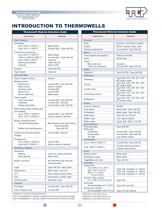
www.tcproducts.com a division of Marsh Bellofram www.marshbellofram.com 1-800-727-5646 Thermo-Couple Products Co. INTRODUCTION TO THERMOWELLS Thermowell Material Selection Guide Application Material Heat Treating Annealing Up to 704°C (1300°F) Over 704°C (1300°F) Black Steel Inconel 600,a Type 446 SS Carburizing Hardening Up to 816°C (1500°F) 1093°C (1500 to 2000°F) Over 1093°C (200°F) Nitriding salt baths Cyanide Black Steel Inconel 600,a Type 446 SS Ceramicb Type 446 SS Nickel (CP) Neutral Type 446 SS High Speed Ceramicb Iron and Steel Basic oxygen furnace Quartz Blast furnaces Downcomer Stove...
Open the catalog to page 2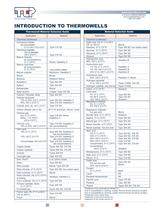
www.tcproducts.com a division of Marsh Bellofram www.marshbellofram.com Thermo-Couple Products Co. 1-800-727-5646 INTRODUCTION TO THERMOWELLS Thermowell Material Selection Guide Application Material Chemical (continued) Ammonium nitrate All concentration 21°C to 100°C (70 to 212°F) Type 316 SS Ammonium sulphate, 10% to saturated 100°C (212°F) Type 316 SS Barium chloride, all concentrations, 21°C (70°F) Monel, Hastelloy C Barium hydroxide, all concentrations, 21°C (70°F) Low carbon steels Barium sulphite Nichrome,c Hastelloy C Brines Monel Bromine Tantalum Monel Butadiene Type 304 SS Butane Type...
Open the catalog to page 3
www.tcproducts.com a division of Marsh Bellofram www.marshbellofram.com 1-800-727-5646 Thermo-Couple Products Co. INTRODUCTION TO THERMOWELLS Thermowell Material Selection Guide Application Material Chemical (continued) Phosphoric acid 1%, 5% 21°C (70°F) 10% 21°C (70°F) 10% 100°C (212°F) 30% 21 to 100°C (70 to 212°F) 85% 21 to 100°C (70 to 212°F) Type 304 SS Type 316 SS Hastelloy C Hastelloy B Hastelloy B Picric acid, 21°C (70°F) Type 304 SS Potassium bromide, 21°C (70°F) Type 316 SS Potassium carbonate, 1% 21°C (70°F) Type 304 SS, Type 316 SS Potassium chlorate, 21°C (70°F) Type 304 SS Potassium...
Open the catalog to page 4All Marsh Bellofram catalogs and technical brochures
 Full Catalog BelGAS
307 Pages
 5204
52041 Page
 P627 High Flow Gas Regulator
10 Pages
 P212 Pressure Regulator
16 Pages
 P200 Pressure Regulator
19 Pages
 P95H Regulator
15 Pages
 P99 Pressure Reducing Regulator
11 Pages
 P133 Pressure Regulator
12 Pages
 P140 Pressure Regulator
4 Pages
 P303 Pressure Regulator
11 Pages
 P300 Pressure Regulator
11 Pages
 P203 Pressure Reducing Regulator
18 Pages
 F300 Pressure Regulator
7 Pages
 P600 Pressure Regulator
7 Pages
 P289RC Exhaust Booster
2 Pages
 W627 Liquid Gas Regulator
8 Pages
 F627 High Flow Gas Regulator
7 Pages
 BELLOFOAM™ 7804
1 Page
 BELLOFOAM™ 7704
1 Page
 BELLOFOAM™ 7604
1 Page
 Marsh Catalog
84 Pages
 P79 Air Relays
4 Pages
 Automated Timing & Controls
142 Pages
 Motor Protection
86 Pages
 Digital Controllers
30 Pages
 P630 High Flow Gas Regulator
12 Pages
 P39 Standard Gas Regulators
4 Pages
 P40 & P40 NACE Regulators
2 Pages
 P912 Pressure Regulator
2 Pages
 P119 Control Valve
4 Pages
 BelGAS Product Overview LT5040
12 Pages
 KING-GAGE Product Catalog
12 Pages
 BelGas P200 Pressure Regulator
18 Pages




Archived catalogs




- Valve
- Connector
- Manual valve
- Cylinder
- Temperature probe
- Electrical power supply connector
- On/off valve
- Angular encoder
- Incremental encoder
- Pressure gauge
- Pressure limiter
- Profile
- Double-acting cylinder
- Gas valve
- Level probe
- Single-stage pressure regulator
- Liquid level sensor
- Rectangular connector
- Pneumatic cylinder
- Incremental rotary encoder