
- Catalogs
- Marsh Bellofram
- Marsh Bellofram Diversified Electronics Division Isolated Switches

Marsh Bellofram Diversified Electronics Division Isolated Switches
1 /4Pages

Marsh Bellofram Diversified Electronics Division Isolated Switches
1 /4Pages
Catalog excerpts

800.727.5646 atcdiversified.com Diversified Electronics Information Isolated Switches // Information 261 ISOLATED SWITCHES Hazardous locations are classified by the National Electrical Code according to the level of hazard that may exist in the area. A hazardous location is designated by its class, group and division. Class and group specify the type of hazardous substance that may exist in the classified location. The division indicates the conditions under which the hazardous substance may be present. The ATC Diversified Electronics series of Isolated Switches have been tested and approved for listing under Underwriters Laboratories (UL) UL913 Intrinsically Safe Apparatus and Associated Apparatus. The input(s) to these switches have been approved for use in all classes, groups and divisions of hazardous locations. \\\INTRINSICALLY SAFE SINGLE & MULTIPLE CHANNEL INPUTS CLASS I Locations in which flammable gases or vapors may be present in the air in quantities sufficient to produce explosive or ignitable mixtures. CLASS II Locations which are hazardous because of the presence of combustible dust. GROUP A Atmospheres containing acetylene. GROUP E Atmospheres containing metal dust including aluminum, magnesium and their commercial alloys and other metals of similarly hazardous characteristics. GROUP B Atmospheres containing hydrogen, gases or vapors of equivalent hazard, such as manufactured gas. GROUP F Atmospheres containing carbon black, coal or coke dust. GROUP C Atmospheres containing ethyl-ether vapors, ethylene or cyclopropane. GROUP G Atmospheres containing flour, starch or grain dusts. GROUP D Atmospheres containing gasoline, hexane, naphtha, benzine, butane, propane, alcohol, acetone, benzol, lacquer solvent vapors or natural gas. CLASS III Locations which are hazardous because of the presence of easily ignitable fibers or flyings, but in which such fibers or flyings are not likely to be in suspension in air in quantities sufficient to product ignitable mixtures. DIVISION I Locations in which hazardous concentrations in the air exist continuously, intermittently or periodically under normal operating conditions. DIVISION II Locations in which hazardous concentrations are handled, processed or used but are normally confined within closed containers or closed systems from which they can escape only in case of accidental rupture or breakdown.
Open the catalog to page 1
ISO Series Diversified Electronics atcdiversified.com 800.727.5646 262Isolated Switches // ISO Series The ISO Series single channel devices are used to provide a safe and reliable means of controlling loads from hazardous locations without releasing sufficient energy, under normal or abnormal conditions, to cause ignition of a flammable or combustible atmospheric mixture while in its most easily ignited concentration. An isolated output turns on when the control switch input from the hazardous location is closed. When the control switch input opens, the isolated output turns off. The Style A...
Open the catalog to page 2
800.727.5646 atcdiversified.com Diversified Electronics ISO, ISL Series 263 Mul t ipl e Cha nn e l I so l a t e d S w i t c h The ISO/ISL Series multiple channel devices are used to provide a safe and reliable means of controlling loads from hazardous locations without releasing sufficient energy under normal or abnormal conditions to cause ignition of a flammable or combustible atmospheric mixture while in its most easily ignited concentration. An isolated output turns on when the corresponding control switch input from the hazardous location is activated. When using normally closed control...
Open the catalog to page 3
ISO, ISL Series Diversified Electronics atcdiversified.com 800.727.5646 264 Isolated Switches // ISO & ISL Series \\\WIRING
Open the catalog to page 4All Marsh Bellofram catalogs and technical brochures
 Full Catalog BelGAS
307 Pages
 5204
52041 Page
 P627 High Flow Gas Regulator
10 Pages
 P212 Pressure Regulator
16 Pages
 P200 Pressure Regulator
19 Pages
 P95H Regulator
15 Pages
 P99 Pressure Reducing Regulator
11 Pages
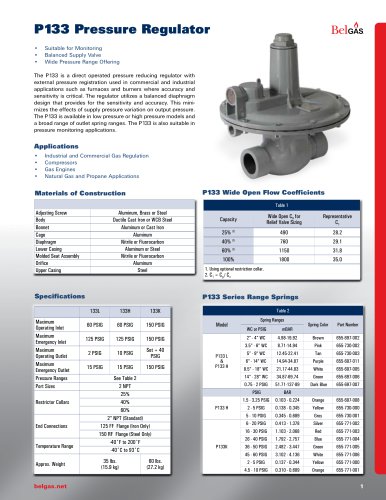 P133 Pressure Regulator
12 Pages
 P140 Pressure Regulator
4 Pages
 P303 Pressure Regulator
11 Pages
 P300 Pressure Regulator
11 Pages
 P203 Pressure Reducing Regulator
18 Pages
 F300 Pressure Regulator
7 Pages
 P600 Pressure Regulator
7 Pages
 P289RC Exhaust Booster
2 Pages
 W627 Liquid Gas Regulator
8 Pages
 F627 High Flow Gas Regulator
7 Pages
 BELLOFOAM™ 7804
1 Page
 BELLOFOAM™ 7704
1 Page
 BELLOFOAM™ 7604
1 Page
 Marsh Catalog
84 Pages
 P79 Air Relays
4 Pages
 Automated Timing & Controls
142 Pages
 Motor Protection
86 Pages
 Digital Controllers
30 Pages
 P630 High Flow Gas Regulator
12 Pages
 P39 Standard Gas Regulators
4 Pages
 P40 & P40 NACE Regulators
2 Pages
 P912 Pressure Regulator
2 Pages
 P119 Control Valve
4 Pages
 BelGAS Product Overview LT5040
12 Pages
 KING-GAGE Product Catalog
12 Pages
 BelGas P200 Pressure Regulator
18 Pages




Archived catalogs




- Valve
- Connector
- Manual valve
- Cylinder
- Temperature probe
- Electrical power supply connector
- On/off valve
- Angular encoder
- Incremental encoder
- Pressure gauge
- Pressure limiter
- Gas valve
- Profile
- Double-acting cylinder
- Level probe
- Single-stage pressure regulator
- Rectangular connector
- Liquid level sensor
- Pneumatic cylinder
- Incremental rotary encoder